
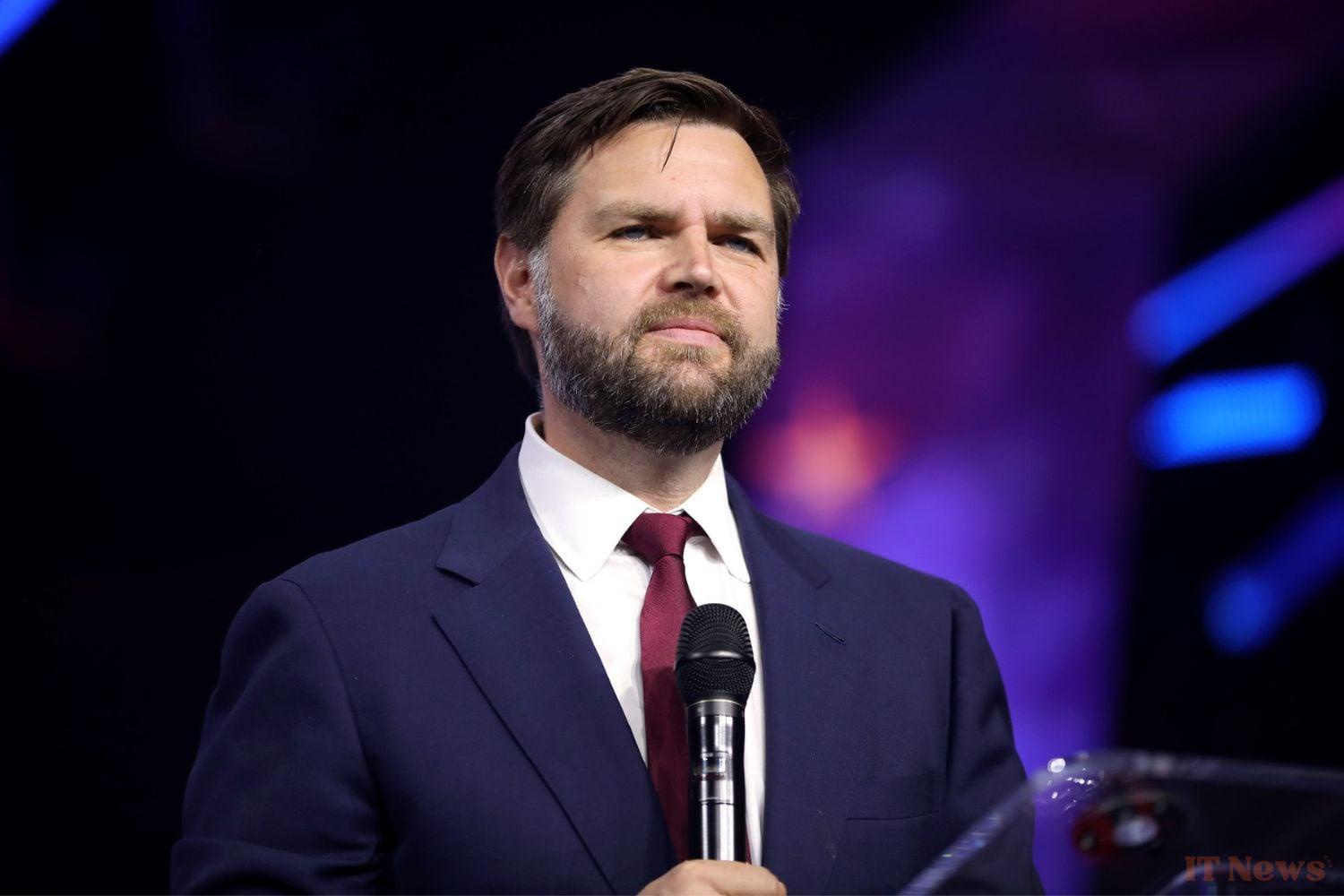
Dotting the i's: Tuesday, February 11, was the closing ceremony of the Paris AI Summit. It was an opportunity for the new American government to bang its fist on the table regarding European regulations on artificial intelligence. American Vice President J.D. Vance took advantage of the stage to warn Europe about its regulations on AI and digital technology.
For the 40-year-old, the Trump administration "will ensure that American technology in artificial intelligence continues to be the benchmark around the world. (…) The United States of America is at the forefront of AI, and our administration intends to remain so."
However, "excessive regulation of the AI sector could kill a transformative industry just as it is taking off," he stressed. As we stand on the cusp of "a new industrial revolution," the latter "will never happen if excessive regulation discourages (...) taking the risks needed to move things forward," he added, before directly attacking the European Union.
The DSA? "Censorship"
"The Trump administration is concerned by reports that some foreign governments are considering tightening the screws on international American technology companies. America cannot and will not accept this," J.D. Vance insisted.
Since 2018, European regulations on digital technology have multiplied. Brussels is indeed seeking to ensure that American giants such as Google, Apple and Microsoft respect certain rules of the game for access to the European market. European lawmakers have adopted regulations and directives that are supposed to be more adapted to these companies that have become more powerful than states, in particular by forcing them to comply with certain rules up front.
Rules described as "onerous" for American companies, some of which have reportedly given up on their users from the Old Continent for fear of "excessive fines", explains the American vice president, citing in particular the DSA (European regulation on digital services) and the GDPR (European regulation on personal data).
"Many of our most productive technology companies are obliged to comply with the DSA and the massive regulations it has created in terms of content removal and control of so-called disinformation", he regrets.
"But it is one thing to prevent a predator from attacking a child on the internet, and that is another "other than preventing an adult man or woman from accessing an opinion that the government considers to be disinformation," he says, taking up an idea repeated ad nauseam by Elon Musk and now Mark Zuckerberg, according to which the DSA would be an instrument of censorship on social networks. This text forces social networks to do more to fight against online hate and the manipulation of information.
For the American vice president, we need "international regulatory regimes that promote the creation of AI technology instead of stifling it. And our European friends, in particular, need to view this new frontier with optimism rather than concern," he continued.
A European position that would be the opposite of that of Donald Trump, who, with his decree on AI, is developing "an action plan on AI that avoids an overly cautious regulatory regime".
For the EU, AI needs to be "secured"
During the summit, Ursula von der Leyen, President of the European Commission, also spoke. Without responding directly to J.D. Vance's words, the head of the European executive declared that "too often, I hear that Europe is behind in the race, while the United States or China are already ahead. I disagree, because the AI race is far from over.
But in this area, "we need our own approach to artificial intelligence. I have heard too often that we should copy what others do and chase their strengths", she lamented. For the politician, "AI needs people's trust and must be secure." And that is the whole objective of the AI regulation, which establishes "a single set of safety rules across the European Union, or 450 million people, instead of 27 different national regulations".
The Commission President nevertheless acknowledges that it will be necessary to "simplify things and reduce bureaucracy", terms also used by Emmanuel Macron the day before.
Instead of following the United States or China, the President explained that it was necessary "instead to invest in what we do best and develop our own strengths here in Europe", before announcing a public and private investment plan of 200 billion euros.
While J.D. Vance did not attend Ursula von der Leyen's speech, the United States chose not to sign the final declaration of the summit. The text calls for “transparent and inclusive AI,” to protect “human rights, gender equality, linguistic diversity, consumer protection and intellectual property rights,” and to “promote the accessibility of AI to reduce digital divides.” The United Kingdom had also not signed the declaration, unlike China, which is one of the first 61 signatories.


0 Comments