

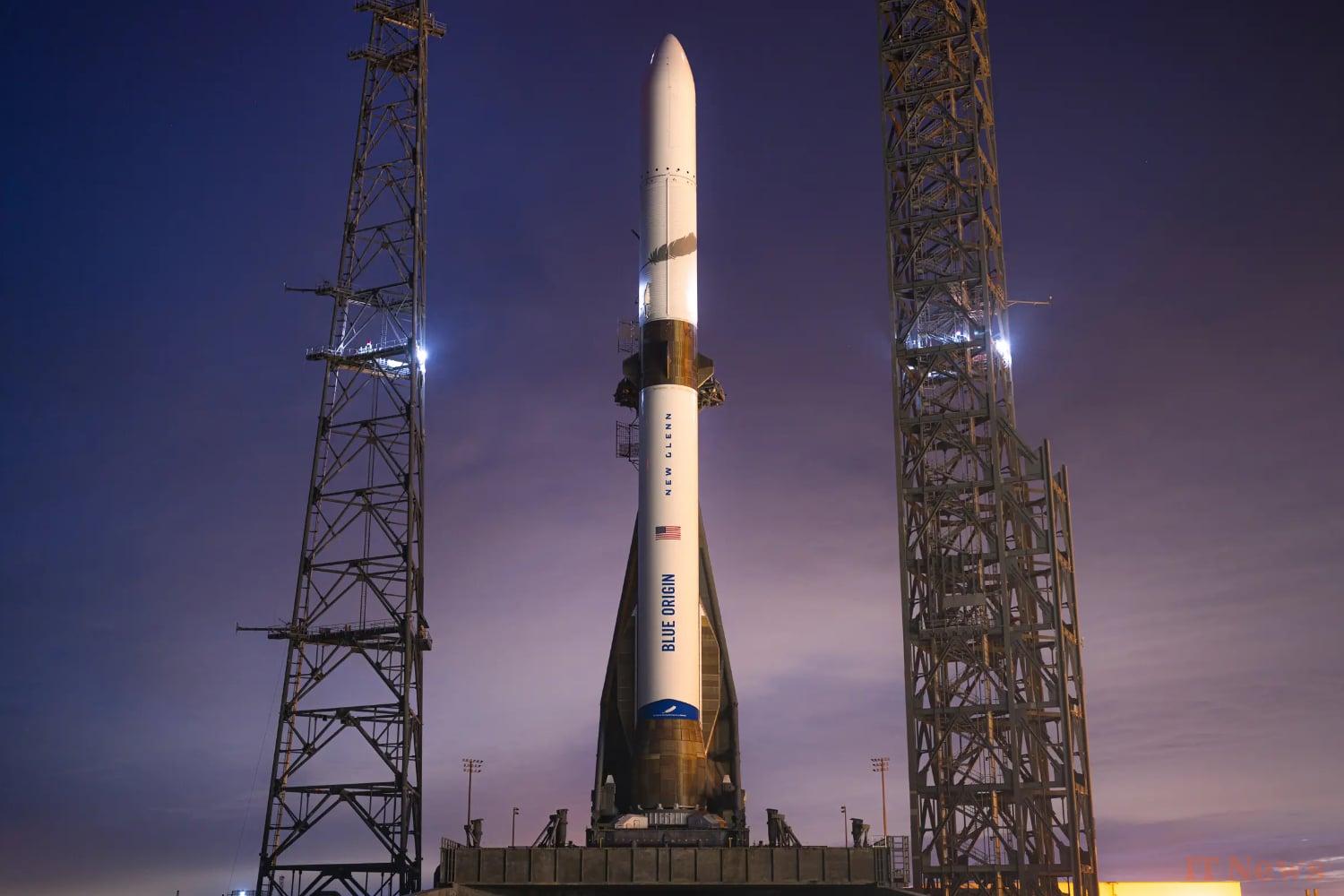
Blue Origin is no longer just a space company with simply suborbital missions. Five years after New Sheppard, and five years behind its initial schedule, the new New Glenn rocket took off on Thursday, January 16, from Cape Canaveral Air Force Base in Florida, on the former launch pad for Atlas launchers. Partly funded by Jeff Bezos, the founder of Amazon, Blue Origin is taking a giant step forward in the industry to join SpaceX, even if there is still a long way to go in terms of development. Despite this gap, New Glenn is taking a different approach to its competitor's Falcon 9, with a giant launcher with multiple capabilities and many secrets.
NG-1: New Glenn's first flight succeeds in its mission
After multiple postponements this week, since January 13, New Glenn has finally found a launch window to take off, Thursday, January 16 at 2 a.m. local time, 8 a.m. in France. On Monday, during its initial launch window, Blue Origin canceled the mission due to ice accumulating on a booster line. On Thursday, there was no report from the company, despite a one-hour delay to cool the BE-4 engines before launch. After the final countdown, New Glenn was able to fly on a nominal trajectory in front of hundreds of employees gathered for the launch at Blue Origin’s headquarters in Kent, Washington, and at a facility in Cape Canaveral, Florida.
Orbital launch, main booster fails to land
In addition to a successful launch, Blue Origin hopes to achieve two other feats on New Glenn’s first flight. The first is to put the spacecraft into orbit, a rare feat for a space company on a maiden flight. The second, even more difficult, is to land the core stage again, on a boat off the Atlantic Ocean. For the sake of discretion, Blue Origin has chosen to stop its live broadcast (probably due to a lack of video resources).
In detail about the takeoff, New Glenn burned its liquid methane and oxygen from the main stage for three minutes, before the second stage separated and took over, at an altitude of 70 kilometers. The next stage lasted 10 minutes, during which the rocket was able to reach an orbital speed of 28,800 km/h, to deliver its payload, a certain Blue Ring (orbital tug).
Unfortunately, Blue Origin was unable to land its main stage on the boat located offshore. "We did indeed lose the thruster," said Ariane Cornell of the aerospace company. As a reminder, SpaceX had to perform 19 launches before successfully landing an orbital rocket for the first time, in December 2015.
Why should New Glenn be considered over SpaceX?
Blue Origin does not like excessive communication. It must be said that, compared to SpaceX, it is difficult to do better, and so much. Its delay in the development of New Glenn has made it more discreet, even if its activity in space tourism with New Shepard regularly allows it to show exceptional images of the Earth, seen by amateur astronauts… including Jeff Bezos himself. However, everything has accelerated in recent months with New Glenn and the possibility for Blue Origin to inaugurate it at the end of 2024. The deadline was too short, as we were only able to witness a static launch on December 28.
Five types of gas, for interplanetary propulsion
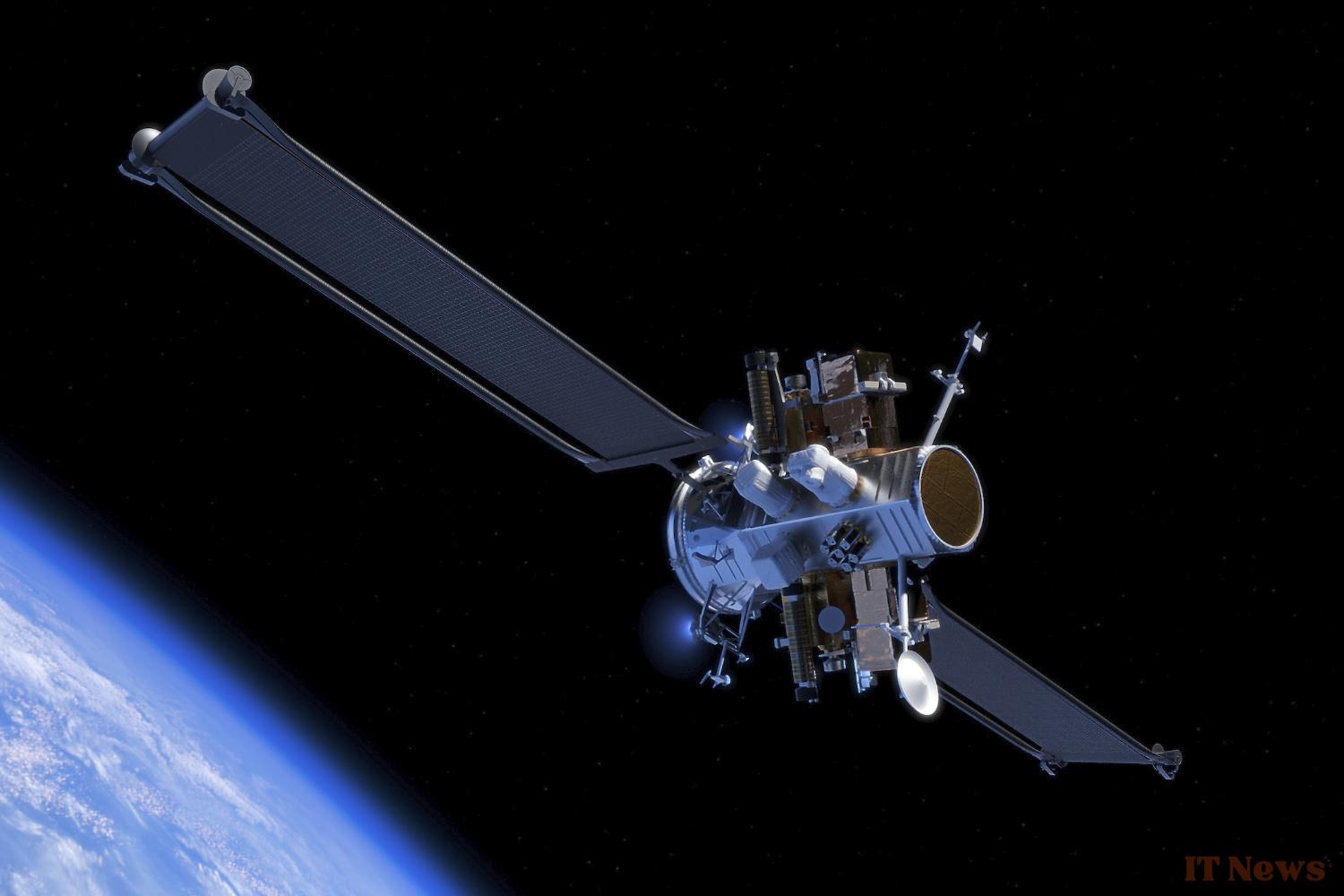
Not enough to calm the ardor, however. New Glenn's capabilities mean that SpaceX may not have to be wary of China, but rather of an old rival, which has had the same ambitions for at least as long. The American company has existed since 2002 and despite the development of New Glenn being launched only in 2016, ten years after the Falcon 9, the rocket has great ambitions, and should not be underestimated. At 100 meters high and 7 meters in diameter, New Glenn has two stages, or even three if we take into account the Blue Ring space tug, located at its top. In all, five types of gas allow the rocket to be propelled: oxygen, methane, hydrogen, hydrazine and xenon, for two ion engines located on Blue Ring.
Why choose to work with so many different energy sources? Blue Origin makes no secret of it: its New Glenn rocket with 1,700 tons of thrust must be capable of sending 45 tons of payload into low orbit, as well as sending 13.6 tons into geostationary orbit, and even 7 tons to the Moon. These capacities are much greater than those of the Falcon 9 Block 5, with a significant additional feature: the ability to propel satellites onto interplanetary, or even interstellar, trajectories. Its intended missions will therefore be both commercial, but also with NASA and the American Defense. Up to 10 flights are planned in 2025, and 24 in 2026. Enough to show the interest and anticipation surrounding the Blue Origin rocket, but also its reuse capabilities…
Dual development, double reuse
Because Yes, like SpaceX and its Falcon 9 rocket that democratized the sending of satellites into low orbit, New Glenn must be reusable, up to 25 times with the main stage. To do this, Blue Origin wants New Glenn to correct a small defect in the Falcon 9 boosters. When returning to the atmosphere, the SpaceX rocket performs two go-arounds, to slow down the mass and not crash. With New Glenn, Blue Origin wants its main stage to enter the atmosphere by gliding more horizontally, so that the resistance is stronger and the booster only needs one firing. Enough to save fuel, and have much more for its ascent.
The upper stage would not be left out, while the "Jarvis" project, internally, is currently studying the possibility of returning this stage to Earth. This project is very interesting, because it shows the corporate culture established by Jeff Bezos in the space industry. To study the question of the reusability of the upper stage, the company chose a dual development. It put two of its teams in competition, with a different objective for each. The first is studying the possibility of reusing the second stage. In parallel, the second is working on a highly optimized design of the stage, to ensure that its reuse is no longer even necessary to control costs. Enough to waste no time and choose the best solution.
A 7-meter fairing, for mega-constellations
In addition, New Glenn has a 7-meter fairing, which is reminiscent of Blue Origin's ambitions with its Kuiper project. Behind this name, a megaconstellation, initially planned to compete with SpaceX's Starlink and its satellite Internet network. For a few months now, the ambitions seem different, since Jeff Bezos is now talking about geopositioning tracking, a competitor to GPS (like Galileo in Europe). The Kuiper project was first announced in 2019, with a first phase that should include the placement in low orbit of no less than 3,236 satellites. In a second phase, 7,774 satellites should complete the constellation.
With 45 tons of payload available for low orbit, New Glenn will be the vehicle that will work on this project. As a reminder, SpaceX's Falcon 9 can only carry 22 tons, enough to give Blue Origin a competitive advantage, even if SpaceX obviously has a considerable head start, since its constellation has been offering an Internet service for over a year now, and its launches are not slowing down: in 2024, SpaceX has carried out 138 launches. In parallel with the Kuiper project, the 7-meter fairing will allow the integration of payloads from other customers, such as NASA with the Rocket Lab ESCAPADE spacecraft mission to Mars. Then, the American Defense wants to rely on New Glenn, in particular thanks to its future launch pad in California, on the Vandenberg base, aiming for polar orbit.


0 Comments