
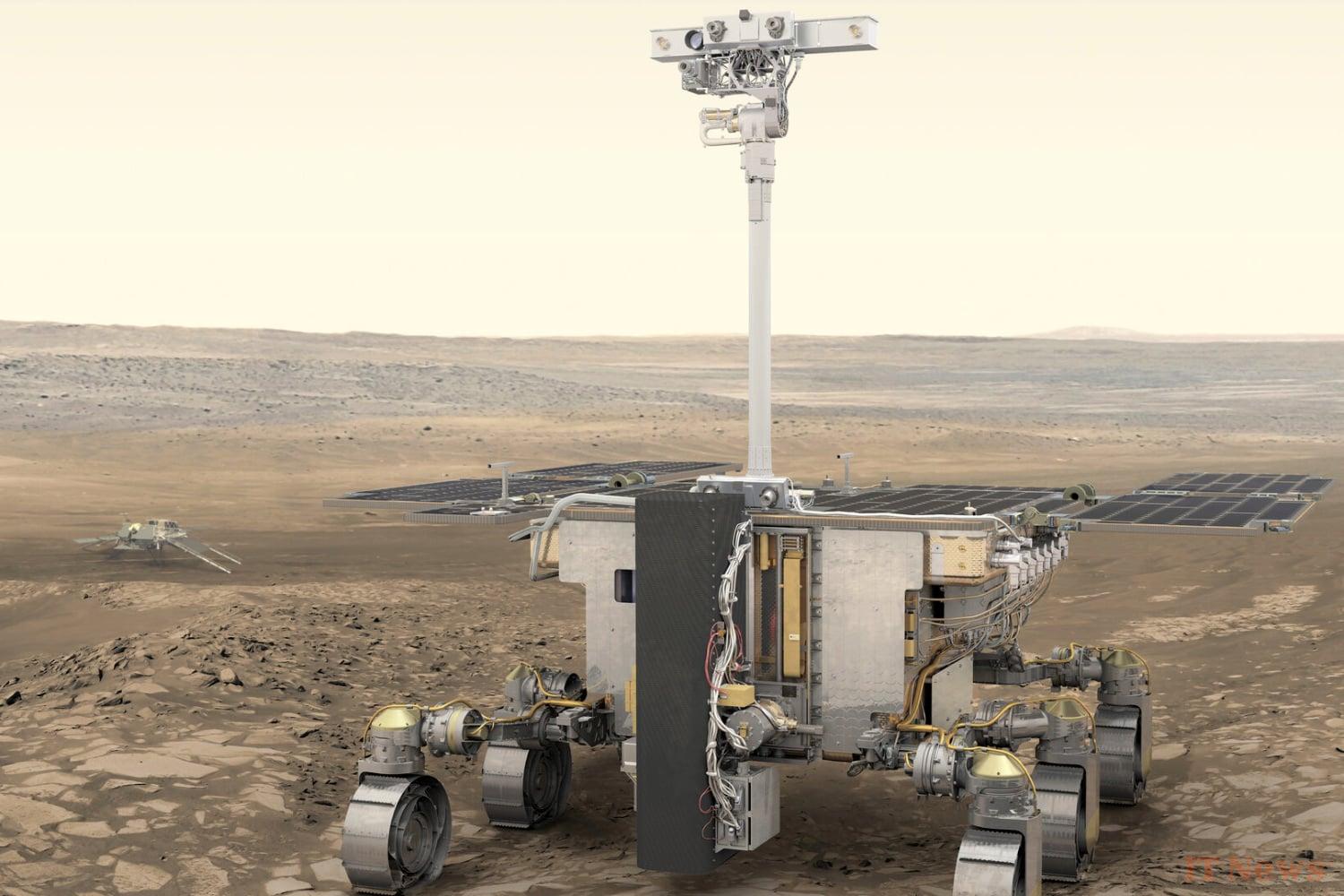
On December 17, 2024, the European Space Agency (ESA) launched a new call for projects for a new technology for "advanced Mars entry, descent and landing capability". This is reminiscent of Rosalind Franklin, the rover that is due to take advantage of a window in 2028 to target our neighboring planet, which should constitute the first landing of a rover on the red planet for Europe, after an initial failure in 2016 with Schiaparelli.
However, Europe does not intend to replace its ExoMars rover project, but rather to prepare its sequel, scheduled for 2035. That year, a new launch window will open. According to ESA, this will be "the most favourable launch date in the next decade", reported the call for proposals document, obtained by European Space Flight.
The agency wants to start preparing the project early to "obtain sufficient information on the technology readiness, development schedule and budget estimates". A ministerial meeting is planned for a first point in November.
For now, no further details have been added, apart from the fact that ESA is inviting stakeholders to "advance the development of guided entry landers and their associated technologies, avoiding technological deadlocks as capability advances".
8 years late for the Rosalind Franklin rover, why?
Rosalind Franklin, the rover of the ExoMars program for 2028, was initially scheduled to take off in 2020, then was pushed back to 2022, and finally to 2028. The reasons are simple: Europe suffered from the invasion of Ukraine by Russia, and ESA ended its cooperation with the Roscosmos company. Unfortunately, it was she who had developed the landing platform.
Now, the contract is awarded to Thales Alenia Space, and the rover will be sent not by an Ariane 6 but by an American launcher, while the ESA signed an agreement with NASA in 2024.
The rover will carry a 2-meter underground sampling drill and an analytical laboratory drawer with nine scientific instruments. The main mission of the Rosalind Franklin rover will be focused on the search for biomolecules or biosignatures of past life.
Its research could last a total of 7 months. Its movements, at a maximum speed of 70 meters per Martian day, should take it a total of 4 kilometers. It will not be surprising to see the rover of the next decade extend this range.
Source: European Space Flight


0 Comments