
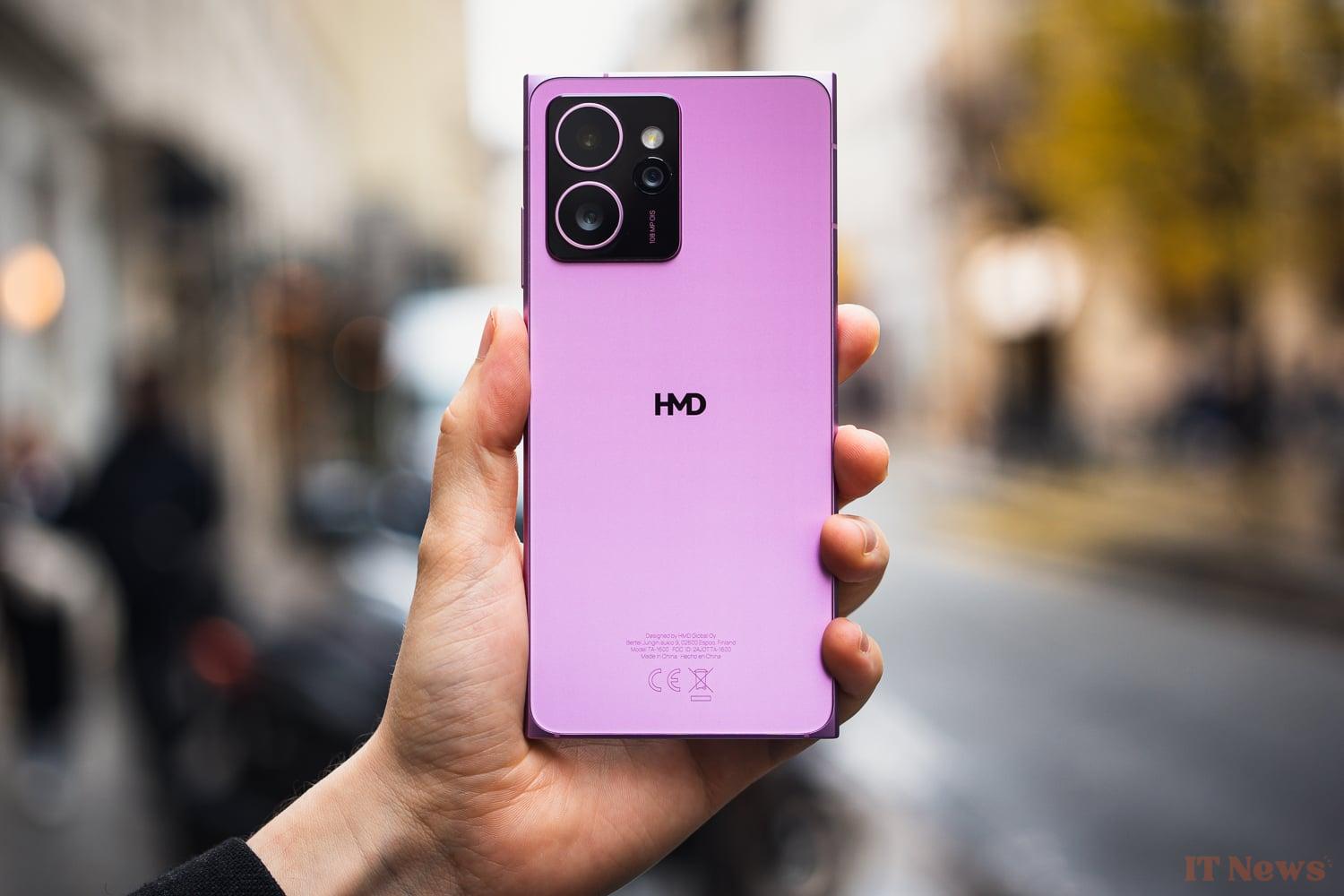
Before we get to the heart of this test, let's be honest for two minutes: design-wise, even in the fairly new segment of expensive foldables, almost all phones are more or less identical. A fact that your servant finds a little sad. So, when the HMD Skyline arrives and its lines that are (slightly) different from the first Android or Apple smartphone to come along, it feels good.
Especially since this HMD terminal (freed from Nokia since 2024) offers other fairly new elements in the highly calibrated world of smartphones, starting with its promise of easy repairability and its additional side button. But is it really a good smartphone? Well, let's take a look at the full test to find out!
HMD Skyline price and availability
The HMD Skyline is available from 499.99 euros in blue, black and pink. This price applies to the version with 8 GB of RAM (which we tested), while the one with 12 GB goes to 599.99 euros.
Design: taking inspiration from the past, a tank to be made
Windows Phone is (unfortunately) dead, but the design of its Nokia Lumia survives thanks to HMD. Clearly inspired by the late 1200 range, the HMD Skyline is what we would call a “beautiful baby” with its thickness of 8.9 mm and its weight of 209.5 grams. Even without a case, it will take up space in your pocket. However, provided you do not have very small hands, this smartphone is very comfortable to hold, thanks in particular to slightly rounded side edges.
This is also one of the only points that the HMD Skyline shares with some competitors, since it ignores rounded corners to embrace very marked protruding corners. A choice that will inevitably divide, but which has the merit of existing.
Especially since this frame, made of metal (and therefore subject to the outside temperature, be careful), reinforces the premium side of the smartphone, which offers a glass plate on its back. This, it is rare enough to point out, does not capture fingerprints too much. Still on the back, the photo block this time quite classic, although not very thick, unfortunately unbalances the smartphone when it is placed flat.
Let's finish our visual tour with the edges. The bottom one houses the SIM slot (the HMD Skyline supports eSIM), a USB-C port and a speaker. A small screw is also there for disassembly, but we will come back to that later. On the right, a classic volume button is next to the power button which also acts as a fingerprint reader. The latter is therefore not located under the screen, as is often the case lately elsewhere. It’s a shame, but it’s probably the price to pay to ensure the easy repairability of the screen. Finally, on the left, HMD offers one of the main arguments of this mid-range smartphone: a configurable button. More details on the latter later in this test.
Screen: a solid, but imperfect proposition
Regarding its screen, HMD has also decided to stand out a little from other competitors. We are indeed faced here with a 6.55-inch pOLED panel with an FHD+ resolution (2400 x 1800 pixels). Enough to offer a nice density of 402 ppi, with an average screen coverage of 85.6%. We will also appreciate a manual or adaptive refresh rate that can climb up to a pleasant 144Hz.
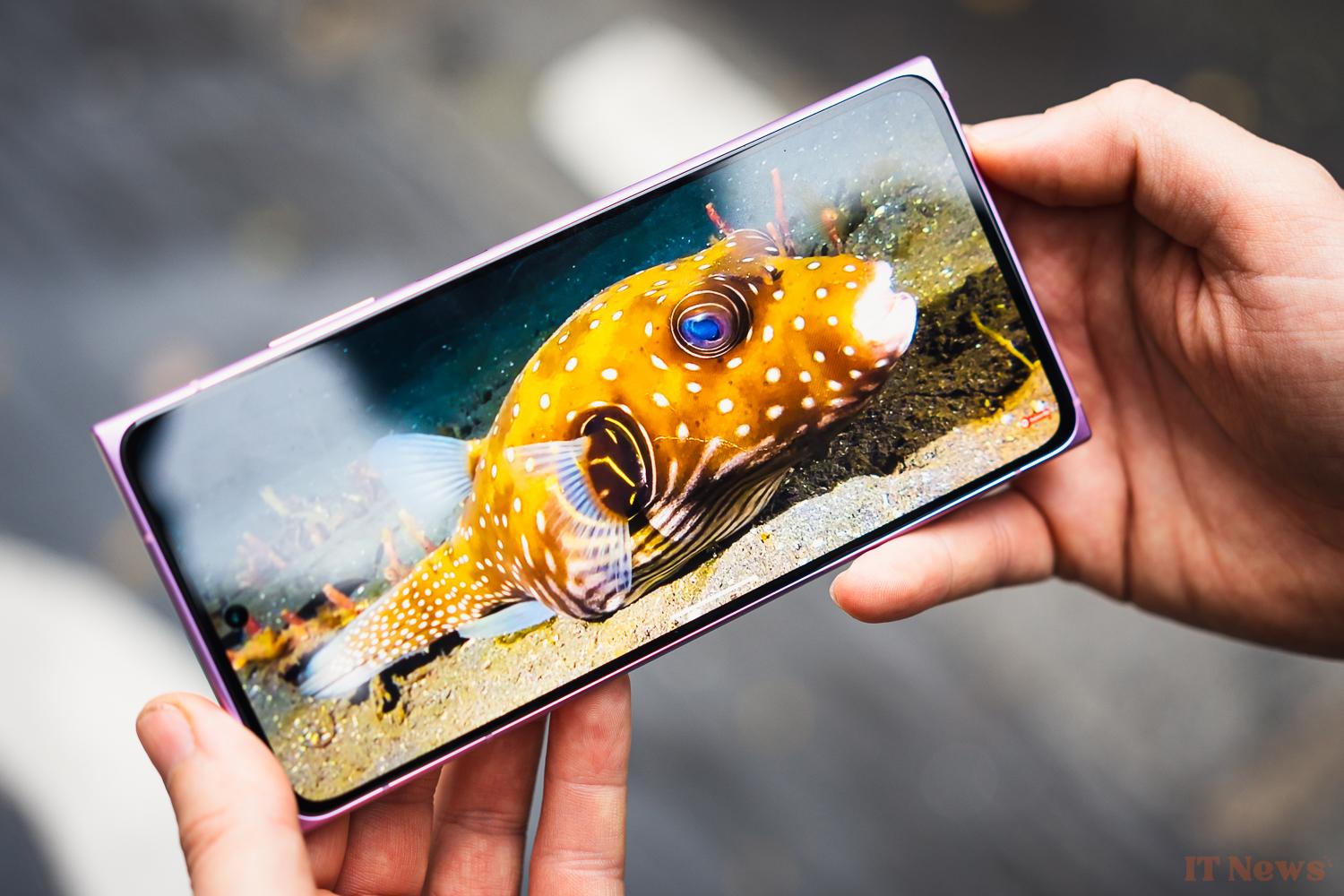
The average person will probably be very satisfied with it in all cases, but if we dig a little deeper, this screen turns out to be an average student, both for brightness and for color fidelity. Its average brightness of 1011 cd/m² (and max at 1085 cd/m²) does not place it among the best in this range. Same thing for its relatively high Delta E with the default profile, at 4.59. This is due in particular to the values of warm colors that fly away. HMD does not offer any other color profile here, simply allowing you to play on the white balance.
Sound: potato, but don't push it too much
Despite the presence of a single speaker grille at the bottom of the terminal, there is indeed one hidden at the top. Enough to offer stereo sound, which has the particularity of offering an amplification mode. This allows you to boost the sound power beyond 100% to, for example, be heard properly outdoors. Without much surprise, and even if it is not the worst we have heard, we are as often here in the realm of supplementary, with a sound that saturates quite quickly but which manages to remain relatively balanced at normal volume (and to offer some bass). The solution is very decent for listening to a video, a little less so for music. No jack socket on the horizon, while the thickness of the smartphone could have allowed it.
Performance: mid-range just enough
According to our AnTuTu tests, chance would have it that the overall score of this HMD Skyline is almost identical to that of another terminal tested only a few weeks ago in our columns: the Honor Magic 7 Lite. An observation that raises some eyebrows, since the latter is a little less expensive and offers a previous generation SoC, while the Skyline adopts a Snapdragon 7s Gen 2. The latter offers eight cores (four Cortex-A78 clocked at 2.4 GHz and four Cortex-A55 at 1.95 GHz), supported by 8 (or 12) GB of RAM.
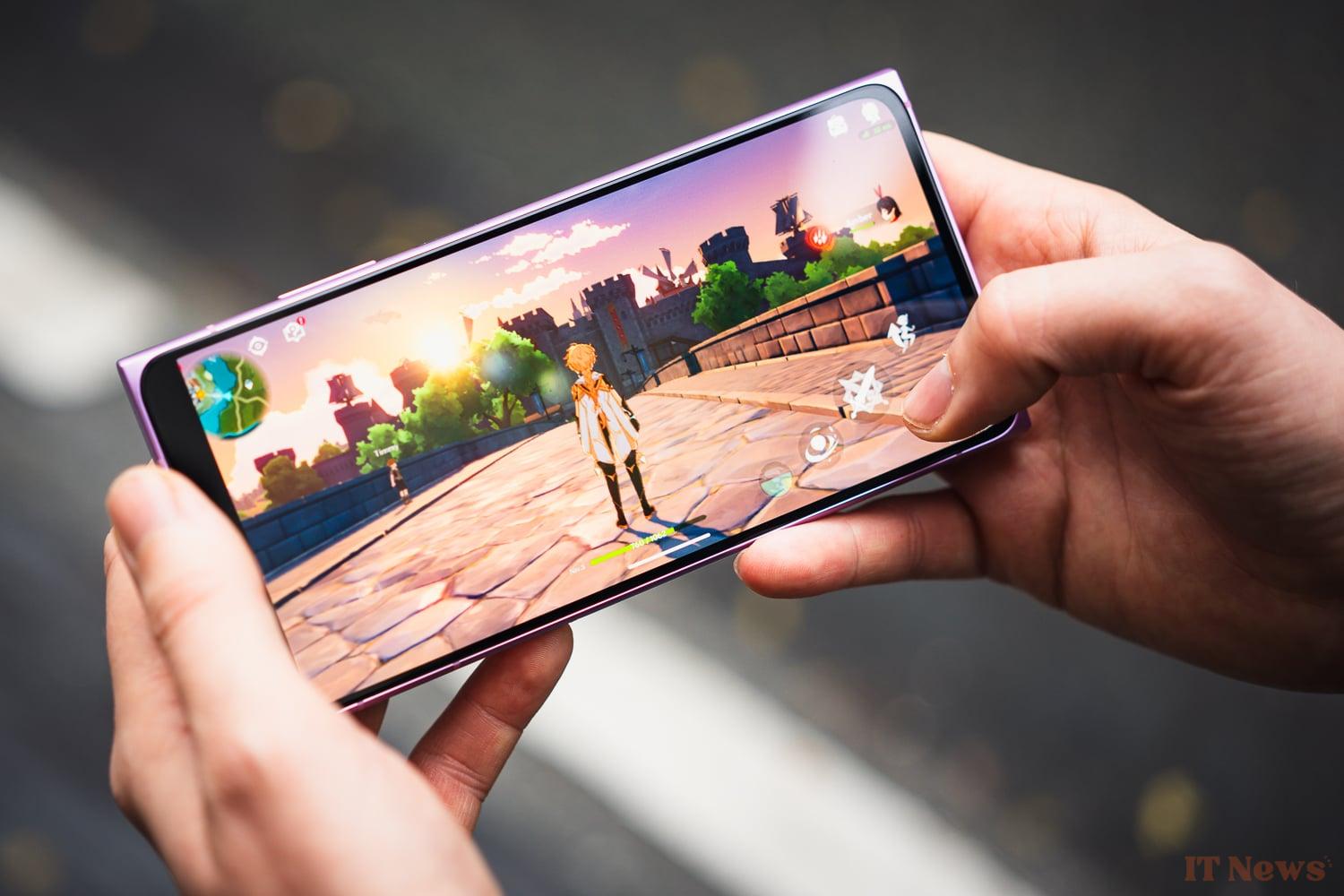
Fortunately, in reality, this smartphone is sufficiently efficient on a daily basis in its interface and apps to not complain. Only the most demanding games will probably not be able to reach the maximum possible 144 Hz, unless you lower the graphics. The fact remains that reaching and maintaining around 60 FPS without making too many sacrifices in the settings should not pose too much of a problem for titles like Genshin Impact.
We will appreciate that the heating, despite a metal body, remains very contained (max 37.4 degrees). Finally, on the embedded chips side, 5G, WiFi 6E, NFC and Bluetooth 5.2 are there. Storage ranges from 128 to 256 GB, with MicroSD expansion up to 512 GB.
Photo:
Within the HMD Skyline's photo block, we find the following trio: 108 Mpx wide-angle (f/1.7 with OIS), a 13 Mpx ultra-wide-angle (f/2.4) and a 50 Mpx x4 telephoto lens (f/2). By choosing the latter, HMD has skipped the (often relatively useless) macro sensor that some offer.
The main sensor does very well when conditions are good. The colors are quite flattering and the rendering precise. The smoothing applied to certain textures can, however, be a little too aggressive at times.
The ultra-wide-angle sensor also does well. While it partially avoids the trap of edges of shots losing quality, it tends to overexpose the scene a little in bright light or to darken the whole when conditions are not ideal. But when conditions are good, the result is there.
The same thing, a little more obvious, for the x4 telephoto module. The latter can sometimes offer an interesting result, but if the slightest element is not ideal, it is difficult to create something perfectly usable.
When the sun disappears, the smartphone quickly encourages you to switch to its night mode. The latter is quite satisfactory but does not avoid the pitfalls. It should be noted in particular that the ultra wide-angle is not particularly reliable in terms of colorimetry and that the highest zooms severely lose precision and clarity. With the wide-angle sensor, if the scene is minimally lit, the HMD Skyline manages to deliver something decent despite the presence of noise.
On the front, the selfie sensor is quite generous, at 50 Mpx (f/2.5) and with two zoom levels to adapt to the number of subjects. Whether or not you use portrait mode (a little more effective than with the main sensor), the result is very satisfactory.
As we will see in the next part, HMD wants to be quite minimalist on the software side. With one notable exception: the photo. Indeed, the Skyline's photo app offers many modes, rarely offered by the competition, to have fun with photo and video (which can go up to 4K at 30 FPS or 1080p at 60 FPS). For example, there are modes to play with the speed of videos, take photos of the starry sky, capture burst photos or even film ultra stable video. Small important detail on the video. If it turns out to be of quality, with in particular good spatialization of the sound, once a recording is launched, it is then impossible to zoom in or out on its subject. Strange and frankly not ideal.
Repairability: a nice promise, but there is a but
In addition to its look, the HMD Skyline mainly stands out from the competition by the fact that it was designed, like other products of the brand, to be easily repaired directly by the owner. No need to go through a repairer to change a component, while the manufacturer promises the availability for 7 years of the spare parts concerned (screen, shell, battery, SIM drawer, speaker, charging port), in partnership with iFixit. The company specializing in repair also provides the necessary tools and instructions. Fortunately, this specificity does not prevent the terminal from being IP54 certified.
With the dizziness provided by iFixit (or not), unscrewing the screw on the lower edge allows you to very easily lift a corner of the terminal's back cover. Then, with a little more force this time, a pick allows you to completely remove the shell to reach the insides of the smartphone. Finally, depending on the part to be repaired, there are only a few more parts to remove (screws, protection, etc.) and replace. The instructions (to be found on the iFixit website) and the tools provided allow you to do all this yourself, even without prior knowledge.
On the other hand, one point unfortunately makes all these great promises almost useless if you were planning to keep this smartphone for a very long time: HMD only promises 3 years of security updates. So, even if you regularly change defective or tired parts, the HMD Skyline will quickly be subject to security breaches and deprived of the latest versions of Android (Android 16 should be the last supported version). Too bad the software betrays the hardware in this way.
Interface: sober and efficient, but a bit stingy
It's hard to do more sober than the software part of this HMD Skyline (even in its icons, monochrome by default). No invasive overlay here, this is a Stock Android (14) with a few new options and rare bloatware. The result is an easy-to-use solution that does not drown the user in menus and provides the essentials, but which can be a bit weak in certain areas.
This is the case, for example, with adaptive brightness. If activated, it promises to intelligently adapt the brightness level according to the user's habits and manual settings. We would probably have preferred an automatic brightness that is certainly more classic, but also more precise and responsive via the brightness sensor.
Customization is also a bit limited for those who like to tinker with their interface down to the last pixel. A simple alphabetical elevator or a search in the list of installed applications would also not have gone amiss. Details that, put together, can make the experience a bit frustrating at times. However, we prefer this to submenus of submenus of menus or AI all over the place.
Finally, it is of course possible to modify the behavior of the physical button on the left of the HMD Skyline (when double-pressing or long-pressing), but also that of the power button. Changing the ringtone profile, flashlight, launching an app or ChatGPT… there is something to save time with these very practical buttons. Finally, we will note the presence of a Detox mode designed to limit notifications and distractions according to profiles, schedules or even contacts.
Autonomy: a little (a little) better
Compatible with Qi2 wireless charging and 5W reverse wireless charging, the HMD Skyline offers its one and only strong point here in terms of autonomy. Its 4600 mAh battery is a little lower than what the competition offers in this price range.
In practice, with average use, don't expect to last much longer than a day. Heavy gamers or serial scrollers will most likely have to recharge daily, while some options allow you to gain a few hours and relieve the battery. Watching an episode of a series of about an hour on the myCanal app in maximum quality and with the brightness at 50% over WiFi will have cost us 6% of battery. For this price, and without an invasive overlay or greedy AI, we could have expected a little better from the HMD Skyline, but fortunately nothing prohibitive.
Concerning fast charging (charger as always not supplied), which can reach 33W, count 85 minutes for a full charge and 26% after 10 minutes. An honorable performance.


0 Comments