

Google AI Mode
Google's hegemony in search engines has been a reality for years. Only the rise of AI, and more specifically conversational agents, is gradually transforming our search habits. Today, nearly 40% of young French people have adopted generative AI on a daily basis. The American company of course has no intention of missing this turn. It is experimenting internally with an "AI Mode".
Employees can test this solution based on Gemini 2.0. In an email addressed to Google teams but shared by 9to5Google, the firm describes "intelligent searches" that prioritize "information into easy-to-understand sections, with links to explore content across the web". The general idea is to allow more open and exploratory questions than those formulated in the context of a traditional search engine. Questions similar to those you have probably already asked chatbots, in short.
The few examples given by Google are sufficiently evocative. One of the queries is “How many boxes of spaghetti should I buy to feed 6 adults and 10 children, and have enough for seconds?”. Another is “What do I need to start aquascaping?”. If, like us, you are mainly wondering what aquascaping means, the sites highlighted by a Google search (this one is the old-fashioned one) tell us that it is the name given to the art of decorating an aquarium (literally to the "creation of aquatic landscapes").
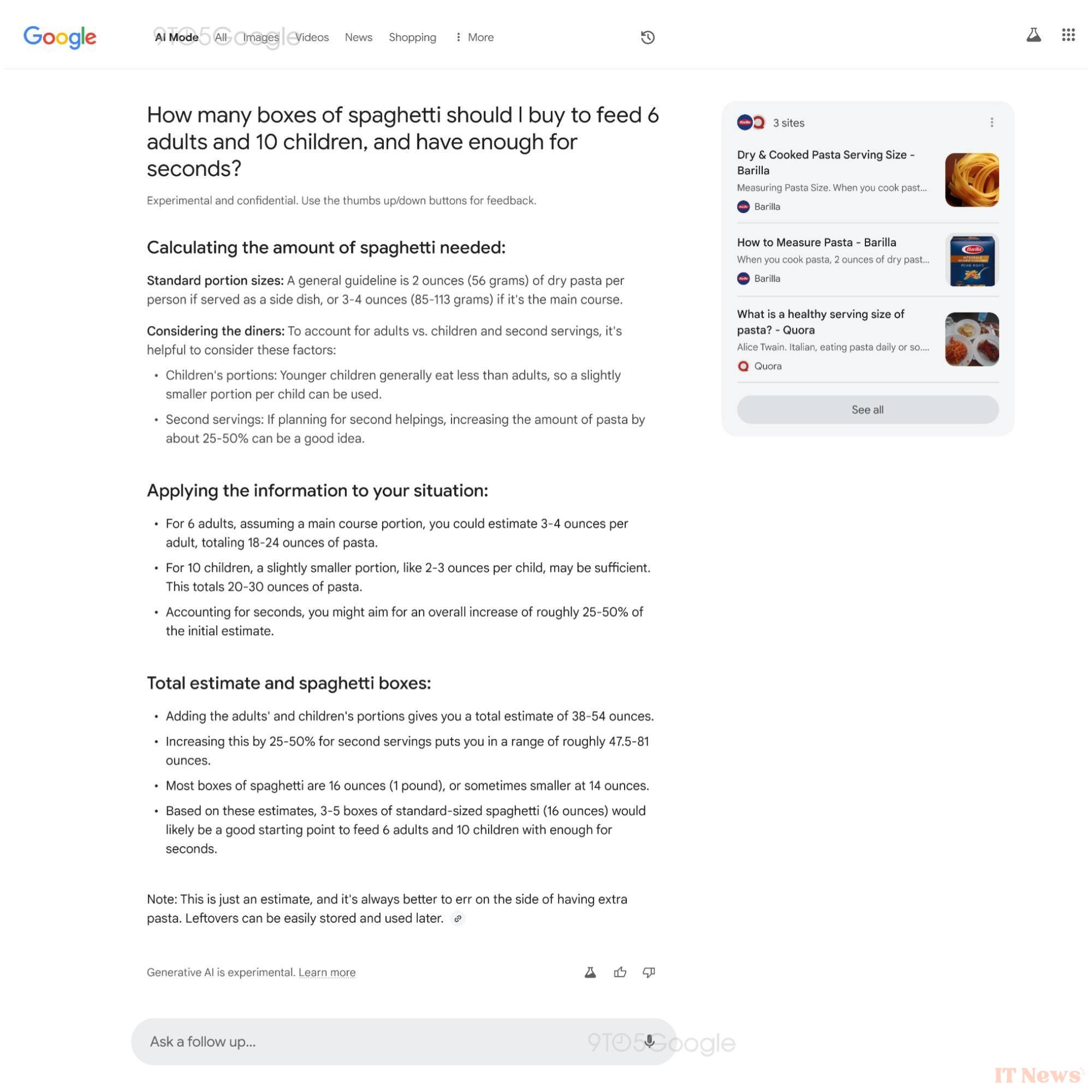
The project is only in its early stages. In terms of form, the user interface remains provisional. In terms of substance, Google is already promising "advanced reasoning and thinking capabilities". Otherwise, the very principle of the search does not fundamentally change for the user: they enter their query and press "Search", but by activating the "AI Mode" option offered alongside the existing filters for images, news, purchases, etc.
ChatGPT Search is open to everyone
Let's take advantage of this paper to open this topic to two other news items. The first takes us away from Google for a moment. It can be summarized in a few lines and illustrates what is stated above. At the end of October, OpenAI introduced a web search feature to its ChatGPT subscribers. The company extended it to free users in December. Now, it is accessible to everyone, without the identification lock - do not understand that registration is no longer a prerequisite. This change of gear clearly positions ChatGPT as an alternative to traditional search engines, and therefore as a potential threat to Google. In practice, the response takes the form of a fairly condensed text. The sources are cited. OpenAI has not provided any information on a possible limit on the number of searches for guests.
Google AI Overview integrates comparisons
The second is the plundering of the web, and in this case, not only limited to training artificial intelligence models. Google is now engaged in product comparisons directly through its AI Overview.
This will not be a revelation, but the economy of most sites is based on their traffic. It is through visits that a media generates revenue, particularly through advertising impressions or affiliate links. This monetization is of course used to finance its operating costs, as well as to remunerate its very human collaborators – this article was not generated by an AI.
Comparisons are among the most popular publications. By offering them directly in search results, Google will logically deprive a good number of sites of precious clicks. Only the snake of Mountain View bites its tail. To generate its comparisons, the algorithm synthesizes those from several sources. In the example below, which compares the Galaxy S24 to the Galaxy S23, AI Overview aggregates data from 21 publications. However, by depriving each of them of part of their audience, generative AI potentially sabotages its reliability (based on massive data vampirization): fewer media outlets will offer this type of paper, which will dry up the quantity of results available, and therefore their relevance (that said, for a comparison of specifications stricto sensu, manufacturer data should in principle suffice).

Don't see this as a complaint. Technological progress has impacted or even replaced many professions for centuries, and there is no reason why freelancers and journalists should not also be impacted (with the reservation of the role of the fourth estate of the press in a democracy; this meaning may seem hackneyed in a context of tech publications, but the impact of all these technologies on our lives is far from trivial). In short, in this case, Google's approach could above all make everyone a loser: the company, the media, and the readers.
Source: 9to5Google


0 Comments