
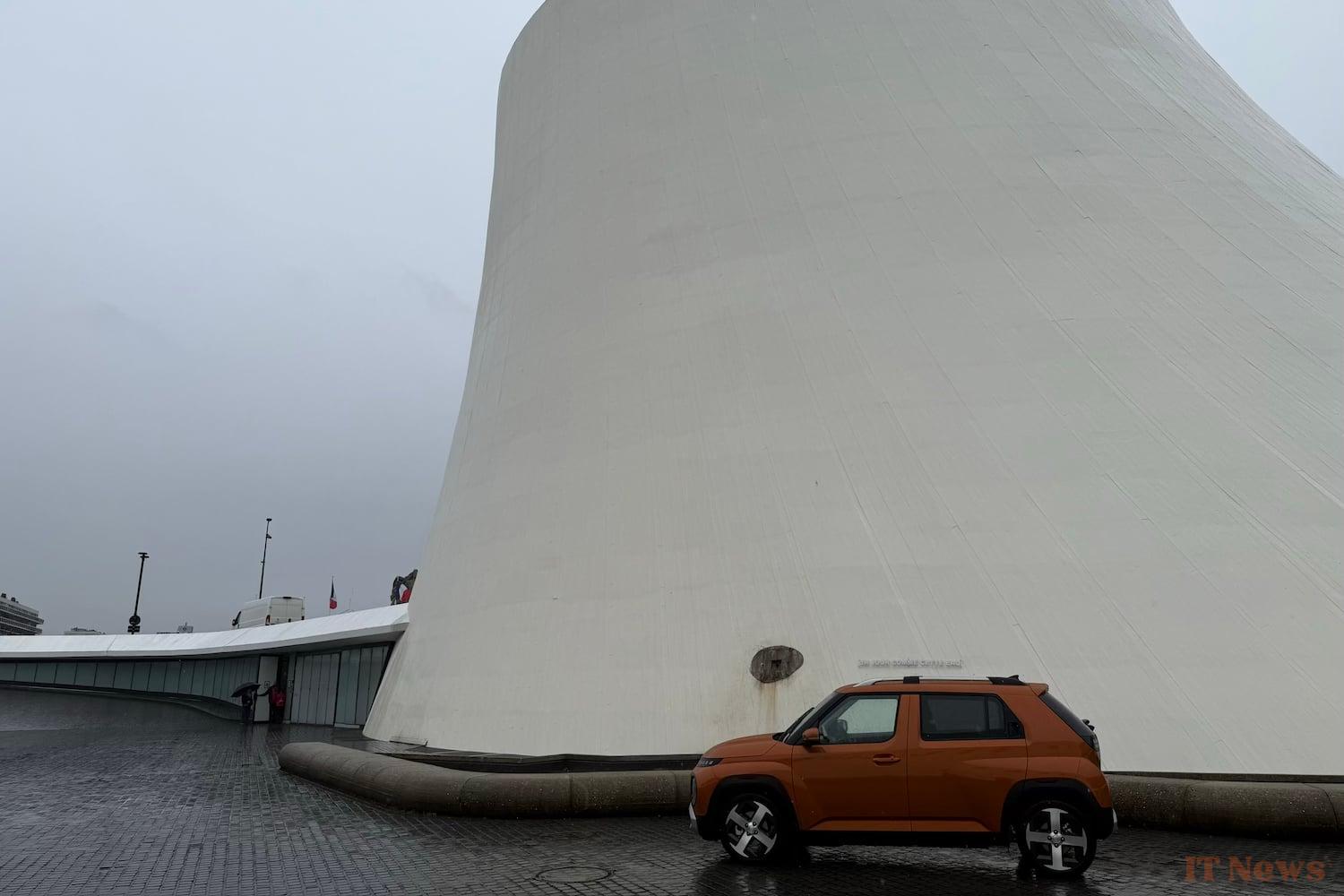
After making a strong impression on family models, including a good number of SUVs, Hyundai is tackling the very strategic market of electric city car. The Korean manufacturer is one of the first to unleash its 25,000 euro electric car and, surprise, it is not in the line of the Ioniq. Indeed, it is the very curious Inster that will embody the entry-level model in Hyundai's catalog for the years to come.
This one arrives in two versions and four trim levels that see its price oscillate between 25,000 euros and a little over 30,000 euros in its best-equipped version. It is the latter that we were able to try out, on the roads of Normandy and in the urban arteries of Le Havre.
The Inster is not only one of the rare electric cars available for 25,000 euros, it is also a city car that offers a very attractive LLD offer. Indeed, in this financing formula, the Inster starts at 129 euros per month. On paper, it is simply one of the best offers of the moment. But if the lease seems interesting, is the car worth it? This is what we wanted to determine in this Hyundai Inster test.
Inster-stellar?
The story of the Inster is first and foremost that of a great opportunity that recalls in many ways what Dacia did with the Spring. This is the story of a purely thermal city car that the manufacturer reserved for a local market and that it decided to switch to electric to adapt it to the very greedy European market.
The parallel with the Spring will stop there as the two models differ in the rest. Because if Dacia has focused on the essentials (and the least expensive), Hyundai has really strived to transform its city car and give it a maximum of arguments to establish itself on a market that should quickly become very competitive.
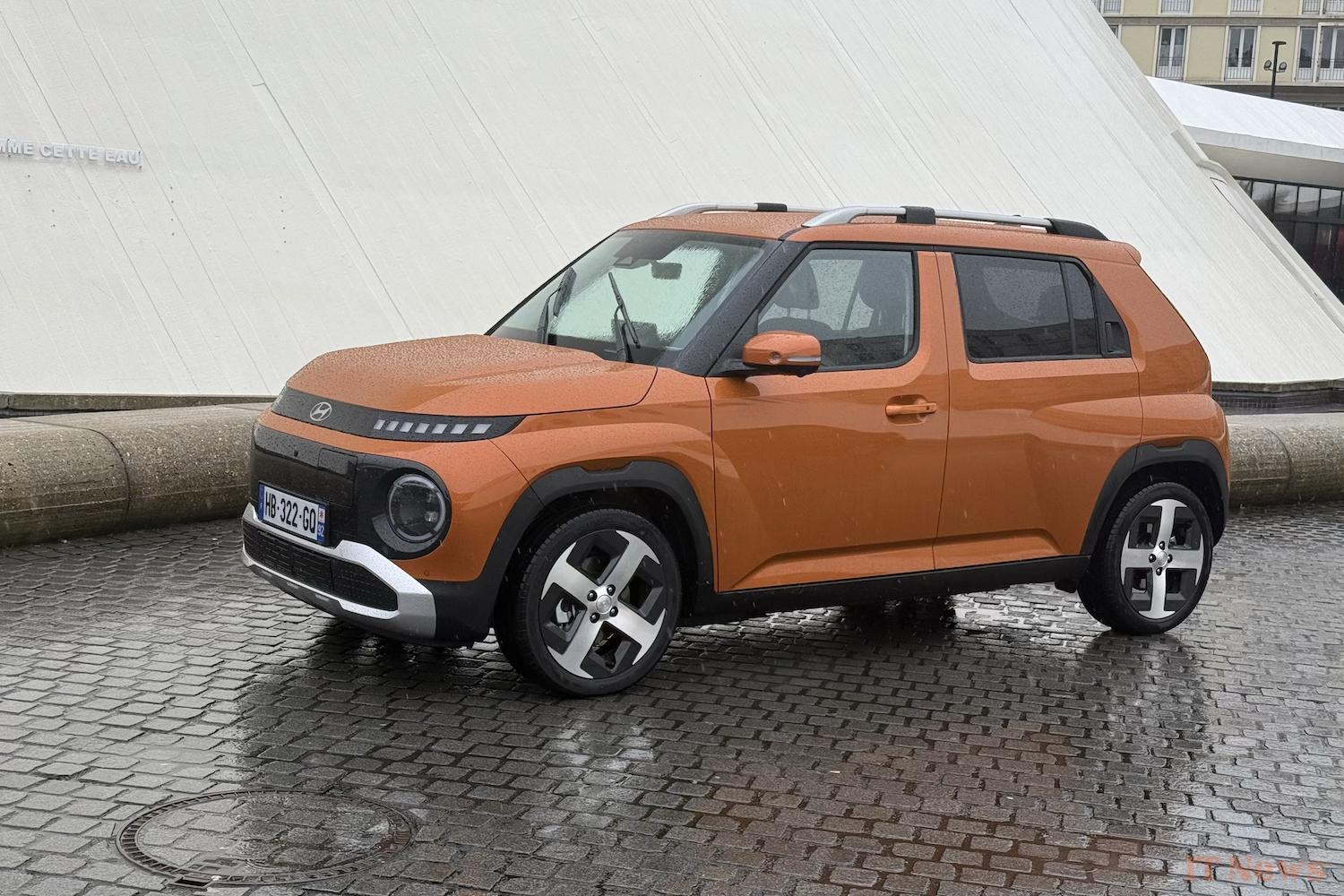
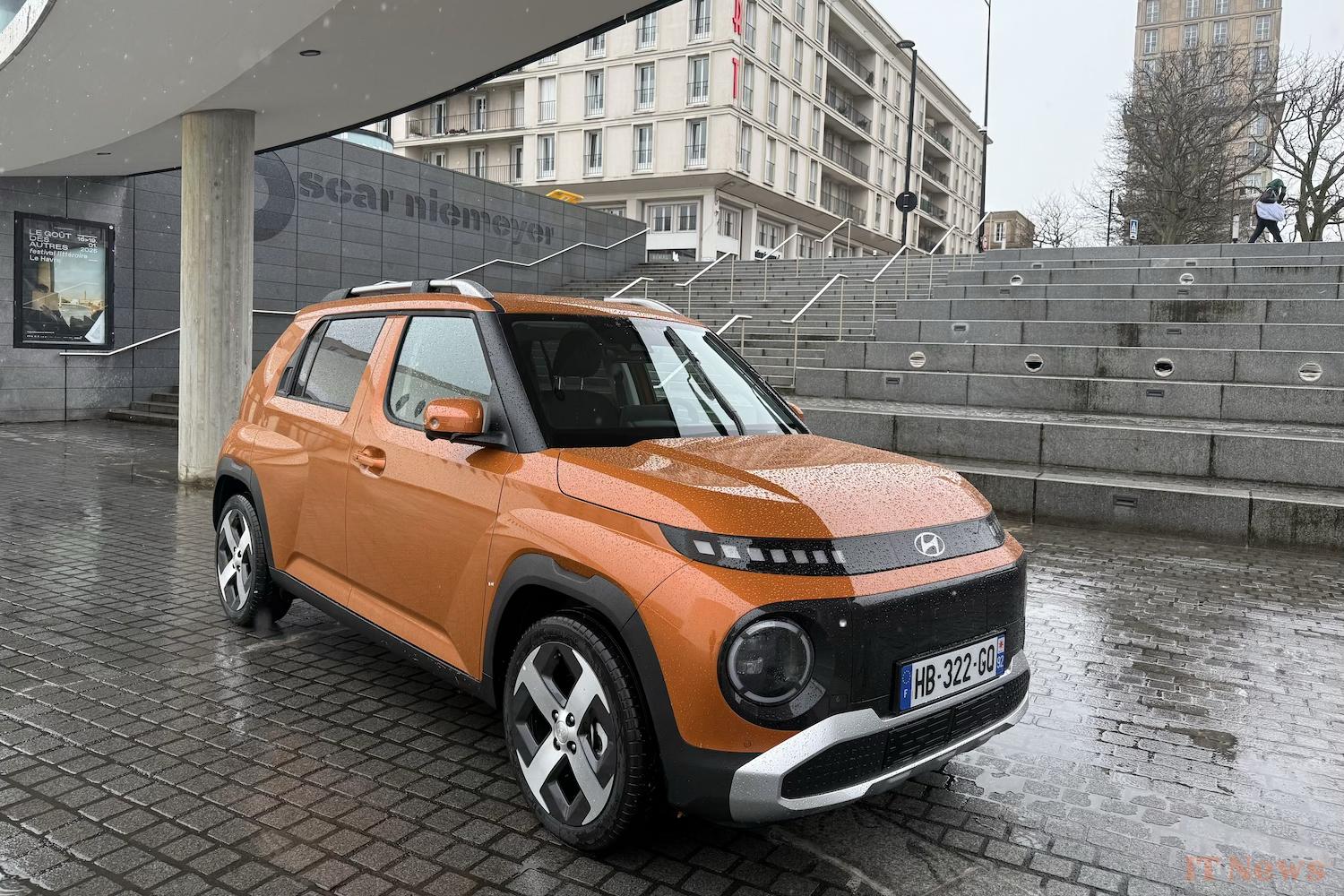
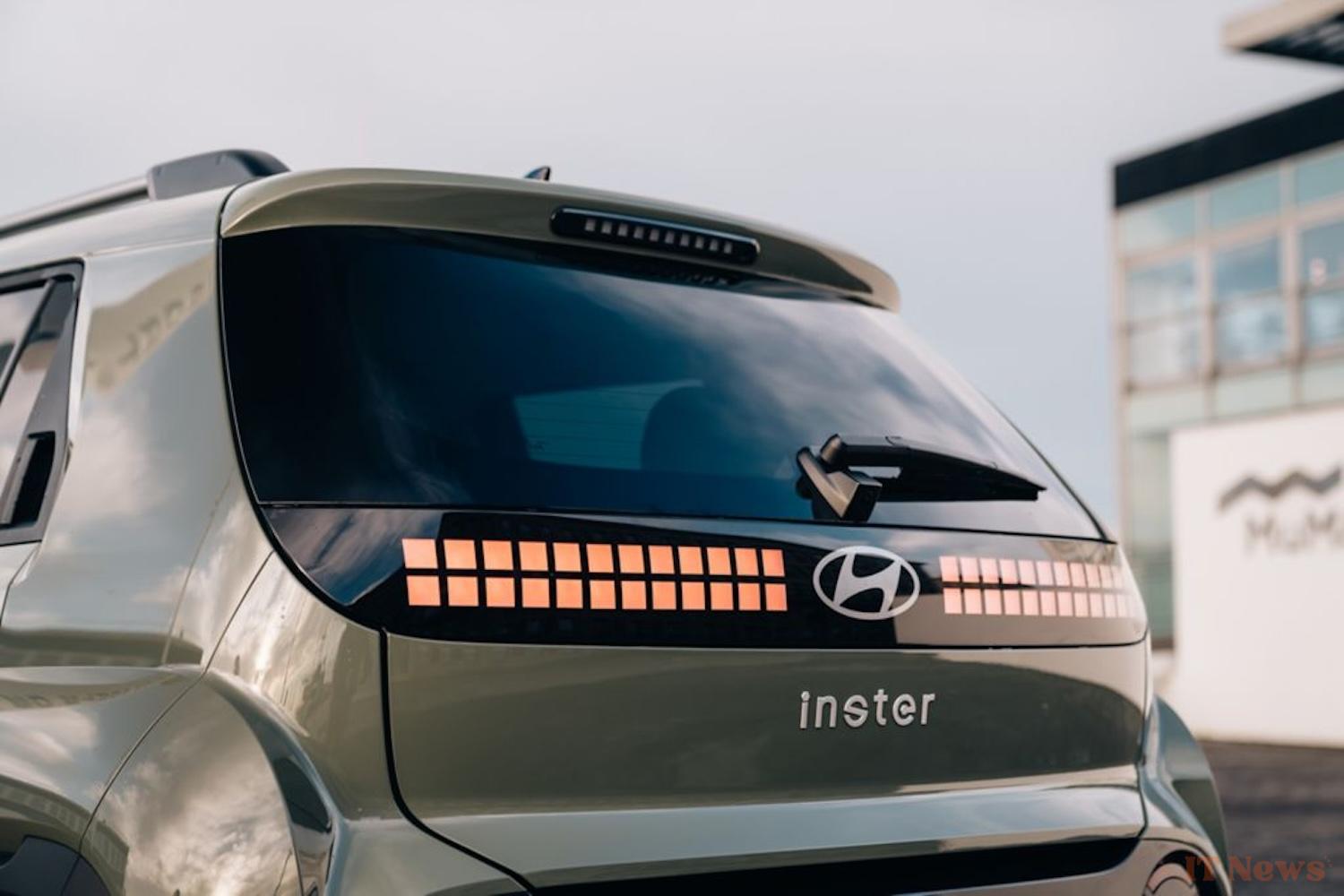
It starts with a rather worked design which, if it will certainly not please everyone, at least has the merit of daring a little. The manufacturer has taken up for the occasion its emblematic lighting signature (called Pixel) initiated with the Ioniq 5 and the Ioniq 6, which suits the aesthetics of the Inster perfectly and which reinforces a little more the feeling of a very compact, almost narrow car. Otherwise, yes, the Inster takes the easy route by adopting the codes and shapes of the SUV, but this choice also gives it a very interesting habitability for its segment as well as a driving position that is very popular at the moment.
Let’s talk about the interior. Hyundai has achieved a fairly subtle blend of old and new. Of course, the quality of the materials does not exude luxury. Some aspects, such as the central console dedicated to the air conditioning, reflect the urgent need to reduce production costs. Conversely, Hyundai is not making any savings on the display side by integrating two rather successful 10.25-inch screens which take up the design of its more premium vehicles. It is therefore a rather curious mix, not very homogeneous, but which nevertheless gives a very practical dashboard and a well-made passenger compartment.
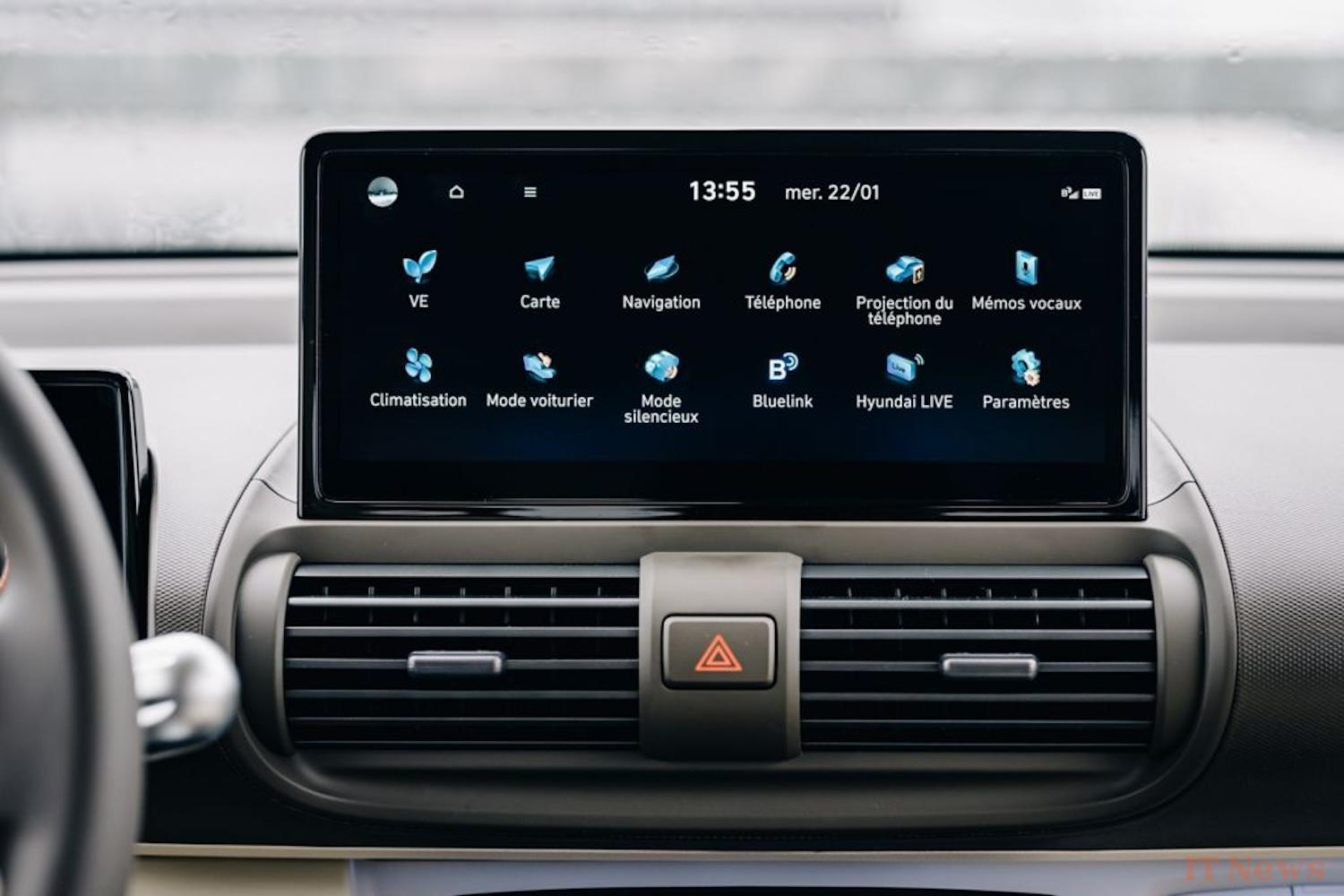
In terms of the interface, we find the classic Hyundai recipe and its unfortunate tendency to affect the driver's system. Indeed, the vehicle's reminders are incessant as soon as you exceed the authorized speed by even 1 km/h or if you have the misfortune to look at a road sign for a few seconds. Let's specify all the same that the rigidity of the Korean has somewhat withered compared to what we had been able to observe during our test of the Ioniq 6, but the OS still lacks some flexibility in the adjustment of its alerts.
Small but very practical
A word all the same on the habitability of the Inster, certainly one of its strong points. Hyundai has managed to offer a very compact car, but also practical and relatively spacious considering its size.
This is the case with the many small storage spaces in the passenger compartment as well as the supports designed to accommodate additional accessories (sold as an option) which improve the habitability of the whole.
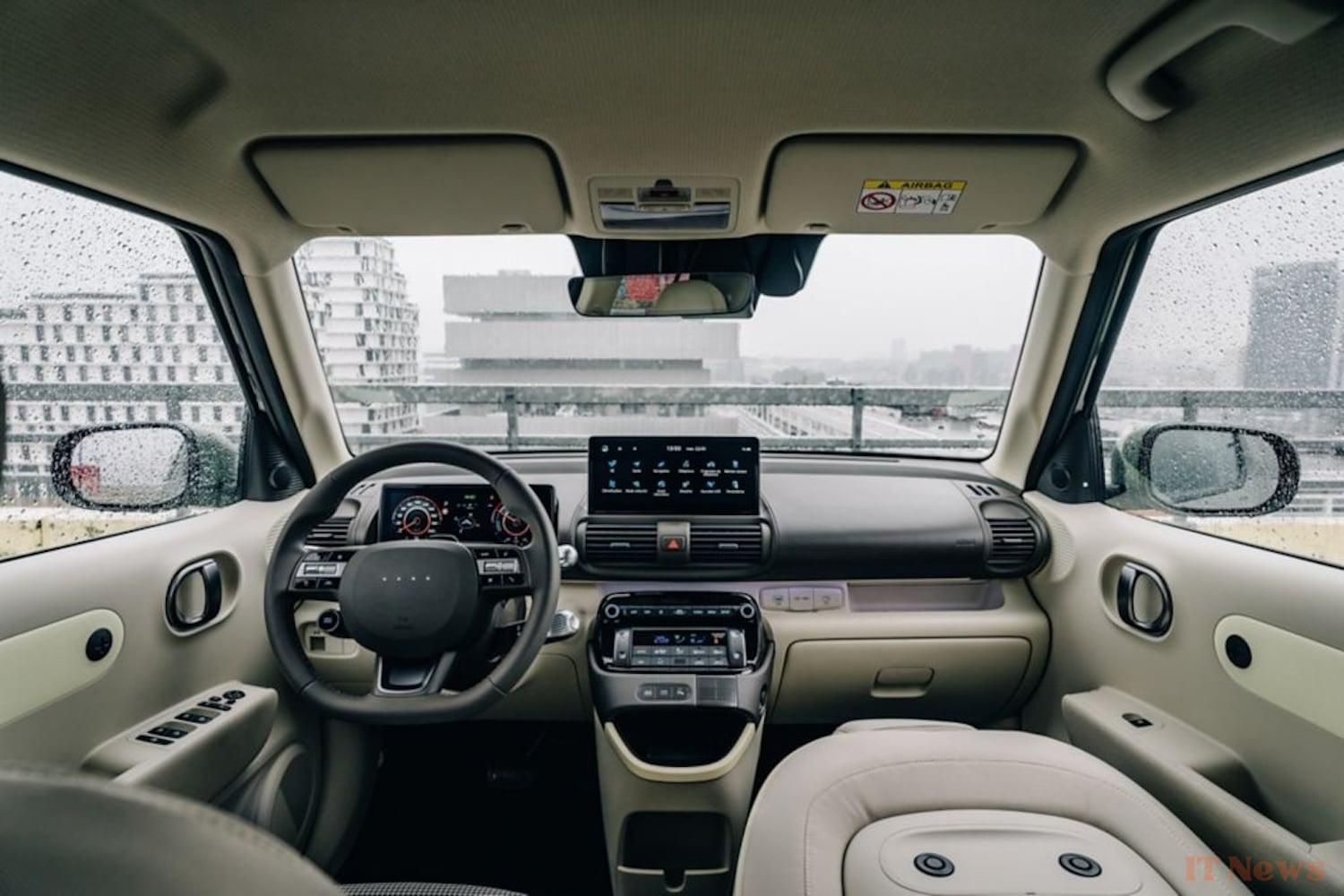
We also want proof of its trunk, whose capacity varies between 238 and 351 L and which includes a space under the floor ideal for storing charging cables. Too bad it was not doubled with a frunk, a trunk at the front under the hood. The folding and rotating capacities will change depending on whether you prefer a 4 or 5-seater version, which brings us to the thorny question of the ecological bonus. Indeed, the State aid (2000 euros or 4000 euros depending on your income level) will only be valid on the 5-seater version, available in the spring. Be careful though, in this version, the back seat is no longer sliding.
The Inster on the road, what is it worth?
As its size and narrowness suggest, driving in the city is child's play for the Inster. And yet, the little Korean cannot boast of having an exceptional turning radius. Its 10.6 m allow it to perform maneuvers easily, but less than with the incomparable Twingo ZE, obviously.
In town and at low speed, we will particularly feel the firmness of the suspensions, nothing alarming, but in our opinion it is this same behavior that will give more character once the road widens. On secondary networks, the Inster is also very comfortable since it benefits from an excellent chassis as well as particularly precise steering. We will not go so far as to emphasize the driving feel of the city car, but its driving qualities helped by a contained weight (less than 1.5 tons) and a good choice of tires are an example to follow for its future competitors.
For the rest, we benefit from a large number of driving aids (as standard), such as cruise control or lane keeping assistance. More than satisfactory.
Autonomy: the small battery will do the trick
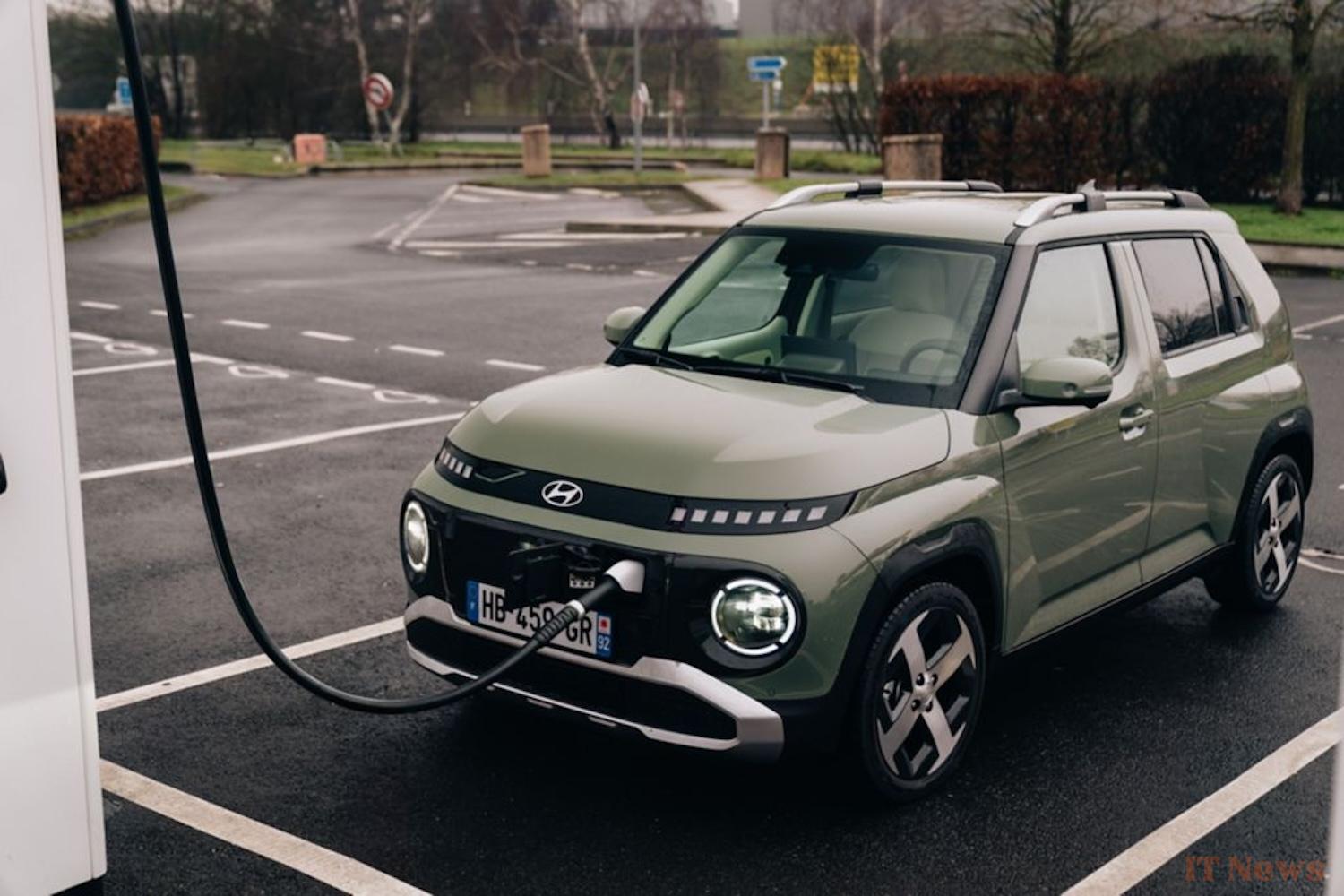
Before giving you our consumption measurements for the Inster, it should be noted that Hyundai's city car will be marketed in two battery versions. The first, the one that will equip the model at less than 25,000 euros, has a capacity of 42 kWh. The "large" battery is barely more ambitious with its capacity of 49 kWh. Why such a small difference? Hyundai believes that it can thus better meet the different demands of consumers from one country to another in Europe. But there is almost no doubt that, in the markets where electric is most developed, it is the 42 kWh version that will be preferred. This is also the one we recommend you choose if you are interested in the Inster.
If the Hyundai city car is the second car in the household, this choice seems obvious. It is not necessary to have a vehicle with a huge range for everyday journeys, especially since recharging at home is child's play.
For these same "short" journeys, the range of the small battery, 327 km WLTP, also seems sufficient to us and the additional cost required to achieve at 370 km of the 49 kWh version seems too high to us.
These considerations would probably have been less valid if the Inster's consumption had not been so interesting. Indeed, during our short trip with the Hyundai city car, we recorded consumption of around 15 kWh/100 km on a mixed route. At higher intensity and in sport mode, this consumption slightly exceeded 16 kWh/100 km on a test portion of just over 72 km of secondary roads. As for purely urban consumption, it effortlessly remained at around 14 kWh/100.
This could probably be improved somewhat by making even greater use of the tools available in terms of energy recovery. We are talking here about the 3 levels of regeneration available via the steering wheel paddles, or even the very effective One Pedal mode. Indeed, during our urban test, we were satisfied with the first recovery level, so it is possible to hope for more flattering autonomy scores.
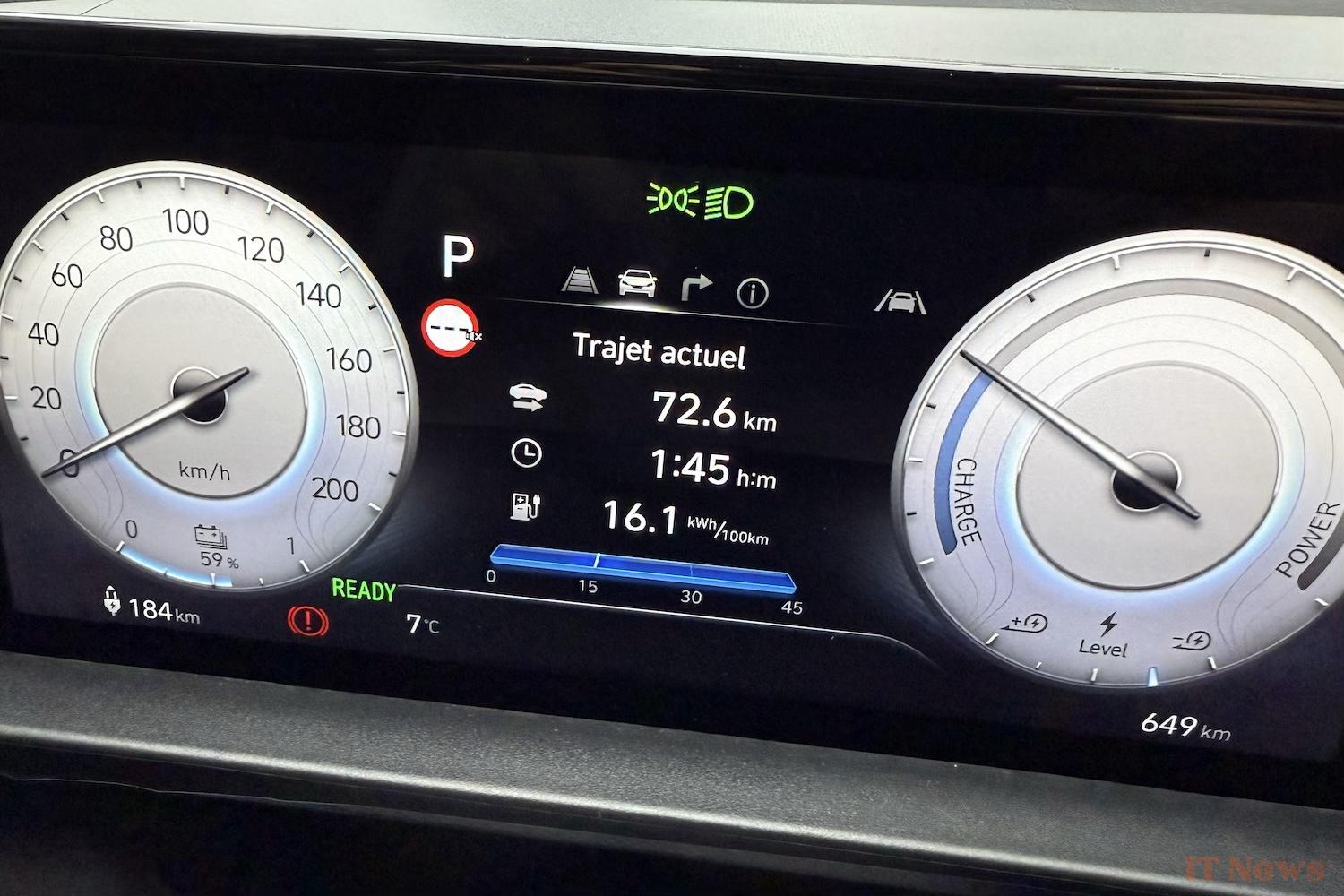
Ultimately, for purely urban use, the 327 km promised by the WLTP cycle seem quite within reach. For mixed use, you will probably have to make do with a range of around 300 km. These values would have been prohibitive in the case of a family or a road car, they are ideal for a city car.
The Hyundai Inster faces its competitors
It is understood that manufacturers will take advantage of the next two years to flood the market with electric city cars. At the end of 2027, the Inster should find itself facing competitors as ambitious as the ID.2 from Volkswagen and its cousins from the German group, but also under threat from a possible Tesla Model Q (or Model 2). And while waiting for 2027? The market currently has only two serious players: the Citroën ë-C3, which arrived a few months early, and the Renault R5 E-Tech, whose version at less than 25,000 euros should be on the market in the coming weeks.
The Inster doesn't have to look down on either of them. Superior in almost every way compared to Citroën, it can also compete with the inevitable R5. Of course, the diamond-shaped city car enjoys an unrivaled popularity rating and superior driving qualities, but in terms of equipment level and habitability, Hyundai clearly marks its territory.
Once again, more than the purchase price, starting at 25,000 euros, it is the rental offer (under conditions of course) at 129 euros per month that could be the right way to approach the Inster. Under these conditions, it is almost a shame that Hyundai's production for France is limited to 5,000 units. On paper, the Inster has arguments to see bigger.
Verdict of our test of the Hyundai Inster:
Coming out of nowhere or almost, the Inster could be in our opinion one of the big surprises of the year. The reason? It is a very serious proposition, not to say finally coherent, of a city car better equipped than the average, very comfortable on the road, pleasant to drive and with sufficient autonomy for the use for which it is intended. We certainly won't cross France in an Inster, at least not in a reasonable time, but we can do almost everything else... For 25,000 euros or 129 euros/month, we will only regret this dark story of a 4/5 seater bench seat which reduces the habitability if we want to benefit from the ecological bonus.


0 Comments