
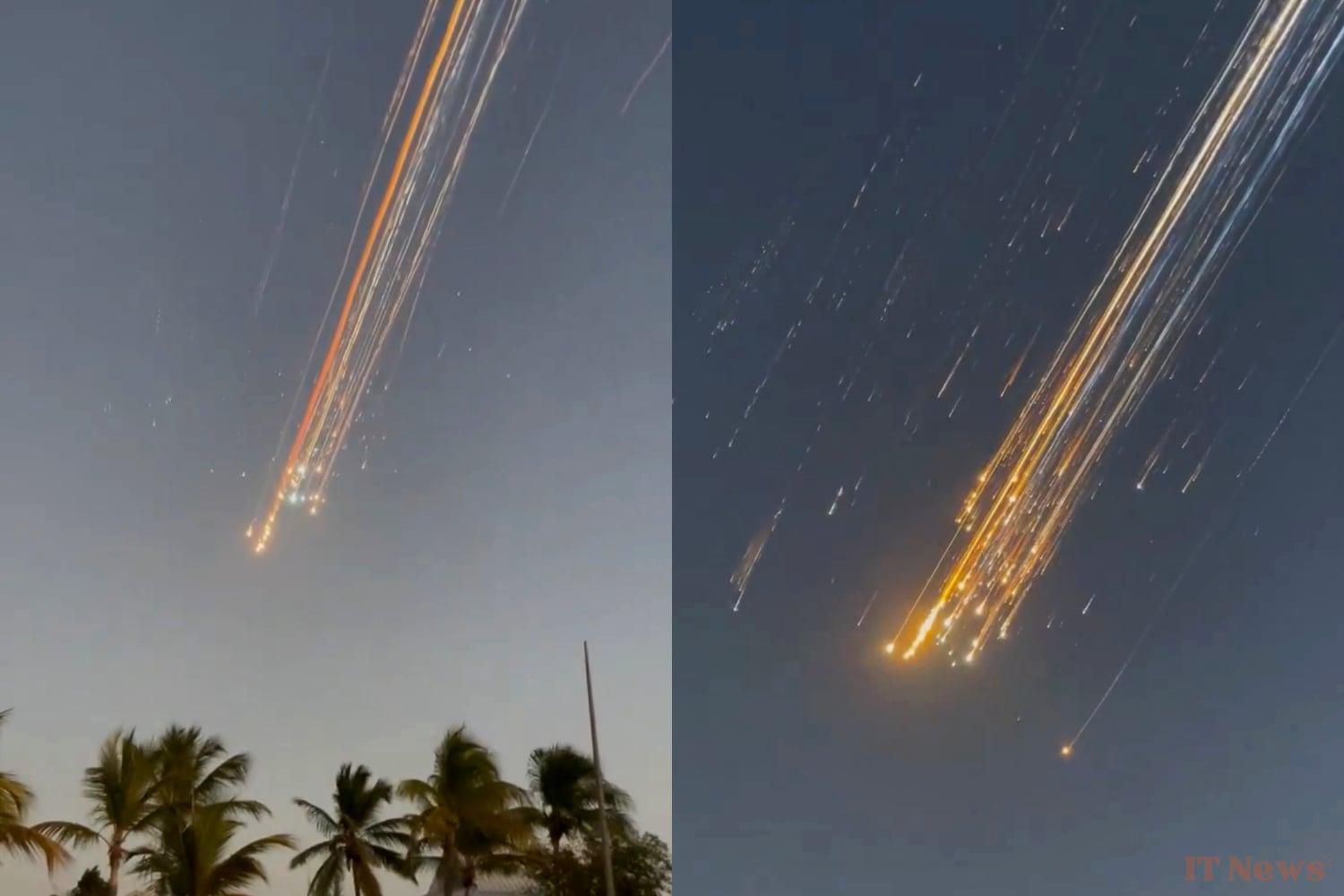
Elon Musk preferred to laugh about it, but behind this shower of multi-colored shooting stars lies an incident that could have gone very badly. On the night of Thursday, January 16 (Friday, January 17 around midnight in France), hundreds of pieces of debris from the first second-generation Starship (Ship 33) appeared in the sky, north of the Dominican Republic and Puerto Rico. "Success is uncertain, but entertainment is guaranteed!", wrote the SpaceX boss, sharing a video that has already accumulated more than a million views.
Updated January 17, 2025 at 11:00 a.m.: SpaceX is well aware that some debris could be found near Puerto Rico and the British Virgin Islands. So the company launched a special phone number and email address, suggesting not to try to handle or recover the debris directly. As an alternative, SpaceX asked to contact local authorities.
Diverted planes and low orbit threatened
At the same time, in the airspace, the American Federal Aviation Administration was sounding the alert, and diverting many planes from their trajectory to separate them from the thousands of trails in the sky. Without much doubt, some debris would reach altitudes accessible to airliners, or even reach the surface of the Earth without having completely vanished in time. A risk, great, but which could have taken on a completely different scale if the explosion of the ship had taken place at a higher altitude, and if the debris had taken several days or weeks before returning to Earth.
By leaving the Earth's attraction, the debris could have ended up in a space, called low orbit, where the slightest threat can cause a chain reaction, with multiple collisions between each gravitating body. A situation that the significant increase in satellites in the sky continues to highlight. The saturation of levels located between 160 and 1000 kilometers in altitude is increasingly worrying, and SpaceX, with its Starlink constellation, has something to do with it: the overwhelming majority of stars in orbit at present come from the company.
Thanks to the meticulous observation of Internet users, the explosion of the Starship was also able to be recorded in the sky. Enough to realize the impressive release of energy at such an altitude and at such a speed (the Starship was around 140 kilometers, at a speed greater than 10,000 km/h. "We have just experienced one of the worst moments of the Starship program. Obviously planes had to change their trajectory to avoid danger. We are surely heading for a major FAA investigation with a ground blockage of several weeks", exclaimed Ufonitik, a YouTuber specializing in aerospace.
Despite everything, NASA's senior administrator, Bill Nelson, congratulated SpaceX on its seventh Starship test flight. The man, who welcomed a new private launcher into the American new space with Blue Origin’s New Glenn extended his support to SpaceX. “Congratulationson the seventh Starship test flight and the second successful booster capture. Spaceflight is not simple. It is anything but routine. That’s why these tests are so important, each one bringing us closer to our path to the Moon and Mars thanks toArtemis».


0 Comments