
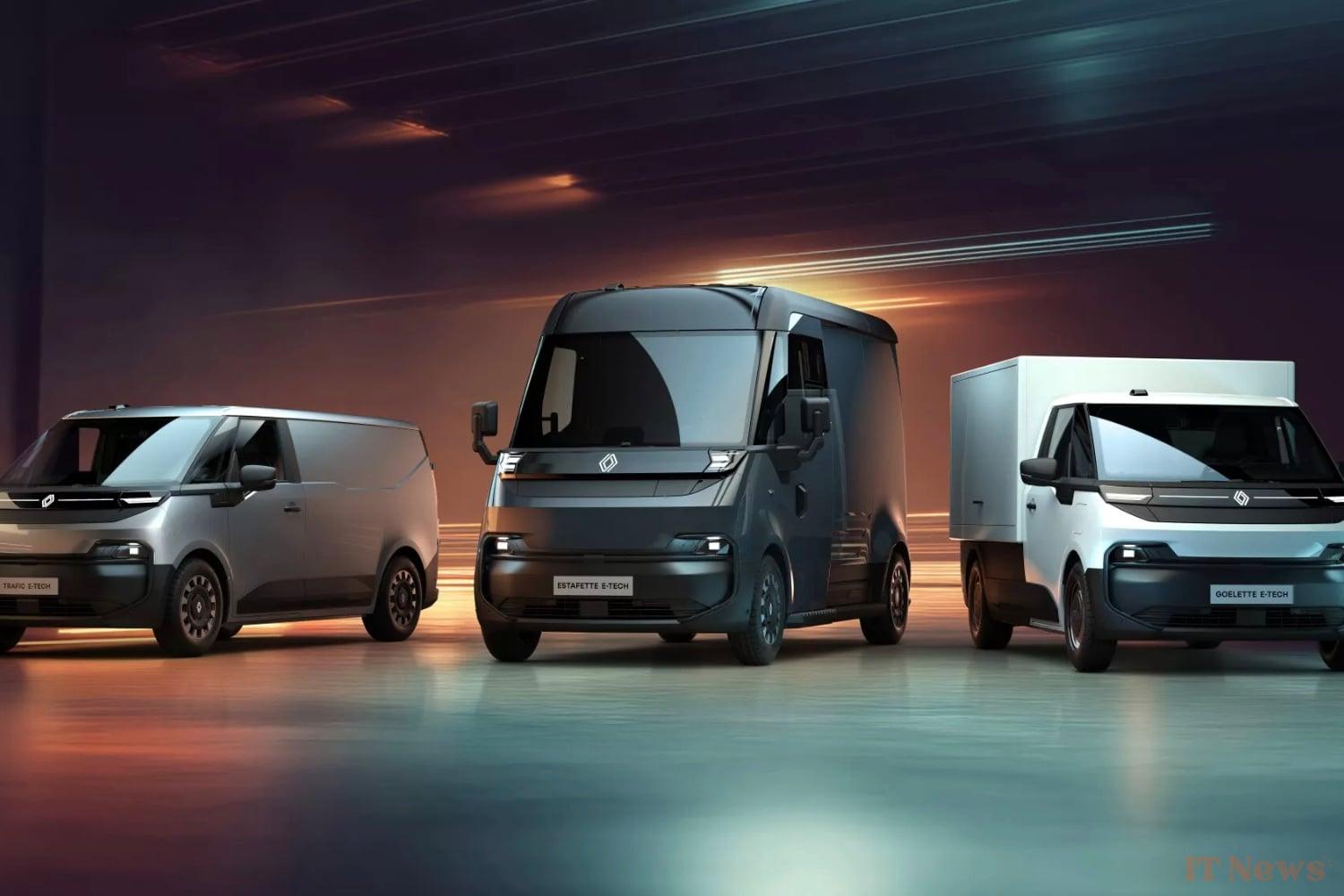
The Renault Utility range is evolving. Thanks to the Flexis joint venture, which the diamond brand launched in April last year with Volvo and CMA CGM, three new vans are arriving in 2026. They will replace a range of electrified vehicles that were based on thermal models, far from being efficient in terms of autonomy, recharging, and space optimization. To mark the occasion, Renault is recalling stars of the past, namely the Goelette (1956-1966) and the Estafette (1959-1980), without forgetting the faithful Trafic, which has never left the range since 1980.
Flexis will allow the different investors in the joint venture to put a different logo on each model, and thus share the costs. It should be noted that Renault and Volvo have both spent 300 million euros to invest in this new project, and CMA CGM has completed the bill by spending 120 million euros. The technical platform is however signed Renault, or rather Ampere, with a chassis called SDV (Software Defined Vehicle). The French firm will assemble its own models in the Sandouville factory, east of Le Havre, responsible for the production of Trafic including its E-Tech version.
At Renault, the models will arrive in 2026. From the smallest to the largest, the Renault Goelette will mainly be responsible for last-mile deliveries, or as a utility vehicle for small craftsmen (with the possibility of having a dumper or a box). The Trafic will take up the use that we know of it, by boosting the autonomy of only 300 kilometers that the E-Tech model offers today (with a recharge of only 50 kW at peak). Finally, the Estafette will be the largest of the three utility vehicles, offering space to stand up in the back (its size is 5.27 meters long and 2.6 meters high).
Renault has not communicated on the technical specifications of its three future models, but Flexis had already mentioned the possibility of reaching 450 kilometers of autonomy thanks to an 800 V platform. Enough to also promise faster recharges.


0 Comments