

In the (very) large family of Xiaomi products, I ask for the headphones designed to compete with the AirPods 4 with active noise reduction. This is indeed the mission of these Buds 5, marketed however at half the price (100 euros) compared to the Apple model. Two characteristics are however similar: their classic form factor for earbuds (which will please those allergic to in-ear headphones) and despite this semi-open format, an active noise reduction system. Here is our full review of the Xiaomi Buds 5 after several days of testing.

The design is in any case very different from their American competitors. The emphasis here is more on flashiness than minimalism, especially in the titanium gray color of our test model (they are also available in graphite black and ceramic white.). The case cover is made of glossy plastic, the lower part more matte. On the back of the hinge, a very discreet logo betrays the collaboration with Harman on the audio part.
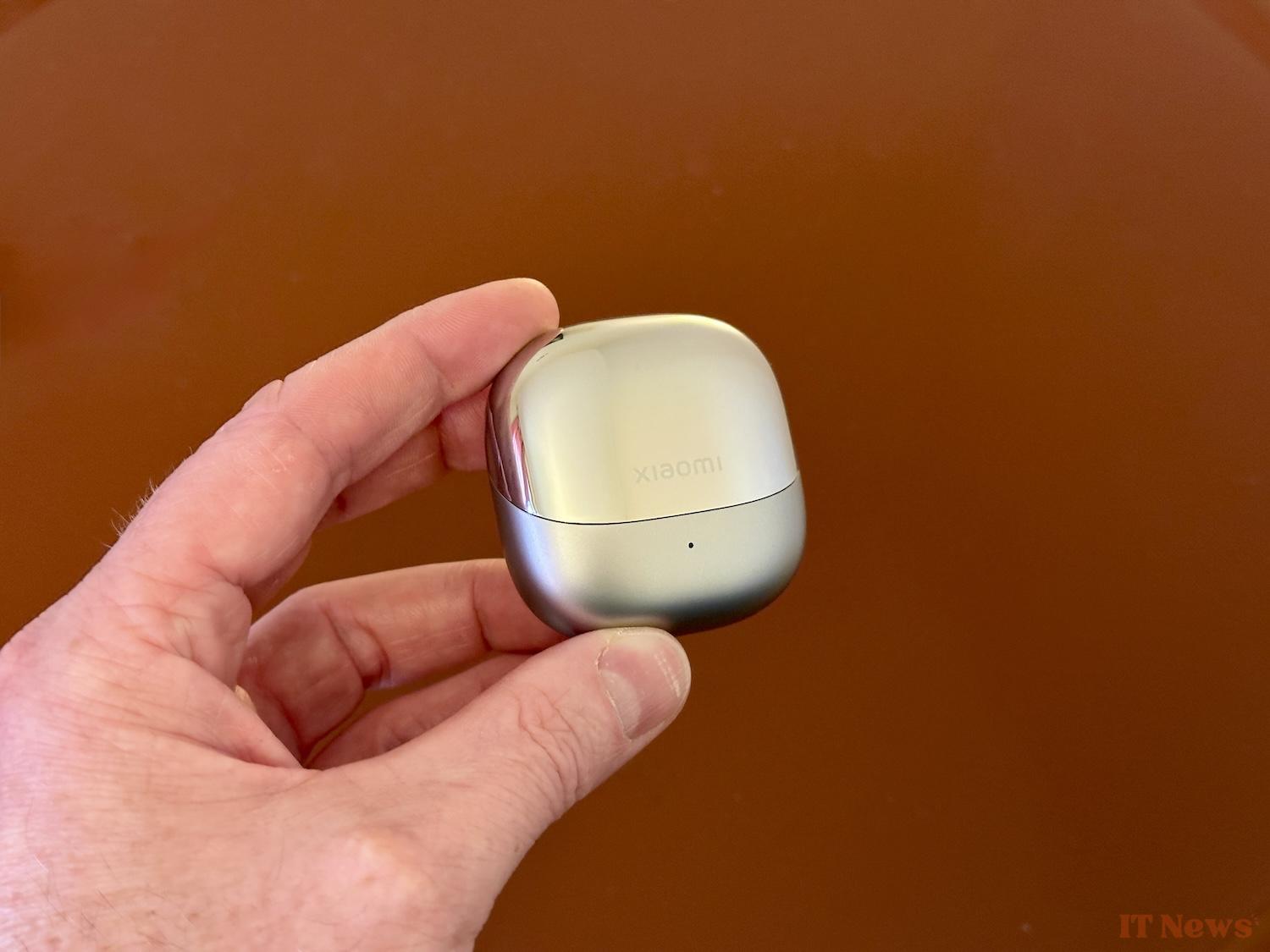
The earphones take up this alternation between shine on the outside of the stems and matte coating for the rest of their body. On their internal part, a rather pretty perforated crown hides the proximity sensor useful for pausing playback when you remove the earphones from your ears. Despite the very affordable price, the finish has not been taken lightly, the finishes are impeccable and the hinge of the case does not present any annoying play.

The design of the Xiaomi Buds 5
The case (36 grams), like the earphones (4.2 grams each) are very light. The whole thing slips easily into a pocket without getting in the way thanks to the small dimensions of the charging case (53.9mm × 53.2mm × 24.5mm). While the latter is not waterproof, the earphones are IP 54 certified (dust and splash resistant). Wearing them during physical exercise can however be risky. Depending on the shape of your ears, they stay in place more or less well and can therefore fall out. It is better to try them out before embarking on an intensive running session. One thing is certain, however: their comfort. We were able to wear them for a whole day without ever being bothered.

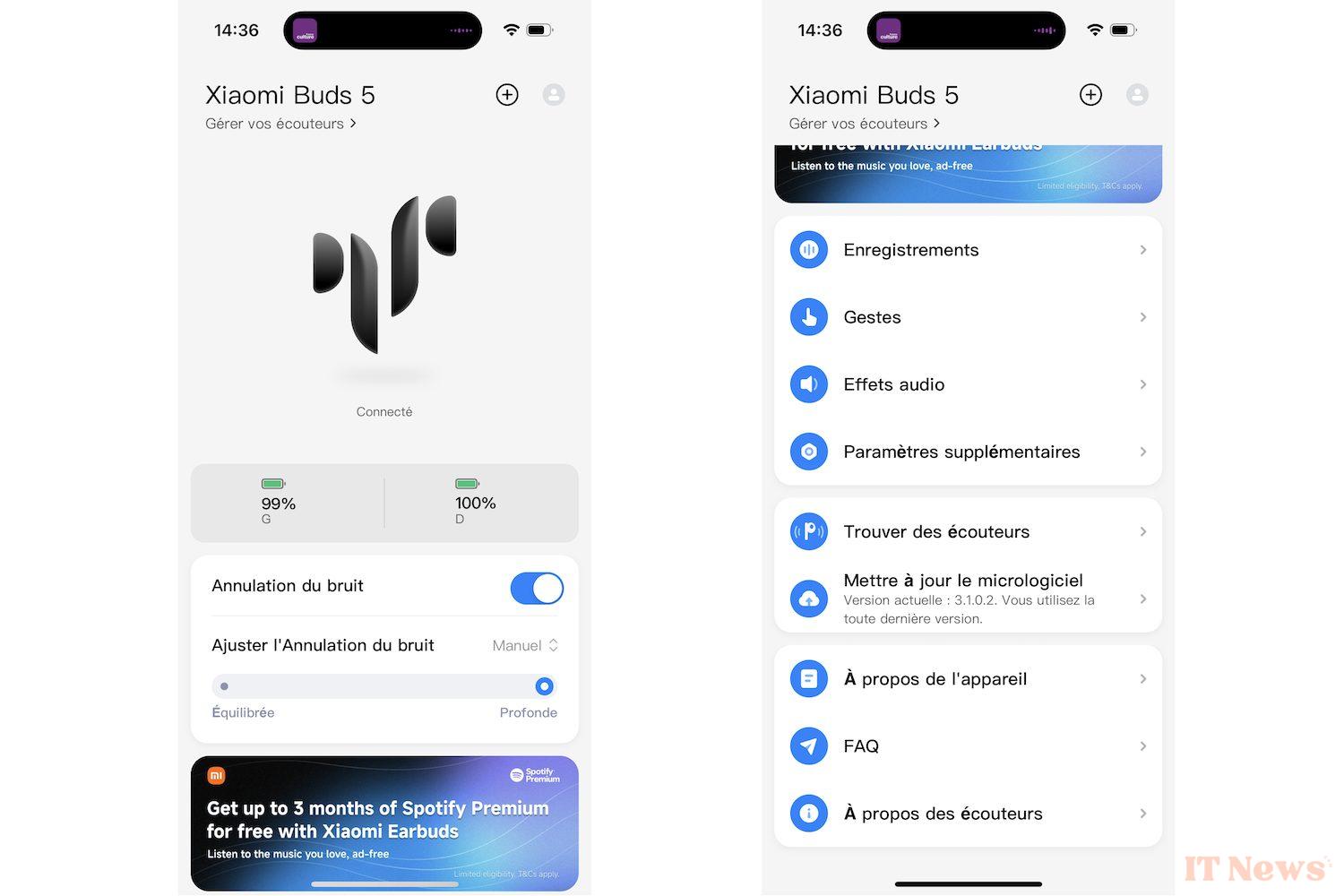
Bluetooth pairing (5.4 with LE Audio) is easy, but does not benefit from any compatibility with Google or Microsoft's fast systems. You must therefore long press the button located under the case to make it discoverable. The Xiaomi Buds 5 are then configurable within the Xiaomi Earbuds application (iOS and Android). A few options are offered: adjustment of the intensity of the noise cancellation level, configuration of control gestures, audio effects (immersive sound, ten-band manual equalizer), in-ear detection and multipoint connection. The list is limited, but the essentials are there.
Our opinion on “immersive sound”
A “Recordings” section is also integrated into the application. It allows you to trigger a recording from the earphone microphones and access the files. It is even possible to record by configuring the functionality on a gesture, such as a double press on the stem of an earphone. It is as practical as it is intrusive since it allows anyone to be recorded without their knowledge. The controls are therefore made by pinching the stems once, twice, three times or by holding them down for a long time. Too bad the volume is also adjusted by pressure rather than by sliding your finger on a stem.

The immersive sound can be forgotten right away as the result it offers is catastrophic. It seems that it simply adds a high-pass filter and a reverb effect. No spatialization (which is much better in classic stereo) is sought here. This process, which is so bad, was nevertheless activated by default when we first used the headphones. We almost put the Buds 5 away in their box and never touched them again, before realizing it and immediately deactivating the option. 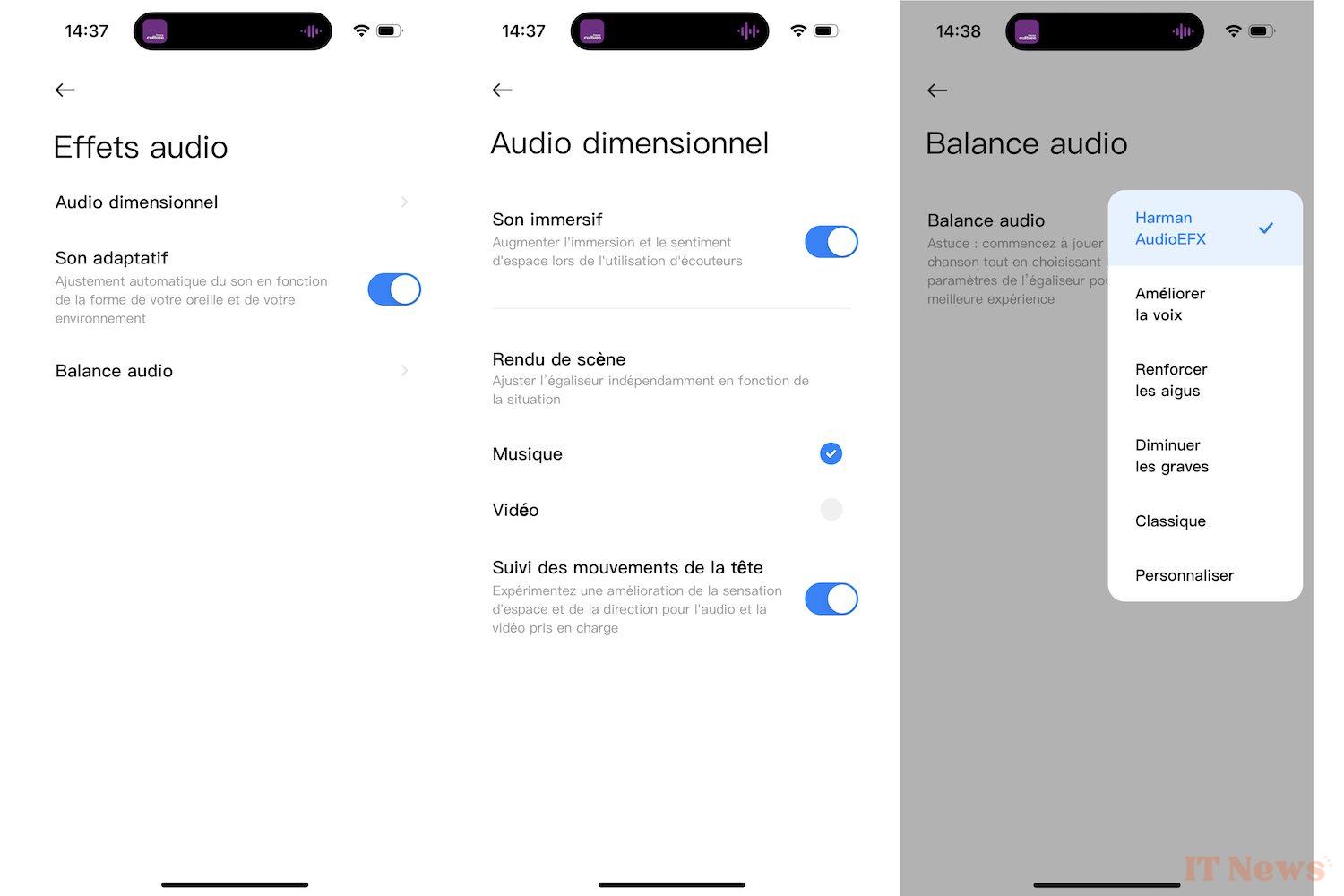
Bass is very present
Here, the audio reproduction has fortunately improved considerably. It must be said that with 11 mm dual magnet transducers, we still expected a little more bass. The Buds 5 do pretty well on this point, within the limits of what this type of earphones are capable of. Without being in-ear, it is difficult to increase the sound pressure in the ear canal. The intensity of the bass therefore depends a lot on the position of the earphone in the ear. The highs are also well represented, but on the other hand, support the increase in volume much less where a lot of distortion is heard on these high frequencies.

The mids would have gained from being a little better highlighted, the voices clearly lack body and seem very bland. The AudioEFX software system developed in collaboration with the renowned audio brand Harman doesn't change much: the audio quality of the Buds 5 is decent for this price and form factor, but without working miracles. And it goes without saying that at this level of performance, the integration of the aptX Lossless codec is more of a marketing gimmick than real capabilities.
Test of autonomy
The noise reduction is not amazing either. It slightly reduces continuous noise (car engine, rolling in transport, etc.), but certainly does not produce a kind of bubble of silence as this process can do on in-ear headphones. The integrated triple microphone is, however, much more effective at picking up voices when using a hands-free kit. You remain intelligible even in noisy environments, such as a busy street.

The autonomy of the 35 mAh batteries is quite limited, since we only reached 3 hours 25 minutes of operation with ANC activated before the headphones turned off, far from the 6 hours 30 minutes promised by the manufacturer. We can console ourselves with the possibility of recharging them a little more than six times thanks to the case and its 480 mAh battery.


0 Comments