
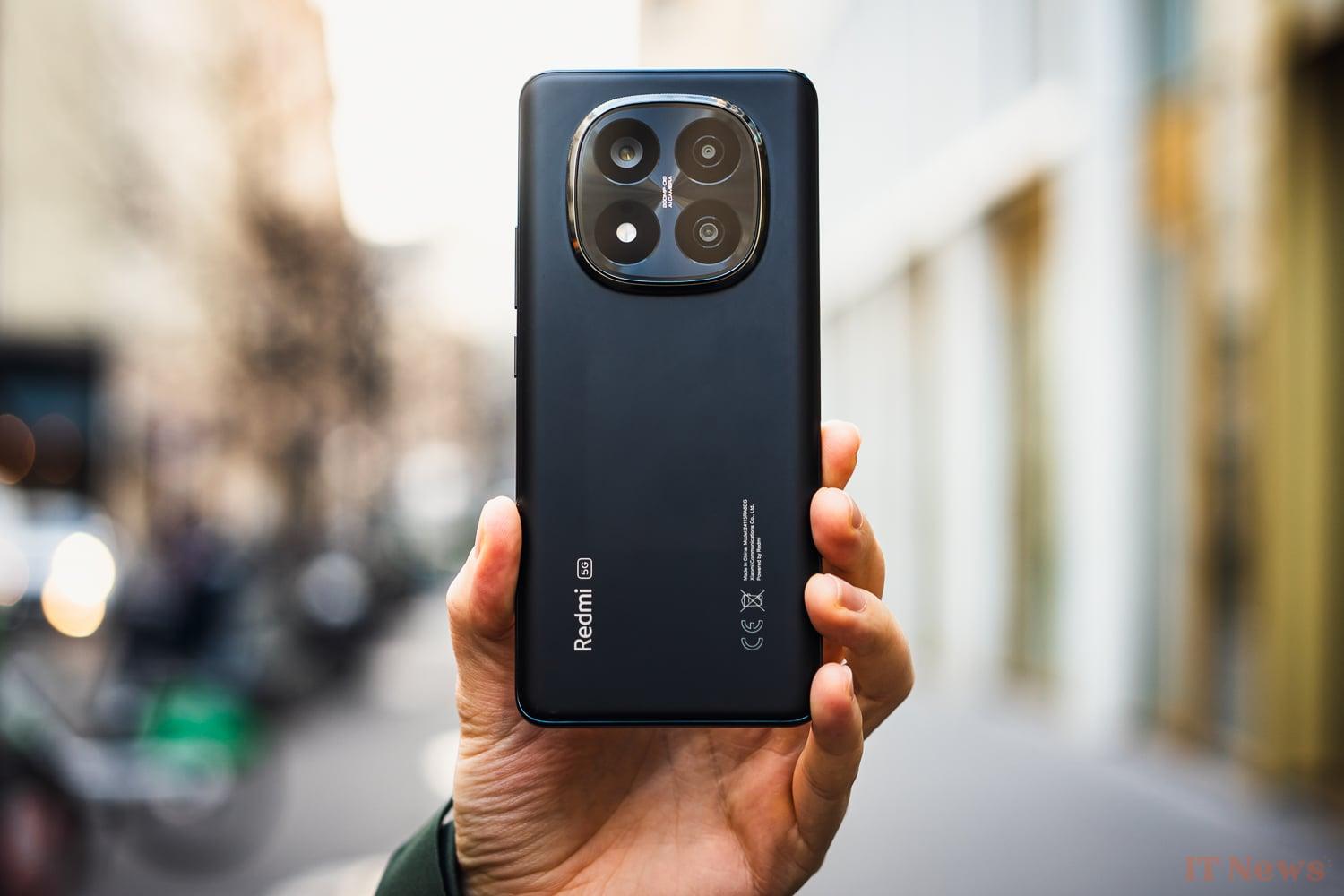
As our test of the Xiaomi Redmi Note 14 Pro Plus is progressing well, we wanted to share with you its excellent result during the new 01Lab charging protocol.
Before examining the results, let's remind ourselves who we are dealing with. Redmi is Xiaomi's star range, which represented more than 50% of its sales in France in 2023 and which therefore contributes greatly to its position as the 3rd smartphone seller. This success is largely due to its exemplary work on the quality-price ratio for years.
In this diagram, the Redmi Note 14 Pro Plus has a somewhat special place, since it is the most expensive of the Redmi Notes. It is he who inherits the best technologies, the finest manufacturing quality, all for a price that nevertheless remains contained at 503 euros.
Now let's take a look at the 01Lab measurements.
The 120W charge works wonders
Let's start by comparing its results to smartphones from brands known for integrating particularly fast charging: Honor, OnePlus and even Xiaomi. We deliberately chose three high-end smartphones to see if the promise of the Redmi range of value for money is well fulfilled.
We can very calmly say that regarding charging, it's a big yes. Compared to the Xiaomi 14T Pro, the OnePlus 13 and the Asus ROG Phone 9 Pro, only the Xiaomi manages to surpass it. In addition, the difference is very negligible, only two minutes less for the 14T Pro. A time that can be explained both by the phone's performance and by our protocol, we can therefore consider that the two align on a similar time.
The promise of the Xiaomi Redmi Note 14 Pro Plus is therefore already fulfilled. For a lower price, you have access to a fast charge capable of dethroning the best smartphones in the sector.
Let's now compare to smartphones playing in the same price range as the Redmi. We have selected the two champions of 500 euros, the Pixel 8a from Google and the Samsung Galaxy A55 from Samsung. In order to compare properly, we have also added last year's model.
The result is clear, not only does the Redmi Note 14 Pro Plus improve its brand compared to last year, and by 10 minutes please, which is far from negligible. But it largely dominates the debates on charging compared to its competitors by charging almost three to four times faster.
How can we explain this charging performance?
To explain this charging performance, there are no 36 solutions. We must look at the power deployed throughout the charge. To do this, 01Lab measures it every minute to get a general idea of the behavior of the phone and its charger.

Above, you can see the power deployed by the 120 W charger with a simple charge, then by activating the maximum charge mode. In the latter case, we see that the measured peak exceeds 100 W (it reaches 102.7 W to be precise), and this for a duration of several minutes, which is already excellent. We also note a second time in the charge that places the power just below 60 W. Here again, this value is well above the standards for smartphone charging, and this explains the excellent performance.
A maximum charge that almost does too much
Since we have the two measurements, one with the maximum charge mode, the other without, let's stop for a moment on the relevance of using this boost mode. We measured a difference in charging time of 7 minutes, for an average power in W higher by more than 15 W.
If you buy this smartphone, we therefore advise you not to use the maximum charge mode, unless there is a specific need (a break of a few minutes before moving away from any socket, professional obligations, etc.). Indeed, a charging time of 32 minutes is already excellent. A higher charging power necessarily leads to more significant heating, you risk wearing out your battery prematurely if you use it too frequently.
We will miss the charger in the box
One thing is certain, these good performances lead us to regret, in passing, that Xiaomi no longer provides a charger in the smartphone box. The Chinese firm decided to do so since the implementation of a European directive at the end of 2024, which requires manufacturers to offer the smartphone either with a charger or without, and to market said charger alone for each model.
As a result, to avoid having two different boxes, a thick one with a charger and a thin one without, the manufacturer preferred to remove its bundle (like the vast majority of the market, it must be emphasized).


0 Comments