

Snapchat is an augmented reality (AR) player that got interested in it before anyone else. Since 2015, the social network has been making its competitors look old-fashioned (before being copied by them) with its famous filters. Today, this lead allows the network to claim a whopping 300 million AR users daily, no less.
AR on smartphones is fun, but for the concept to take off in the long term, it seems obvious that sooner or later all these systems will have to be brought down to eye level. And that is precisely Snapchat's ambition with its "Spectacles", which we were able to try out.
A unique product, but not yet a real product
Don't take your credit card out of your pocket yet, you won't be able to buy these Snapchat Spectacles. It is currently a development kit for developers.
Indeed, Snapchat is launched in a long-term plan. They have even developed a dedicated operating system, Snap OS, with the ambition no doubt to become the future Microsoft or Google of the sector (for Windows and Android). But for an OS to be popular, you need a complete set of applications, otherwise you risk not generating enough interest (Windows Phone users know this well).
The Snapchat Spectacles are therefore quite limited for the moment. Quite bulky, with a significant weight of 226 g to accommodate its battery and its 4 cameras, it offers a battery life of only 45 minutes, heats up a lot and has a rather narrow display surface (46°).
On the other hand, Snap OS already has a complete control system only with the hands which seemed to us to be both ergonomic and responsive. Need a menu to go back? It is located on your left hand. Want to move a window or enlarge it? Just grab it.
Let's add that the glasses are completely autonomous, meaning that they display everything you see in your lenses by themselves and therefore do not need a smartphone to work.

So we were able to play with them for a few dozen minutes, the time to try a Beat Saber clone, draw in the air or listen to a piece of music via branches. All this seemed to us still far from a finished product, and the work remains immense, but the bases of a usable OS are there. Above all, Snapchat's vision seemed very different to us from the Ray-Ban Meta AI, an interesting product, but which does not seek to display information on the lens.
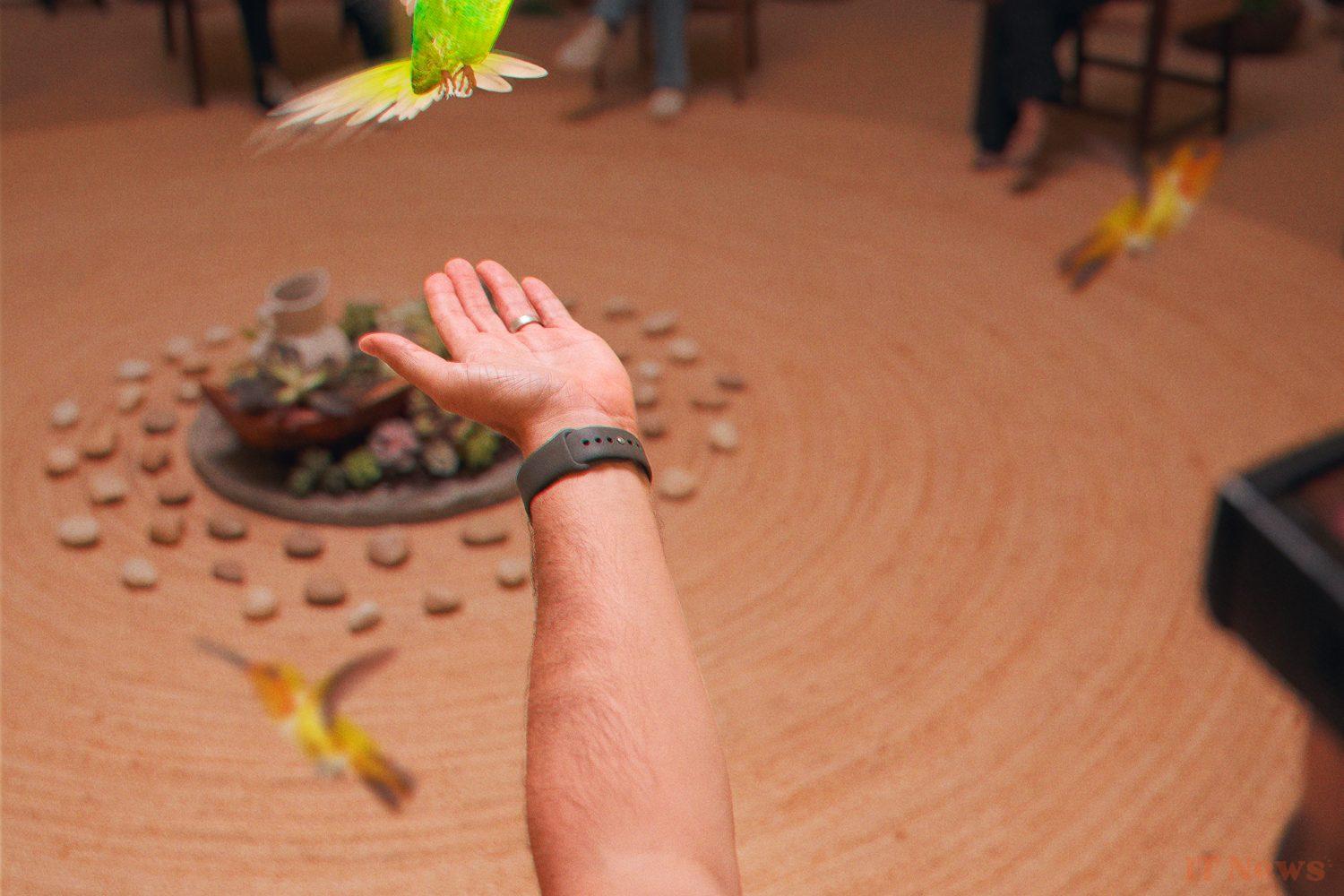
A vision of the future of AR: see-through
Whether by luck or by flair, we must recognize that Snapchat's investment in AR seems today more relevant than ever. Augmented reality is once again on the rise, driven by the Meta Quest 3S or an Apple Vision Pro, or by numerous prototypes seen at CES 2025.
But according to Snapchat, many of these products miss their target. "No one is doing real augmented reality at the moment," says Antoine Gilbert, Director of the AR Studio. Snapchat The difference lies in these two terms: see throught and pass throught.
Pass throught, which is practiced by the Meta Quest and the Apple headset, is the fact of seeing augmented reality via a camera. See throught is the fact of seeing reality with your own eyes, and adding a layer of reality via the lenses of the glasses.
Each solution has its advantages and disadvantages. Pass throught involves a heavier installation, with screens and a limit of perception of reality imposed by the quality of the cameras. See throught, for its part, uses complex display techniques and is therefore still in development and will target much more nomadic use and social interactions. In the case of Spectacles, Snapchat integrates miniature Liquid Crystal on Silicon (LCoS) Projectors.
Concretely, this will take time
To better convince, and "raise more awareness of the potential of augmented reality and increase its impact in the culture, entertainment and education sectors", Snapchat opened an "AR Studio" in 2021, a place where we meet them in Paris in the 13th arrondissement.
The idea of this place is to be able to work with "non-commercial partners" on "projects in a controlled context", as Antoine Gilbert calls them, which aim to "finance the development of cutting-edge augmented reality applications". An example of a controlled context can be found in the "Augmented Egypt" exhibition at the Louvre, which offers to discover pieces in AR via your smartphone. A necessary step on the path from product to consumer.
"There are three steps", explains the studio director. "First, the environment mastered in educational, sports, etc. contexts. Then second, the work of developers" who will be able to create applications on SnapOS. And only after these two steps, can come the third, the general public.


0 Comments