
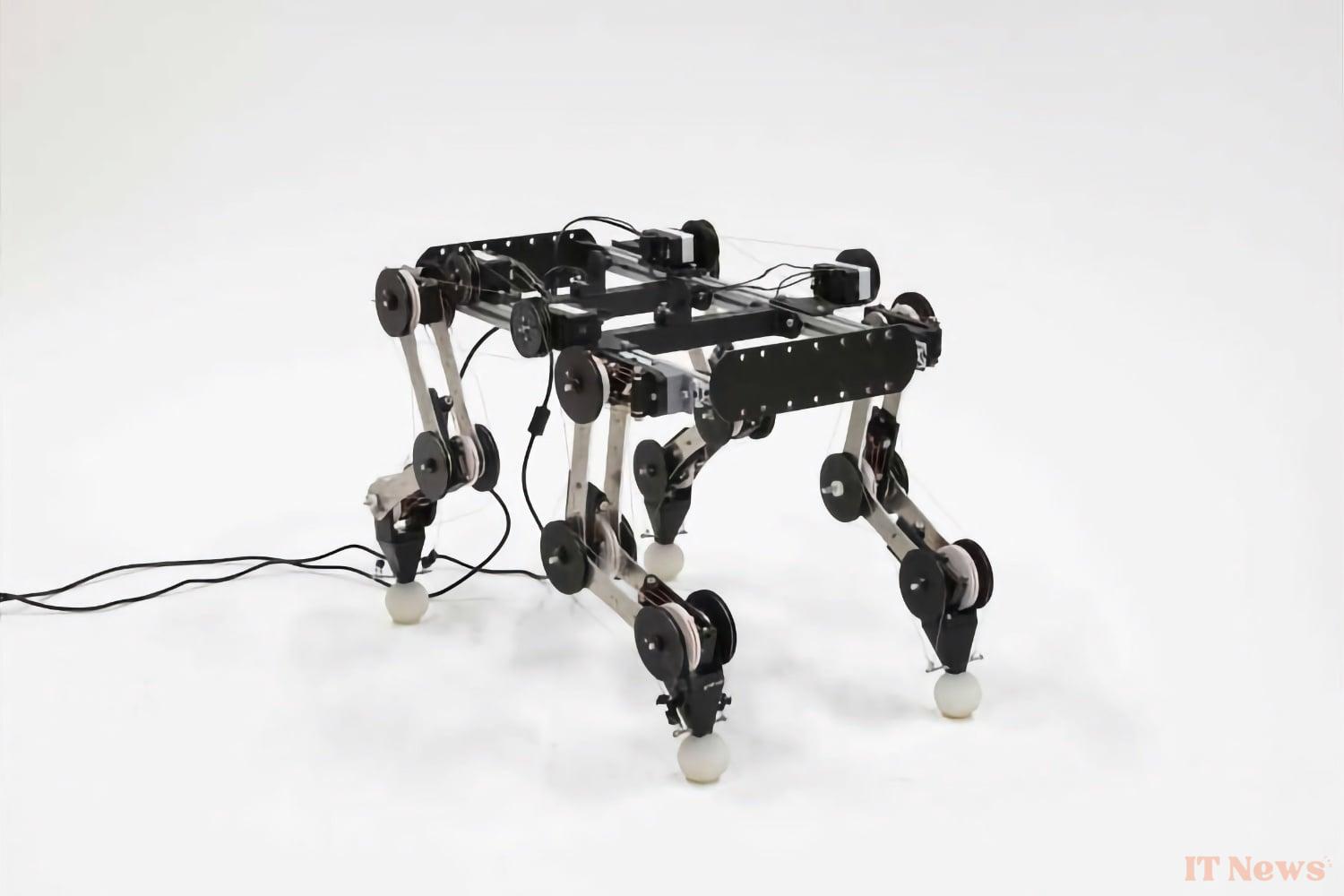
Developed jointly by the Swiss Federal Institute of Technology Lausanne (EPFL) and the Delft University of Technology (TU Delft), PAWS – for "Passive Automata With Synergies" – is a four-legged robot that stands out for its ability to move flexibly and efficiently while consuming very little energy.
A robot that moves effortlessly (or almost)
Unlike Unlike most current quadruped robots, which require numerous motors and complex algorithms to execute their movements, PAWS is based on a simpler architecture, directly inspired by the animal body.
The secret to this approach: motor synergies. In animals, the central nervous system does not control each muscle individually, but activates muscle groups in a coordinated manner to perform complex movements naturally.
It is this logic that the researchers sought to reproduce in PAWS. "We started with real biomechanical data from dogs to identify their main movement synergies, then translated this into a system of tendons driven by the human body." by a reduced number of motors,” explain Francesco Stella and Mickael Achkar, co-authors of the study published in Nature Machine Intelligence.
Result: despite its twelve joints, PAWS only has four active motors - one motor per identified “synergy”. These motors are coupled with cables, springs and flexible joints, which allow it to perform several types of movements, from trotting to galloping, including sitting or jumping.
During treadmill tests, the engineers even observed that PAWS could move forward without any motors activated, solely thanks to the elasticity of its internal structures. Under these conditions, the robot spontaneously adopted a galloping gait, managing to adapt to speed variations or overcome small obstacles.
“Our design shows that a well-designed passive body, with flexible mechanical couplings, can offer a wide variety of dynamic behaviors without the need to motorize everything,” the researchers say. The team is now working to improve the stability of PAWS at using simple sensors and lightweight feedback loops, always respecting this minimalist logic.
Behind this project is another way of approaching robotics: no longer by multiplying calculations and actuators, but by letting the physical structure of the robot do part of the work. A philosophy that could prove valuable in demanding contexts such as exploration, rescue in difficult terrain or long-term missions, where energy autonomy is a central issue.
PAWS is only in its infancy, but it is already posing An interesting question: what if, to make robots more efficient, all we had to do was make them more… animal-like?


0 Comments