

Astronomers have been searching for them for decades. Neptune's auroras have just been observed for the first time. And that's not the only surprise.
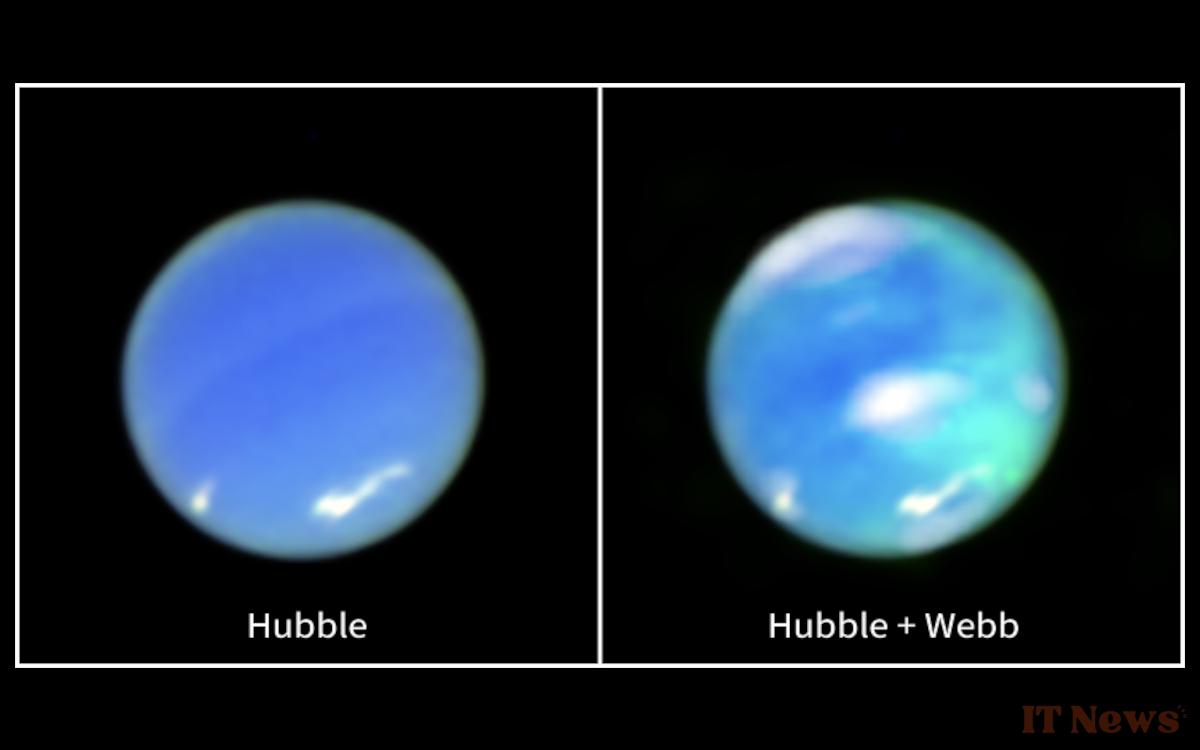
Neptune remains one of the most mysterious planets in the Solar System. Located More than 4 billion kilometers from Earth, it orbits 30 times further from the Sun than our planet. Since its only flyby by the Voyager 2 probe in 1989, scientists had little direct information about its atmosphere. Some phenomena were suspected, such as auroras, but never confirmed by observation. The extreme conditions, the freezing cold, and the distance made any detection very difficult with conventional means.
Thanks to the James Webb Space Telescope, researchers have finally captured an aurora on Neptune. The observation was made possible thanks to the telescope's infrared spectrograph, which measures the presence of ionic trihydrogen (H3+), a clear indicator of auroral activity. Unlike on Earth, where these are concentrated at the poles, they appear at various latitudes. This is explained by a very misaligned magnetic field, tilted 47° to the planet's rotational axis. In the images released by NASA, they appear as small cyan spots of light distributed irregularly on the planet's surface.
James Webb reveals a sudden drop in temperature in Neptune's atmosphere
In addition to this first aurora image, the telescope has made it possible to measure the temperature of the upper atmosphere. Result: it has dropped by several hundred degrees since 1989. The current temperature is about twice as cold as that recorded by Voyager 2 at the time. This drop could explain why the auroras remained invisible for decades. At these extreme temperatures, the light produced becomes almost imperceptible.
These discoveries open a new era for the study of icy planets. A longer observation campaign is planned for 2026, with continuous monitoring of Neptune for a full month. The data could help to better understand its strange magnetic field, its unstable atmosphere and its climate evolution. This work also lays the foundation for future exploration missions to the most distant planets in the Solar System.
Source: NASA


0 Comments