
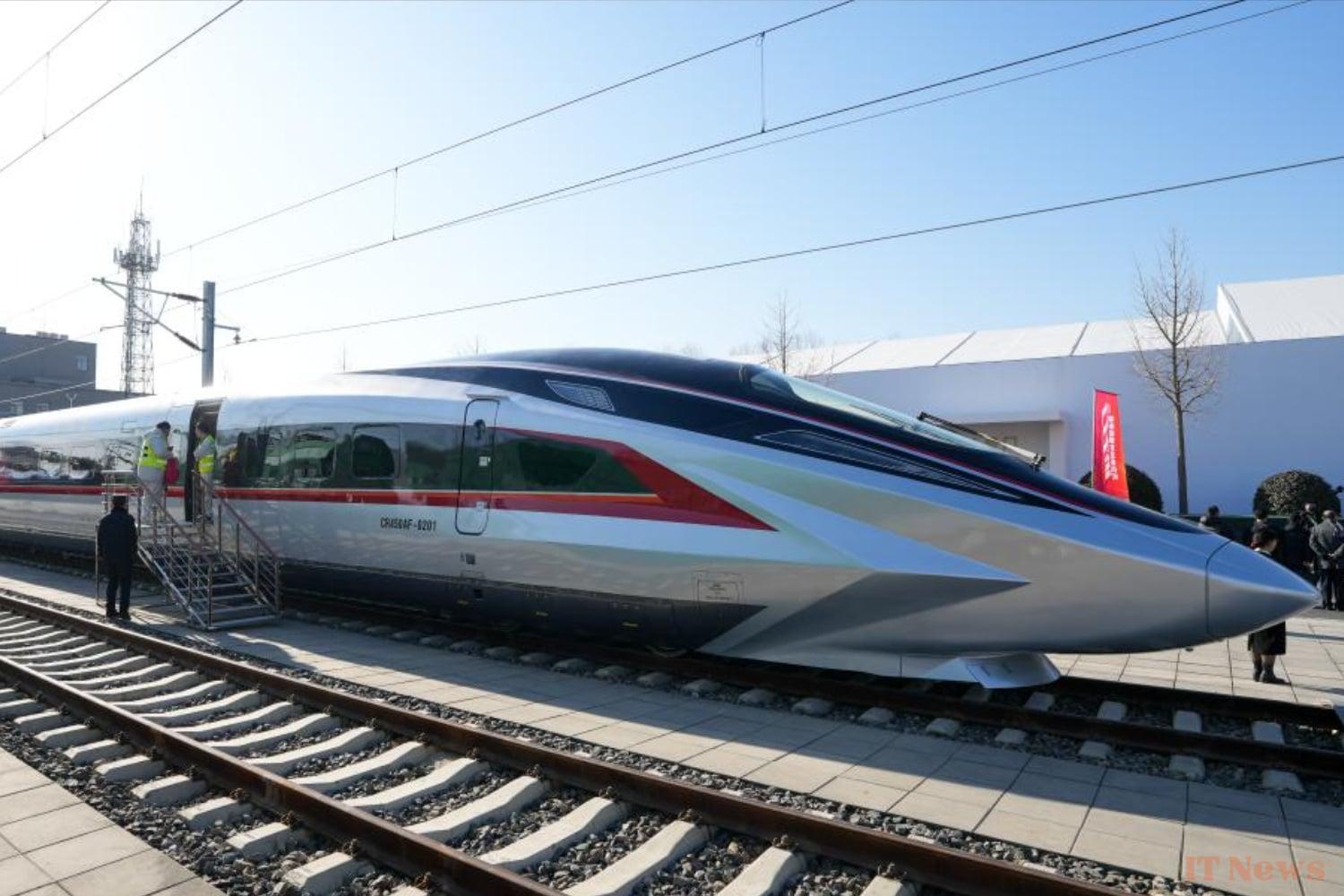
Beijing and Shanghai will now be just 2 hours and 30 minutes apart. With the 1,120 kilometers separating them, China is counting on the Fuxing "CR450" prototype to reduce times, thanks to a train that would reach, at conventional speed, 400 km/h. Last weekend, the railway operator China State Railway Group unveiled the new train model, and presented it as "the fastest high-speed commercial train in the world" from Beijing.
On board, the first images of the train reveal cabins reserved for business and first class, with comfort as meticulous as the best airlines. The cockpit is not left out, with a single seat placed in the center, and an impressive profile.
This train, if it reaches the production stage, would be a replacement for the CR400, which today allows to connect the cities of the country at speeds around 350 km/h. The CR450 would therefore further reduce travel times by traveling 50 km/h faster, thanks to an architecture 10% lighter than its predecessors, and a lower resistance to move the train. On the locomotive side, the CR450 has further lengthened its nose and installed aerodynamic windshields, to further reduce drag. Finally, its braking performance is said to be 20% better.
At the same time, the Chinese government has stated that the CR450 train will be operational "as soon as possible", and is talking about production for 2025. It remains to be seen whether work will have to be done on the lines to support such speeds.
The media outlet Gizmodo quoted the infrastructure consultancy AECOM, which was keen to point out that by increasing the speed of trains, it was also necessary to increase the distance of the railways to make turns, without the train needing to reduce its speed. By gaining 50 km/h, the increase in the angle of each bend would be significant and would correspond to almost an additional kilometer of curve.
Why doesn't the TGV go faster?
For its part, the French TGV set a new speed record in 2007, when it reached, on a test run, the crazy speed of 574.8 km/h, much faster than the previous French record of 380 km/h in 1981. If passengers cannot reach such a speed with their SNCF ticket, it is because the railway world is up against a physical limit that is very difficult to overcome, that of the wave preceding the pantograph on the catenary.
By sticking to the power cable, the device mounted on the train to capture electricity emits a wave that the train can unfortunately catch up with by exceeding a certain speed, which has the consequence of limiting the train's power supply and pose a problem for its ability to accelerate. To achieve its record, the TGV had, in 2007, configured the catenaries so that they were sufficiently taut and resistant to this limiting wave.
Source: Gizmodo


0 Comments