
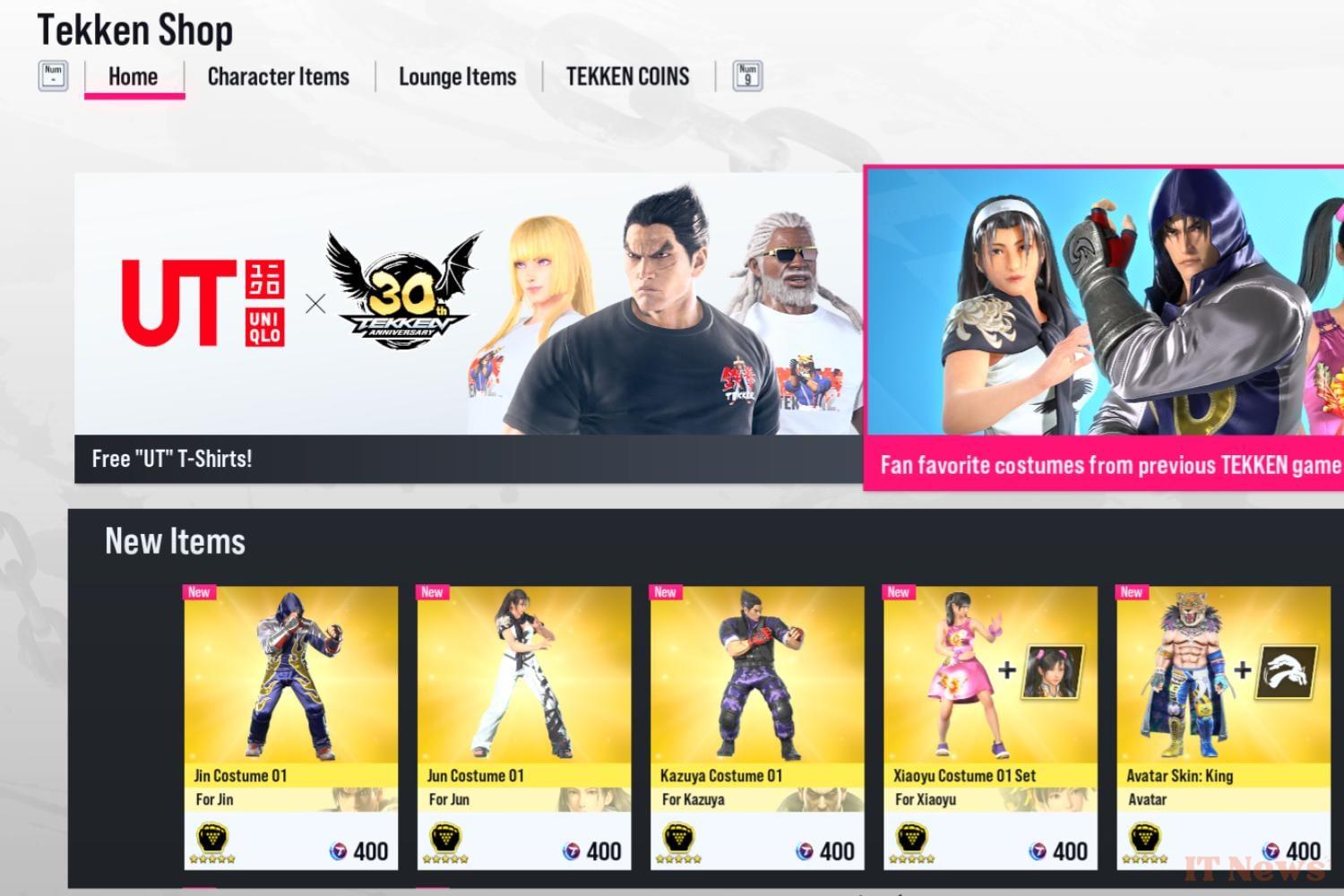
Tekken 8 recently passed the two million copies sold mark, just one month after its release on PC and console. An impressive score, especially for a fighting game — a niche that has never been particularly popular with the general public. But it’s not all rosy; for a few days now, Bandai Namco has been sinking into a nauseating controversy that erupted with the release of the Tekken Shop, the in-game store introduced in the last update.
At first glance, the introduction of this platform that offers the purchase of new customization options is not catastrophic. After all, what’s wrong with offering a few exclusively cosmetic elements, without the slightest impact on gameplay, for a few euros? The initiative even seems perfectly justifiable. Tekken 8 is a game that is meant to last, and if players want to enjoy it for as long as Tekken 7 (which still lasted almost nine years!), they have to find additional sources of income to be able to guarantee this kind of service.
This is all the more true in the current economic climate. Designing such an ambitious game and maintaining the network infrastructure is becoming more and more expensive, and this is a point that Katsuhiro Harada, the face of Tekken at Bandai Namco, has been very vocal about. He explained that the development cost was almost three times that of the last game; it is therefore a question of survival. "If we do nothing, the game will simply stop working in a few months ," he hammered home on Twitter.
So is the problem with the community? Is it a kind of collective hysteria on the part of a spoiled public who is not necessarily aware of the constraints weighing on developers? There may be some truth in that... but it's much more complicated than that.
A problem of timing
Because while the simple fact of saying the word "microtransactions" tends to make people scream, and for good reason, it's not really the Tekken Shop itself that frustrates the community so much. It's rather the way in which it was introduced. While Bandai Namco fueled a phenomenal hype in the months leading up to the game's release, the studio was careful not to mention microtransactions. No one knew that such a feature was in the works, and it was therefore a cold shower when it was announced.
Many players have therefore accused the studio of knowingly keeping this element quiet in order to give themselves time to gain as many sales and positive reviews as possible before resorting to these controversial business practices. On social media, some have even gone so far as to say that they would never have bought the game if they had been informed earlier. An argument that reeks of bad faith, but which nevertheless testifies to the fact that a whole section of the playerbase felt like they had been duped. Is this a stupid communication error, or a real strategic decision that is rather cunning? The question remains open — but the community seems to have chosen its side.
A “predatory” strategy
If opinions seem so divided, it is also because the business model of this famous Tekken Shop is quite questionable. It does not offer to buy these costumes directly; instead, it is centered around a virtual currency, Tekken Coins, which are sold in packs of 500. The problem? Each costume costs… 400 coins. Customers are therefore left with two possibilities: accept an artificial increase in the unit price, or buy even more costumes to make their investment profitable. A strategy described as “predatory” by many users on Reddit and Twitter.

And that's not the only move that has players screaming in alarm. In addition to promoting the Tekken Shop quite aggressively, Bandai Namco also seems to have launched a war against the only alternative: mods. Several creators have revealed that the videos where they present their productions were subject to copyright strikes before the release of the Tekken Shop. Many have interpreted this as an attempt to kill the modding scene in order to channel as many players as possible to their paid platform.
Are these methods justified by the economic context invoked by Harada? Perhaps... but again, it is clear that the community is not convinced by this analysis.
A problem of priorities
But these details are only the tip of the iceberg. If the Tekken Shop is attracting so much criticism, it is also and above all because it seems to have become the studio's number one priority... at the expense of other elements deemed much more important by players, starting with cheating.
It must be said that the ranked mode where players compete in the hope of reaching the top of the leaderboard is an excessively toxic environment at the moment. Tekken 8 leaves the door wide open to dishonest players, particularly through a practice called "plugging". If someone is soundly beaten and is on the verge of losing their precious ranking points, they can simply fall back on a real ejection seat by pressing Alt + F4 to close the game, thus depriving their opponent of a well-deserved victory. Add to that a few weirdos who resort to more traditional cheating methods, like macros or the famous Cheat Engine program, and the situation becomes downright untenable — especially in the higher ranks.
This was already a big problem in Tekken 7. But since the release of the new opus, the problem has taken on even greater proportions. From the players' point of view, putting an end to it should therefore be Bandai Namco's number one priority. But the studio seems totally powerless in the face of these practices that completely distort the competitive ecosystem.
The developers explained during the last Tekken Talk that they could not afford to ban cheaters directly, because they would expose themselves to legal attacks. So far, the studio has been content to reinstate some repeat offenders to the lowest rank—the equivalent of a slap on the wrist, since they can resume their misdeeds immediately.
There are, however, less contentious potential alternatives from a legal standpoint, such as awarding a player the win if their opponent disconnects mid-game, or at least fixing the disconnect rate system to avoid matches against cheaters.
These measures would be easy to implement, and could improve the situation considerably. It is therefore surprising that Bandai Namco does not seem particularly eager to address these issues. From the outside, the studio is more focused on its famous Tekken Shop. And that sends an exceedingly nauseating message to the community. On Reddit and Twitter, more and more Internet users feel like they are being treated like cash cows, despite the arguments put forward by Harada.
It will therefore be interesting to see if the studio will take its responsibilities, because otherwise, the debate is unlikely to run out of steam anytime soon. There is even a good chance that it will start up again in the near future — and more specifically, with the release of the first DLCs, which systematically bring up the debate on pay to win since the developers always refuse to let players train against the new characters unless they buy them. More in the next episode.


0 Comments