
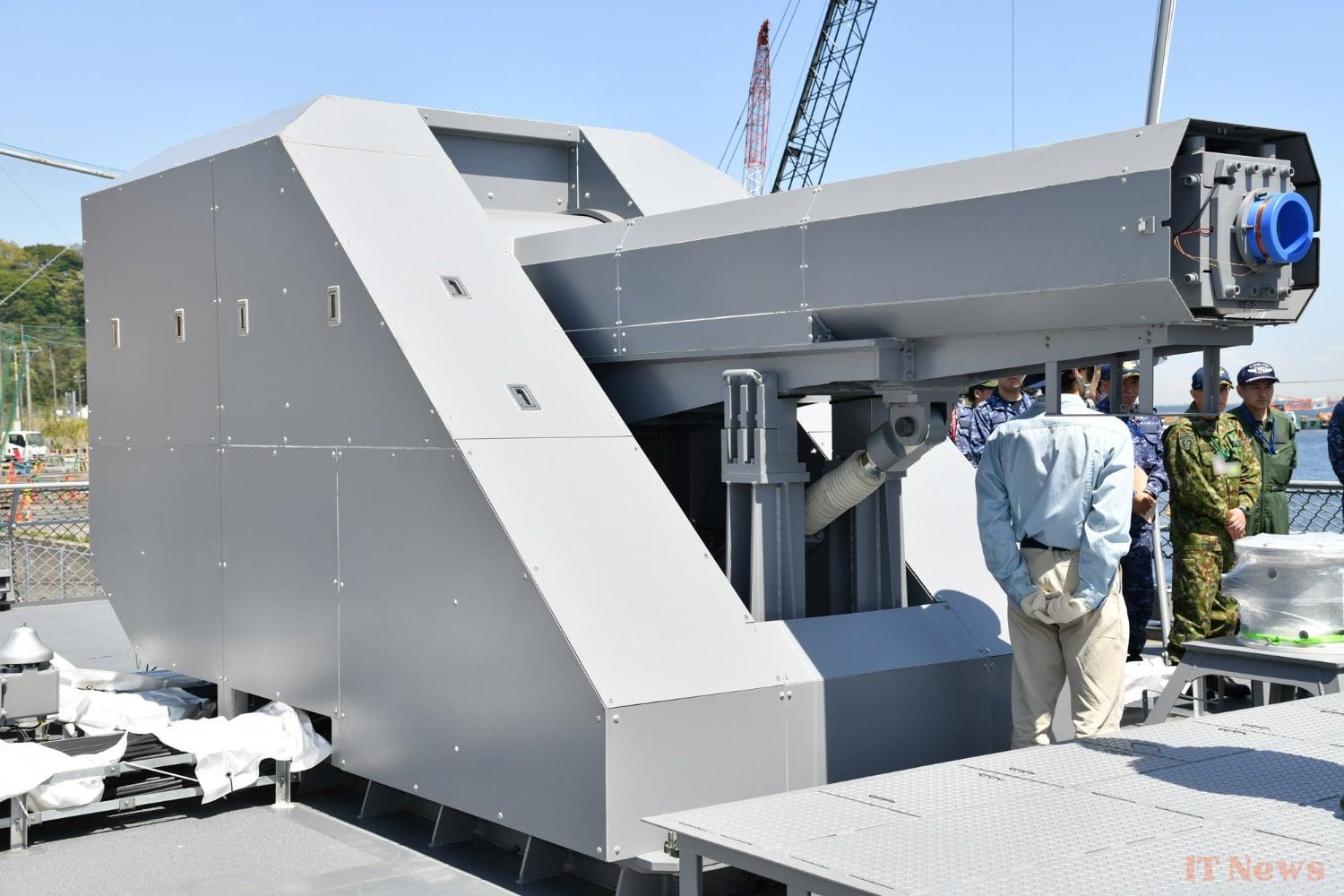
The Japan Maritime Self-Defense Force (JMSDF) has released images of its state-of-the-art railgun, which is currently undergoing testing aboard the experimental ship JS Asuka. This weapon, which is reminiscent of the world of... Minecraft (!), represents the culmination of a program launched in 2016 by the Acquisition, Technology, and Logistics Agency (ATLA).
Hypersonic Threats
The principle of the railgun is based on technology that is relatively simple to understand, even if its practical implementation is complex. Comparable to a flattened electric motor, the system uses magnetic fields to propel projectiles at extraordinary speeds, without the use of traditional explosives. This approach is reminiscent of magnetic levitation trains or the electromagnetic catapults on the most recent American aircraft carriers.
The current Japanese prototype can fire 40mm shells weighing 320 grams at speeds reaching Mach 6.5, consuming around 5 megajoules per shot. The short-term goal is to increase this power to 20 megajoules. These performances place Japan among the most advanced nations in this field, alongside the United States, India, China, Germany... and France as well.
Since 2016, Tokyo has invested heavily in this technology. This is a direct response to the threats posed by hypersonic missiles developed by China and other nations.
Unlike conventional weapons, where combustion gas pressure damages the barrel, the railgun suffers from wear caused by intense electrical currents and friction between the frame and the rails. To address this issue, engineers abandoned the original copper in favor of specialized metal alloys, allowing 120 rounds to be fired without significant performance degradation.
At sea, railguns could intercept anti-ship missiles, particularly hypersonic cruise missiles, which are difficult to counter with conventional means. Their high speed and extended range would enable a layered defense and complement ship-based surface-to-air missiles.
On land, these electromagnetic railguns could conduct counter-battery fire against deep-positioned enemy artillery, surpassing traditional howitzers in range and speed. The ATLA also envisages their deployment as coastal artillery to engage enemy ships offshore, as hypersonic projectiles are capable of piercing hulls and destroying critical compartments.
Intercepting hypersonic missiles, however, represents a major technical challenge. Unlike conventional targets, these projectiles can maneuver, making it impossible to predict their trajectory. Therefore, it is necessary to develop "smart munitions" capable of orienting themselves in flight, equipped with advanced sensors and guidance systems that react in real time.


0 Comments