
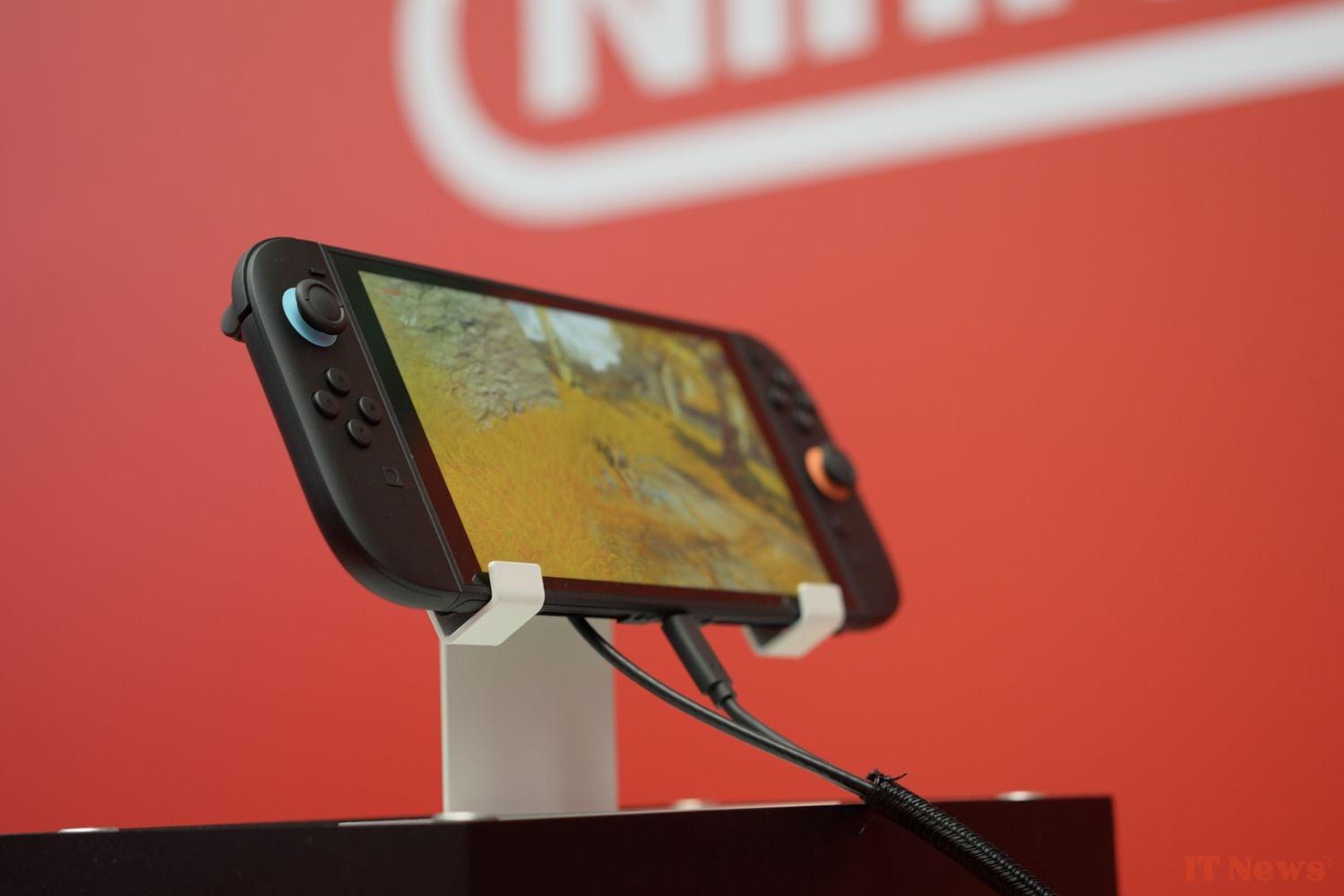
Made official at the beginning of the year, the Nintendo Switch 2 received a more detailed presentation last April. The Direct event provided more insight into the console's features and upcoming titles, but fans of technical details were left wanting more. Indeed, the Japanese company didn't elaborate on the innards of its latest console, even though the power of the Switch 2 has been the subject of numerous questions in recent months. While the first Switch was a colossal success, its limited power is often criticized, and Nintendo must definitely catch up in 2025.
Still equipped with an NVIDIA chip, the Switch 2 will be much more powerful than its big sister. However, it's difficult to know exactly how much this will change the player experience, but new leaks tell us more about the console's core. This information comes from the analysis of a supposedly official motherboard for the console, obtained on the second-hand market in China. The same market where engineering samples of processors are frequently found. The acquisition of this motherboard would have cost around 1,000 yuan, or about 123 euros.
It is important to note that the motherboard in question is not functional; it turns on but displays nothing. It is likely a defective part destined for destruction, but this does not preclude a thorough analysis. This was conducted by Kurnarl, known on X for his detailed chip reviews, and Geekerwan, a YouTuber who is adept at testing.
The heart of the beast: the NVIDIA T239 SoC
Different sources agree on Nintendo using a custom NVIDIA T239 SoC. This reference had already been mentioned by a well-known informant, Kopite7kimi, as early as June 2021. The analysis reveals several key details about this chip, starting with the fact that it is based on NVIDIA's Ampere architecture. This is the same GPU architecture found in GeForce RTX 30 series graphics cards, although in a much less powerful configuration for the console.
In detail, this SoC integrates 1536 CUDA cores and embeds 8 ARM Cortex-A78C cores, as well as 4 MB of shared L2 cache. It benefits from a Samsung 8N (8 nm) engraving and the die measures 207 mm², approximately twice the size of the Tegra X1 in the current Switch. This size is similar to that of the GA107 GPU, used in particular in the mobile RTX 2050 and based on the Ampere architecture, but this card has 2048 cores.

The T239 expected in The Switch 2 would be a derivative of the GA10F and the rest of the motherboard analysis mentions the presence of two Hynix LPDDR5 memory modules of 6 GB each, for a total of 12 GB. This memory uses a 128-bit memory bus and is rated at 8533 MT/s, although actual speeds in commercial use could be lower, as our colleagues at Comptoir du Hardware remind us.
Nintendo Switch 2 performance: what to expect?
Without knowing the exact frequencies of the SoC, it is difficult to precisely determine its power. However, Geekerwan has run a simulation using an RTX 2050 GPU, which shares the same Ampere architecture. While this simulation isn't perfectly accurate due to the uncertainty in clock speeds, it does offer an interesting estimate:
- Docked mode: The simulation suggests that the Switch 2 could offer performance close to a GTX 1050 Ti, thanks in particular to DLSS support.
- Laptop mode: In portable mode, the estimated power would be around a GTX 750 Ti.
Compared to the first-generation Switch equipped with the Tegra X1, these estimates place the Switch 2 at approximately 7 to 7.5 times more powerful. This is a considerable improvement, even if it does not correspond to the promise of "10 times more" power as announced by NVIDIA. In the game of comparisons with other consoles, we note that its graphics chip is ahead of that of a PlayStation 4, in portable and docked form, but remains far from that of an Xbox Series S. The CPU would have more difficulty standing out and would be much less powerful than that of a Steam Deck.
These leaks and analyses offer a glimpse into the innards of Nintendo's future console, but they will have to be confirmed by tests on the official console. Data may vary in real-world conditions, and there are many factors to consider, including the fact that this is a compact hybrid console. It is subject to significant thermal and power constraints, more so than standard consoles or current gaming PCs.


0 Comments