
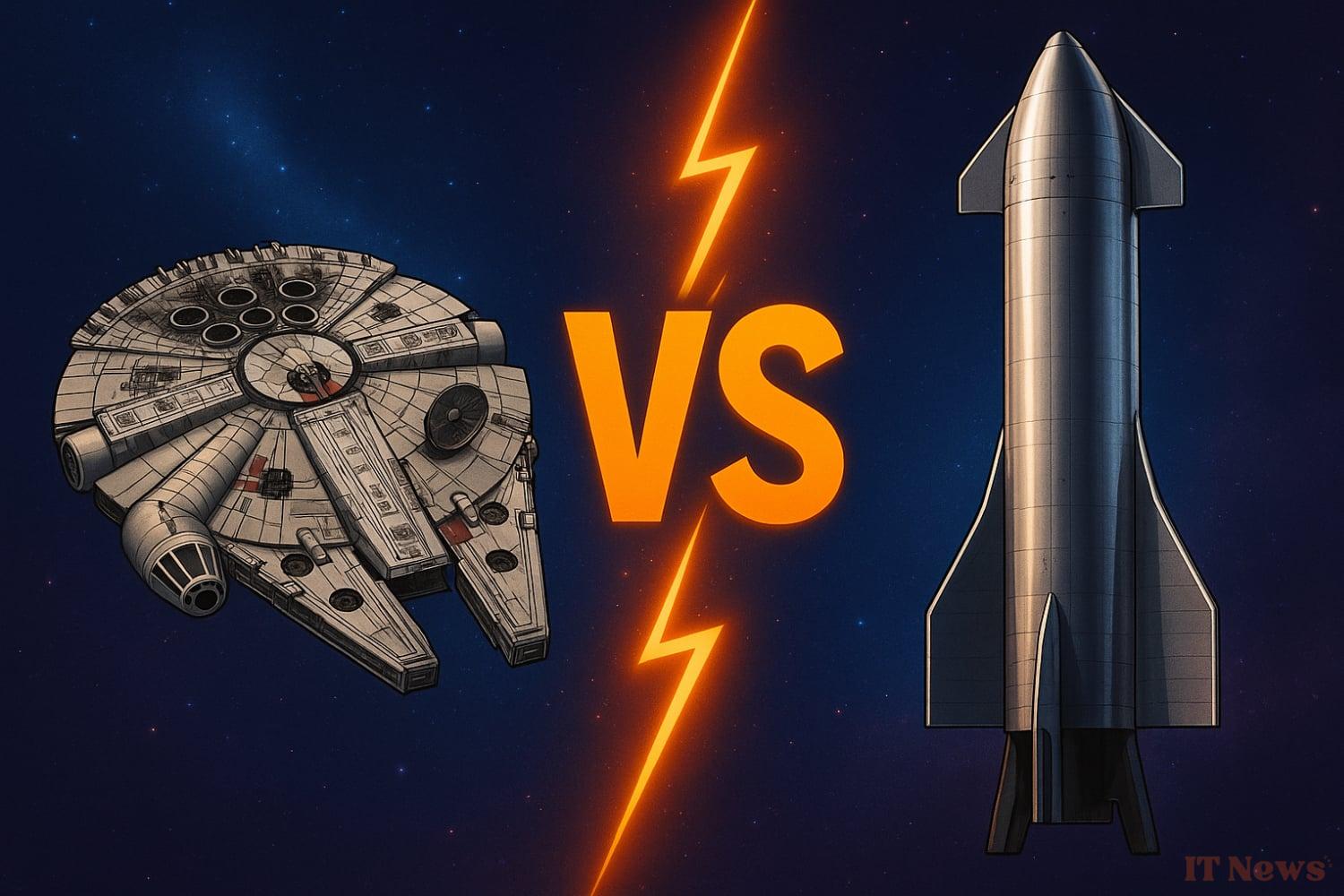
The Millennium Falcon: The Legend of Kessel
In the Star Wars universe, the Millennium Falcon is renowned for having completed the “Kessel raid in less than 12 parsecs” (a cult phrase…) but also for being a scientific puzzle. Because a parsec is a unit of distance, not time. What Han Solo really means is that his ship found the shortest route through a deadly gravitational field, a feat of piloting and technology.
In terms of pure performance, the Falcon is equipped with a Class 0.5 hyperdrive, which is much faster than the Imperial standard (Class 1). In the scale of the Star Wars universe, this allows it to cross thousands of light-years in a few hours. Suffice to say that in the real world, no spacecraft can hold a candle to it. But in reality, what exactly can we compare this speed to?
SpaceX's Starship: reality catches up (a little) with fiction
The Starship is Elon Musk's slightly crazy gamble: a 100% reusable vessel capable of transporting up to 100 people to the Moon, Mars... or even further. During its tests, the Starship reached speeds of around 27,000 km/h in Earth orbit, or Mach 22, no less. Impressive? Certainly. But on a cosmic scale, it's still very slow.
In comparison, light travels at 300,000 km per second, or more than a billion km/h. In other words, the Starship is only 0.0025% of the speed of light, whereas the Falcon, in fiction, travels light years in a few moments. We're clearly not in the same league.
Can we ever catch up with the Falcon?
The answer is simple: not tomorrow. The speeds reached by science fiction ships are based on concepts that are still completely theoretical, such as warp drives, wormholes, or the manipulation of space-time. Some researchers, such as Miguel Alcubierre, have proposed ideas for "warp" propulsion, but the energy required is still far beyond our capabilities (it would take the equivalent of the mass of Jupiter to propel a single ship).
But all is not so hopeless: there is already talk of solar sails, ion propulsion, and even probes capable of reaching Proxima Centauri in a few decades. Science is progressing, even if it moves much more slowly than fiction.
The Millennium Falcon is therefore unsurprisingly the big winner of this match. Faster, more stylish, and more armed than any terrestrial prototype. But what it embodies above all is human imagination pushed to the extreme, a fantasy of freedom and adventure that projects like Starship are humbly trying to make a reality. So no, SpaceX won't be crossing the galaxy in 12 parsecs tomorrow morning!


0 Comments