
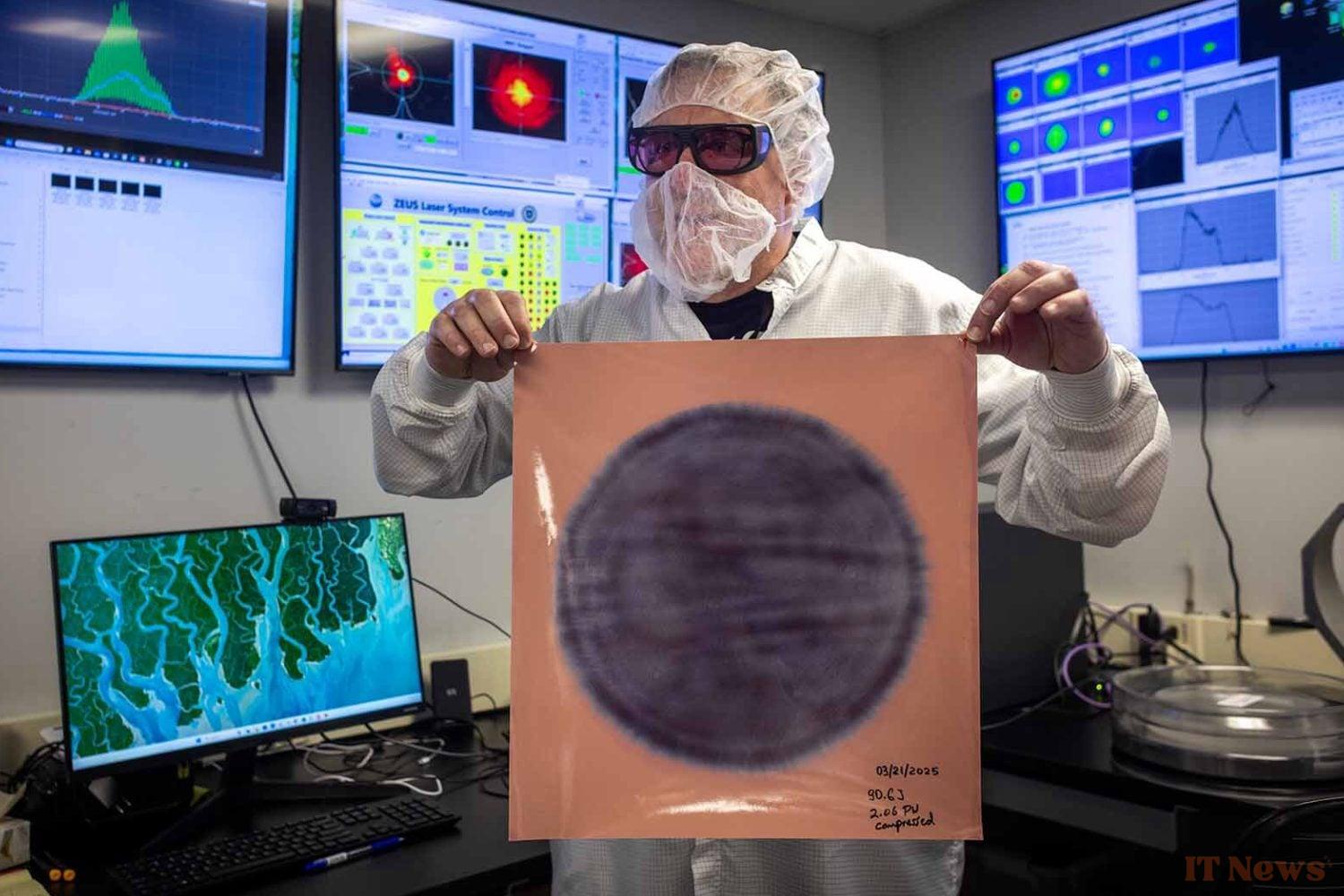
It might be hard to guess from the outside, but in a corner of the University of Michigan, a technological monster has just reached a milestone. The ZEUS laser (for "Zettawatt Equivalent Ultrashort laser pulse System") has sent its very first shot at 2 petawatts, which represents two million billion watts. For comparison, it's as if all the electricity produced on Earth were concentrated in a flash lasting... 25 quintillionths of a second. Yes, it's that brief.
A beam of light more powerful than anything else
But it's not the duration that matters here, it's the intensity. "This shot opens the way to many experiments never before attempted in the United States," explains Karl Krushelnick, who heads the center where ZEUS is located. This giant laser is open to researchers from around the world: they can submit their experimental ideas and, if they are deemed promising, come and test them on site.
Among the first to use it: Franklin Dollar, from the University of California, Irvine. He and his team want to produce electron beams as powerful as those created by enormous particle accelerators—but much more compact. ZEUS could achieve 5 to 10 times more energy than what it has already generated. All thanks to a method called "wakefield acceleration," where electrons "surf" on a wave of plasma, as if they were being pulled by a high-speed speedboat.
The heart of this power is an infrared beam that passes through a series of lenses and vacuum chambers, until it is compressed to a width of less than a micron. All this to concentrate maximum energy on a very small area. And going forward, ZEUS will be even more powerful: a sapphire crystal (doped with titanium and manufactured in over four years) will soon be installed to boost the laser to 3 petawatts. This component is nearly 18 centimeters in diameter and there are only a few of them in the world.
Since its official launch in October 2023, ZEUS has already hosted 11 experiments, involving 58 researchers from 22 institutions. And it still has power under the hood. Ultimately, the laser will be used to explore extreme physics, but also to develop new medical imaging techniques or to better understand materials. In other words, a real Swiss Army knife for curious scientists.


0 Comments