

Astronomers recently identified a new, unusual star that appears to break a number of rules and could be the first representative of a new class of celestial bodies.
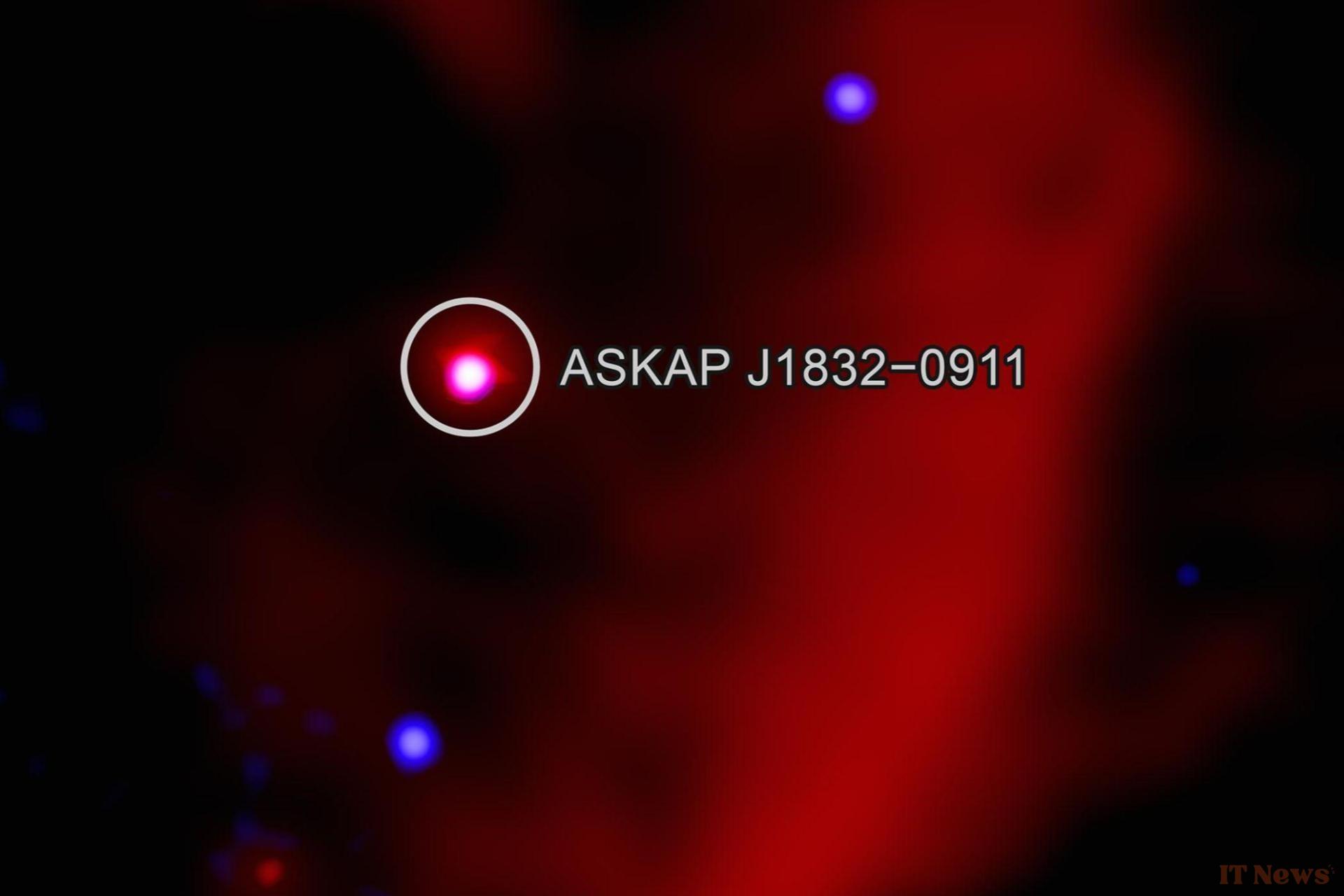
This strange object was located using Chandra, a renowned X-ray space telescope, and ASKAP, a radio telescope based in Australia. By combining observations from these two devices, a team of astronomers pinpointed an object called ASKAP J1832-0911 – and they quickly realized that it was going to give them a hard time.
Long-Duration Transient Radio Sources: A Persistent Mystery
This is what is known as a transient radio source – an object that periodically emits bursts of radio waves. Signals of this type are often associated with pulsars, neutron stars that spin at a dizzying speed while emitting a powerful stream of particles accelerated by their very intense magnetic field. Because of this enormous rotation speed, signals from pulsars tend to be very close to each other; the interval can vary from a few milliseconds to a handful of seconds.
But in recent years, astronomers have also spotted other transient radio sources with significantly longer periods, sometimes lasting up to several tens of minutes. This duration was once thought impossible, and for good reason: according to traditional theory, objects rotating so slowly should not be able to maintain the conditions necessary for the emission of radio waves!
Sources of this type have therefore found themselves at the heart of a major scientific quest that is still far from being completed. To this day, we still do not know exactly what type of object is capable of producing this type of signal. Could these be magnetars slowed down by an unknown phenomenon? White dwarfs belonging to a binary system? For now, the mystery remains – and it continues to deepen as astronomers discover signals with increasingly long periods.
Radio wave emissions… and X-rays
The discovery of J1832-0911 adds a new piece to this great scientific puzzle. Its period, measured by ASKAP, reaches 44 minutes, making it one of the slowest transient radio sources ever identified. Even if it is not an absolute record (that honor goes to GLEAM-X J0704-37, an object identified in 2024 whose signal reaches us every… 174 minutes), this figure is already enough to make it a particularly interesting target for astronomers.
But they were not at the end of their surprises, because their new discovery presents another even more exciting particularity. Using the Chandra telescope, they found that the object not only emits radio waves: it also emits a similar signal in the X-ray range, something that had never been observed before.
To top it all off, the intensity of the emissions associated with J1832-0911 dropped dramatically after several months of observation, and in both ranges. And again, this is a first. This strange mix of short-term pulses and long-term changes is unlike anything seen in our galaxy to date.
As usual, the astronomers behind this observation tried to determine what kind of celestial body could behave in such an atypical manner. And as with other long-period transient radio sources, they initially hit a wall. The characteristics of the radio signal, for example, seem incompatible with the magnetar hypothesis.
That of the pulsar or the white dwarf belonging to a binary system also seems unlikely. The intensity of the signals associated with these pairs is generally much greater than what the authors of the study observed in the case of J1832-0911. To make this scenario coherent, J1832-0911 would indeed have to have the most powerful magnetic field ever observed in a white dwarf in our galaxy.
A phenomenon never before identified?
In conclusion, it is therefore possible that an unknown phenomenon is affecting the behavior of the object at the origin of this signal... or even that we are in the presence of a new type of celestial body never before documented.
It will therefore be interesting to look into the future work that this fascinating discovery will undoubtedly generate. With any luck, J1832-0911 will finally allow astrophysicists to better understand the origin of these strange radio signals, and by extension, to gather valuable new information about the workings of our universe.
The text of the study is available here.


0 Comments