
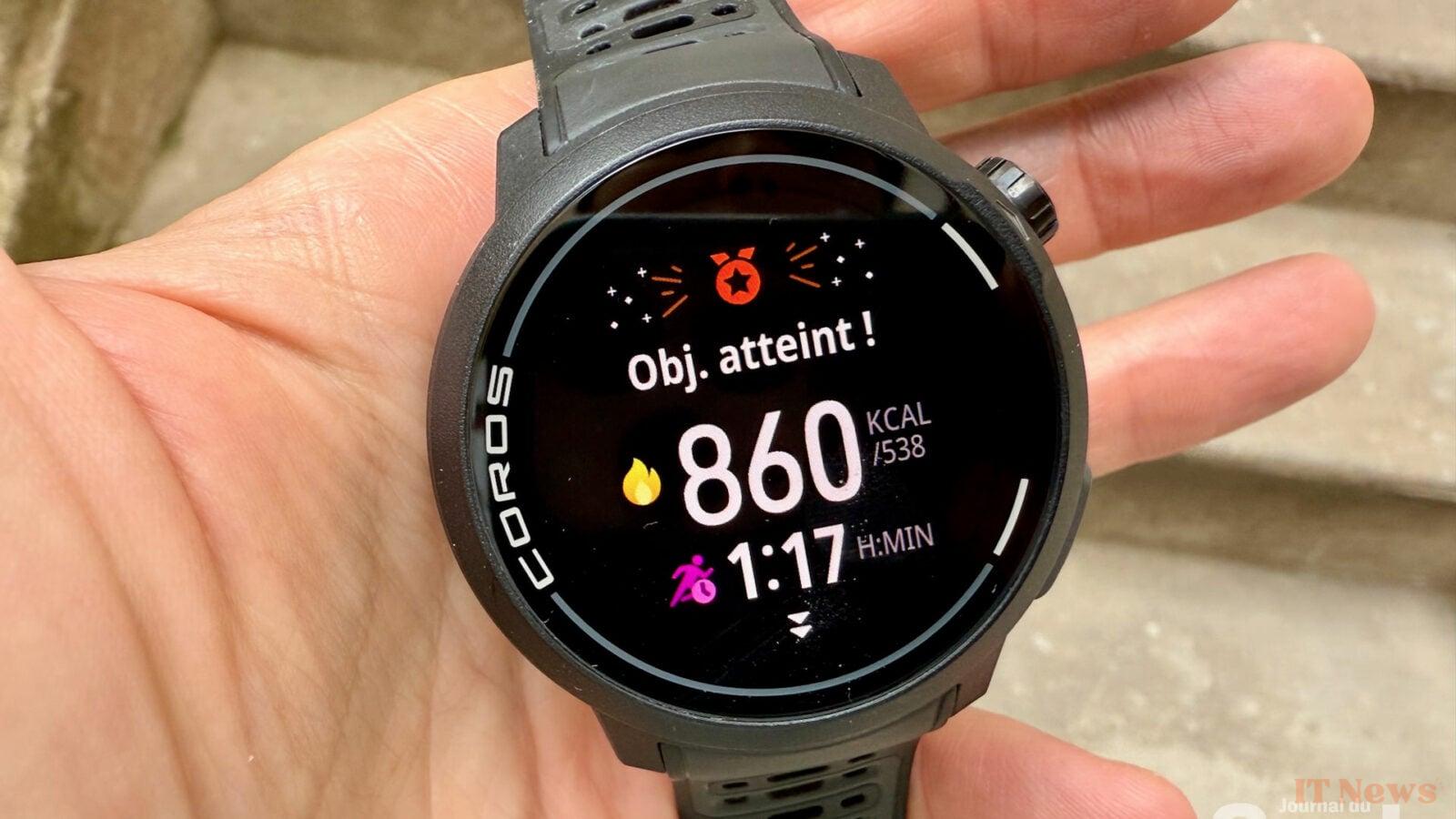
With the Pace Pro, Coros is continuing its strategy: offering comprehensive watches, designed for performance, at affordable prices. This new model is positioned between the Pace 3 and the Apex 2, and introduces for the first time in this range an AMOLED screen, onboard mapping and a generous storage space (32 GB). In short, the Pace series is getting serious.
The 1.3-inch screen is not the brightest on the market (1500 nits, compared to 3000 for an Apple Watch Ultra 2 but 1000 nits for the Garmin Fenix 8), but it does the job perfectly and remains easily readable in all circumstances, including in bright light. We should praise its reading comfort, the color rendering, the fluidity of the transitions and the energy savings enabled by dark backgrounds. No wow factor, but a controlled display.
A watch made for long outings
The real surprise comes from the battery life. As is often the case with Coros, the promise is kept, and even exceeded. In daily use (notifications activated, sleep tracking, 4 to 5 weekly workouts), the watch easily lasts around ten days. In dual-frequency GPS, it reaches up to 38 hours. In simple GPS mode, it's more than 70 hours. Few competitors with AMOLED screens do as well.
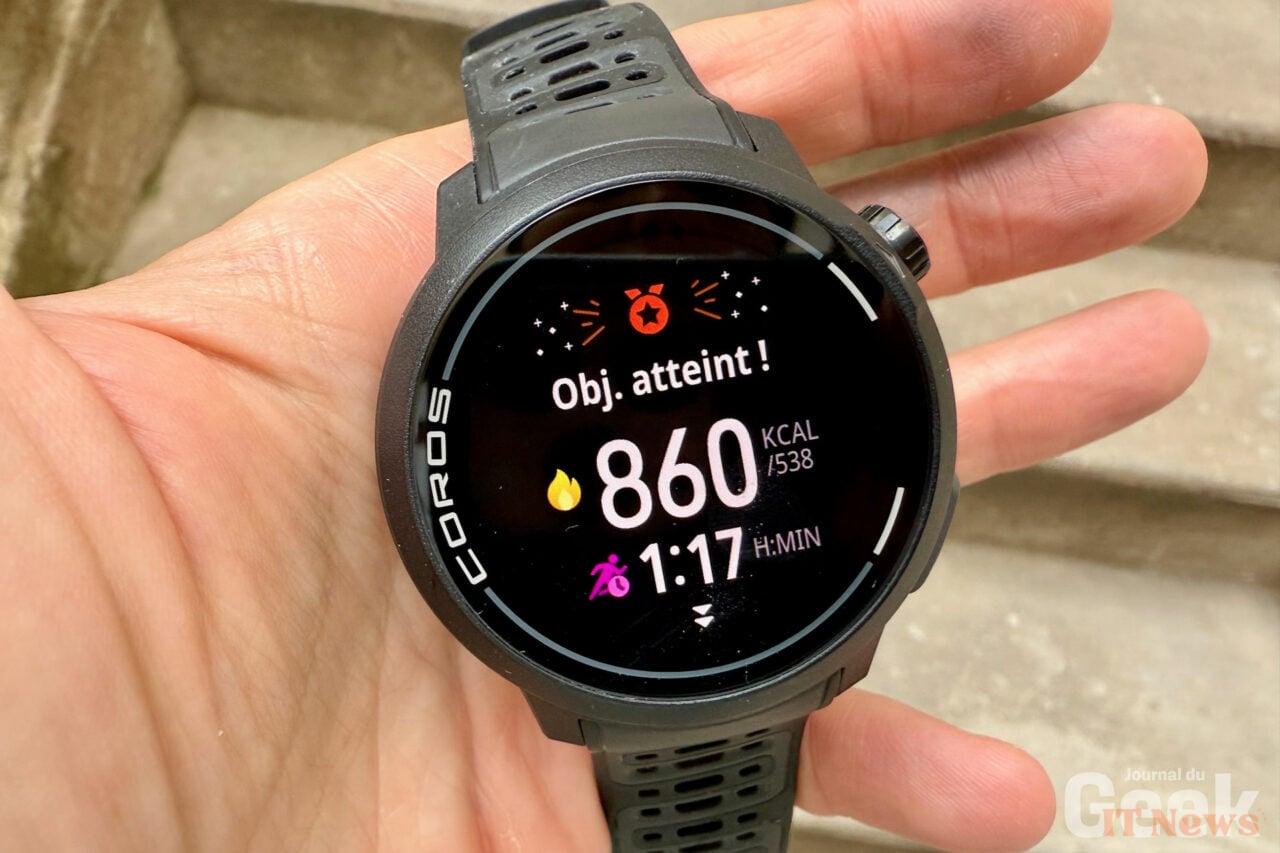
This is a key selling point for trail runners, hikers, or long-distance cyclists. No need to recharge every three days, nor to worry about running out at the end of the race. Add to that a fast recharge (less than 2 hours for a complete cycle), and you get a truly durable watch. Note that the little accessory for recharging it is very clever. Integrated into a key ring "cover", you can take it everywhere with you. Simply plug in a USB-C cable and connect the watch to recharge.
Simple and effective ergonomics
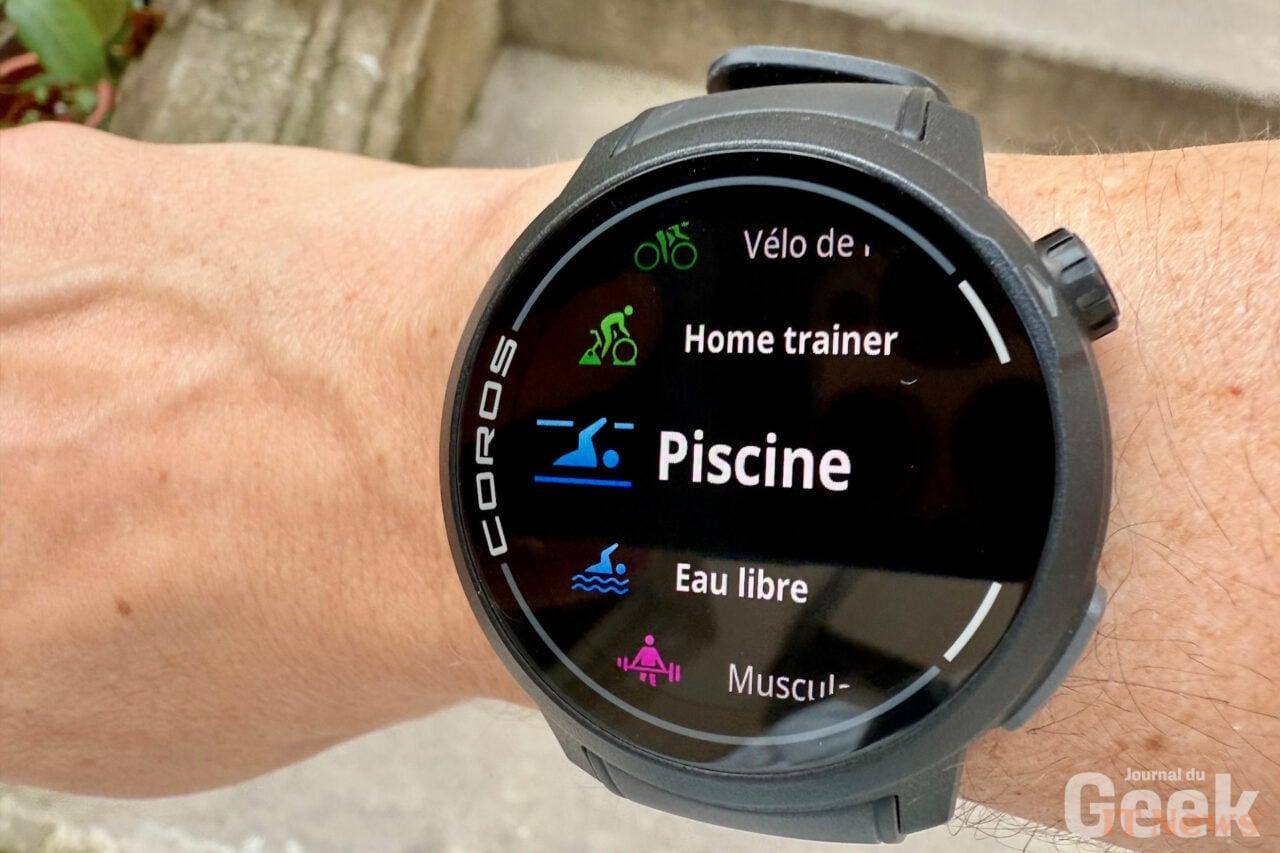
The dial + button system works perfectly, but you can also operate the watch via the touch screen. Navigation is fast, fluid, and works even in the rain (or with gloves). Coros has kept a minimalist but well-designed interface: weather widgets, daily summary, live heart rate, battery level, everything is accessible in two gestures.

During activity, the screens are customizable as desired: number of fields, display order, color, alerts. Even during a 4-hour trail outing on technical terrain, we were able to follow the data at a glance, without complex manipulations. The only downside is that the training load automatically restarts from zero every Monday, which can frustrate athletes who prefer rolling or monthly tracking. An option to customize the tracking period would be welcome for those who want a more detailed analysis of their progress.
Reliable GPS, welcome mapping
The Pace Pro incorporates a dual-frequency GPS, which improves accuracy in difficult areas: dense forests, deep valleys, urban areas. In the field, the lines were clear, with very little drift. The pace remained stable, even during fast intervals.
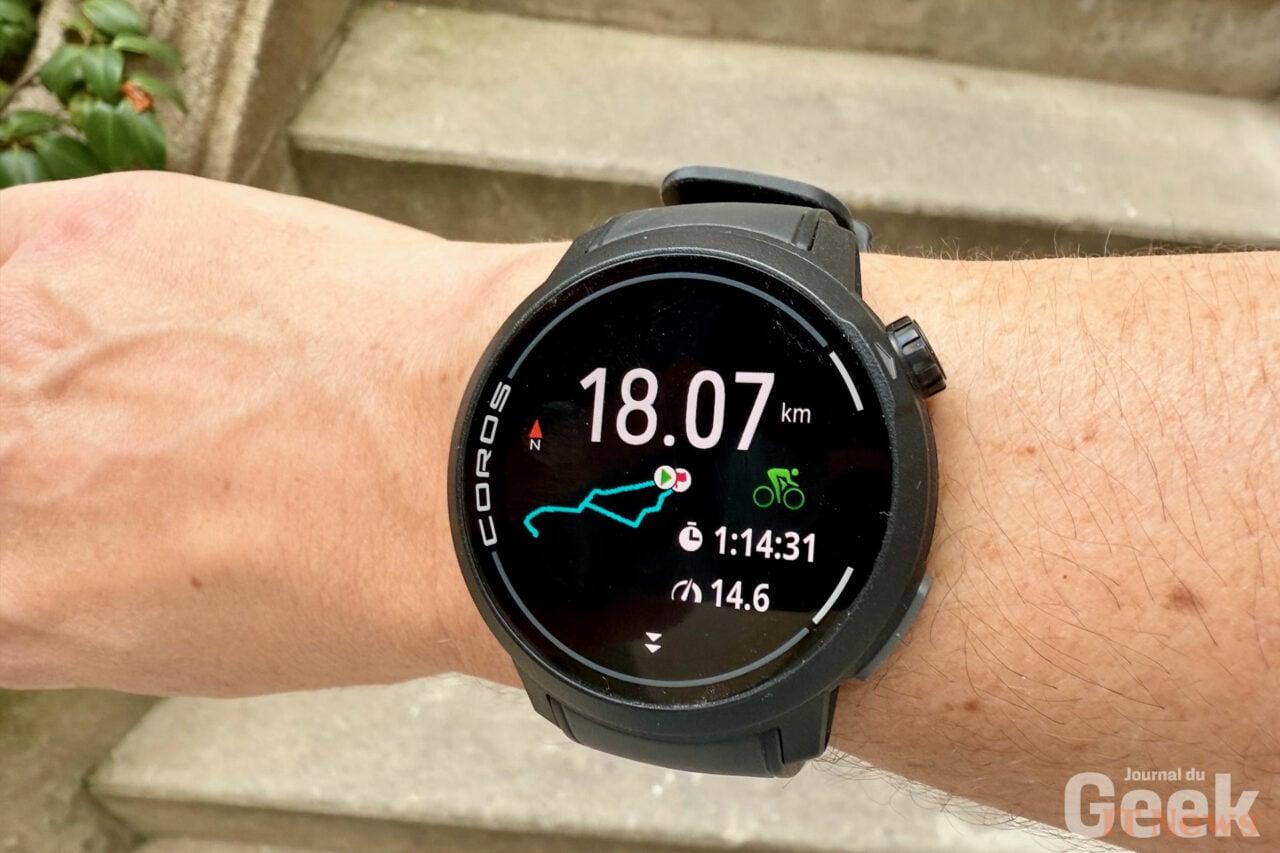
The big new feature is the onboard mapping. You can load topographic maps from the Coros app (via Wi-Fi) and follow a pre-recorded route. Navigation isn't dynamic (no recalculation), but you're notified if you go off-track. This is enough to get your bearings on a GR or mountain bike loop. Zooming is done using the wheel, and the screen remains readable even when moving.
Generally reliable sensors
Sensors have the essentials: optical heart rate, barometric altimeter, accelerometer, compass, and thermometer. The heart rate is consistent at a stable pace, but as is often the case with this type of technology, it remains less reliable during rapid variations or very intense sessions. During an interval test, we noticed a difference of 5 to 8 bpm compared to a Polar belt, the market benchmark.
On the other hand, altitude tracking is accurate, especially when trail running or hiking. The cumulative elevation gain matched the data from my reference watch, with a very small margin of error. The sleep tracking and automatic effort detection are decent, without reaching the precision of some competing ecosystems.
An ecosystem in constant improvement
The Coros app has improved a lot. It includes activity history, performance by heart rate zone, training load, estimated recovery, and more. It also offers a real tool for creating complex workouts. In two minutes, you can create a 3 x 10-minute threshold workout with warm-up and cool-down, and send it to the watch.
The app also lets you load GPX routes, manage maps, modify watch faces, and adjust settings. Synchronizations are fast, and exports to Strava and TrainingPeaks are automatic.
What's missing? Still no music player or contactless payment. The watch doesn't offer podcast or offline playlist management. Too bad for runners who like to go without gadgets.
Who is this watch for?
Those who run regularly (2 to 5 times a week), who want to track their progress without breaking the bank, and who appreciate a readable, durable, and lightweight watch. It will be perfect for road runners, hikers, beginners to experienced trail runners, and even triathletes thanks to its numerous multisport profiles. On the other hand, ultra-data geeks or runners looking for music on their wrist will have to turn to more complete (and more expensive) models.
Specifications
- Screen: 1.3″ AMOLED (260 x 260 px, 1500 nits)
- Battery life: up to 20 days (38 hours in dual-frequency GPS)
- Sensors: Dual-frequency GPS, altimeter, compass, thermometer, optical heart rate sensor, accelerometer
- Storage: 32 GB
- Mapping: topographic (offline)
- Weight: 49 g (with silicone strap)
- Water resistance: 5 ATM
- Price: €349


0 Comments