

The App Store generates hundreds of billions of US dollars in spending each year. A boon for developers looking to generate money from iPhone owners. But what about the commission Apple receives on transactions?
406 billion US dollars. That's the amount generated by sales and billing of products and services through the App Store in 2024 alone in the United States, according to an Apple-funded study conducted by Professor Andrey Fradkin of Boston University's Questrom School of Business and economist Jessica Burley of Analysis Group.
It's worth noting, however, that this impressive number doesn't just include app purchases and in-app transactions. It encompasses absolutely all revenue generated by the ecosystem, including Uber Eats orders, ride-hailing reservations, and advertising revenue. Most of this US$406 billion is therefore not subject to the famous commission charged by Apple, because it concerns activities that are not subject to it. “For more than 90% of the billing and sales generated by the App Store, developers have not paid any commission to Apple,” the company specifies.
iPhone owners spend like crazy
Apple receives a commission on the sale of digital goods and services: paid apps, subscriptions to a streaming platform, in-app purchases in an app or game, etc. This amounts to 30% for the most popular apps and 15% for the smallest. This is why publishers want to avoid it by bypassing the App Store payment system. Epic Games recently won a major legal victory on this issue. For the sale of goods and services (purchasing a product on Amazon, meal delivery, etc.) or for advertising, this tax is not applied.
“Over the past five years, the size of the App Store ecosystem has nearly tripled, from $142 billion in 2019 to $406 billion last year, and revenue from US-based developers has also more than doubled. Smaller developers, in particular, have performed exceptionally well, with revenue increasing by 76% between 2021 and 2024,” Apple announced, citing the results of the study.
It should be remembered that the iPhone market share in the United States is much higher than in the rest of the world. Across the Atlantic, more than one smartphone sold bears the Apple logo on the back. iPhone users also have a wealthier profile and are more likely to spend money on their mobile, whether on paid app purchases, in-game microtransactions, or on products and services. This is why iOS and the App Store are often the priority for developers: they know that it is easier to monetize their platform with Apple consumers than with those on Android.
Consumer trends are emerging
By communicating such performance, Apple is clearly trying to remind people that there is no better ecosystem than its own to make money for app developers. The firm also makes sure to point out that it continues to work to facilitate the distribution and visibility of applications and teases new features to personalize its product page.
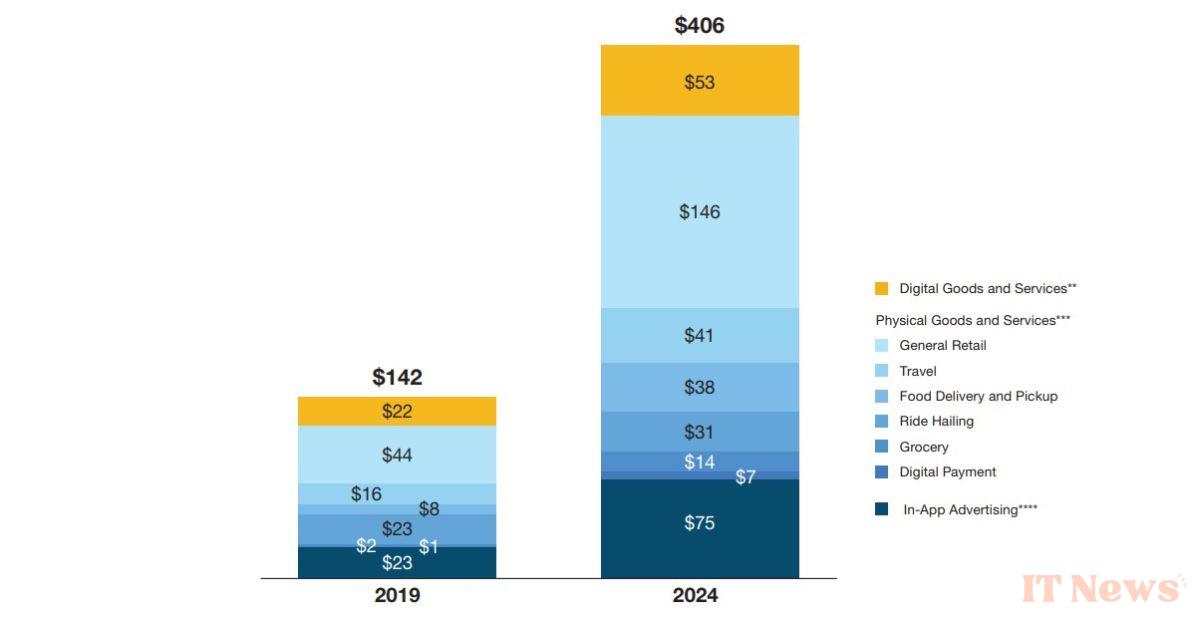
Of the 406 billion US dollars generated on the App Store last year, 277 billion came from from billing and sales of physical goods and services, $75 billion from in-app advertising, and $53 billion from digital goods and services. “Key drivers include growth in food and grocery delivery, entertainment, and enterprise applications,” the report notes.
“Since 2019, spending on physical goods and services has more than tripled, while spending on digital goods and services and in-app advertising has more than doubled,” we learned. Spending on travel and food delivery and pickup has outpaced that of ride-hailing, we observed. Productivity, education, and business apps have also seen strong growth. But it is still the gaming category that has recorded the highest revenue over the period.


0 Comments