
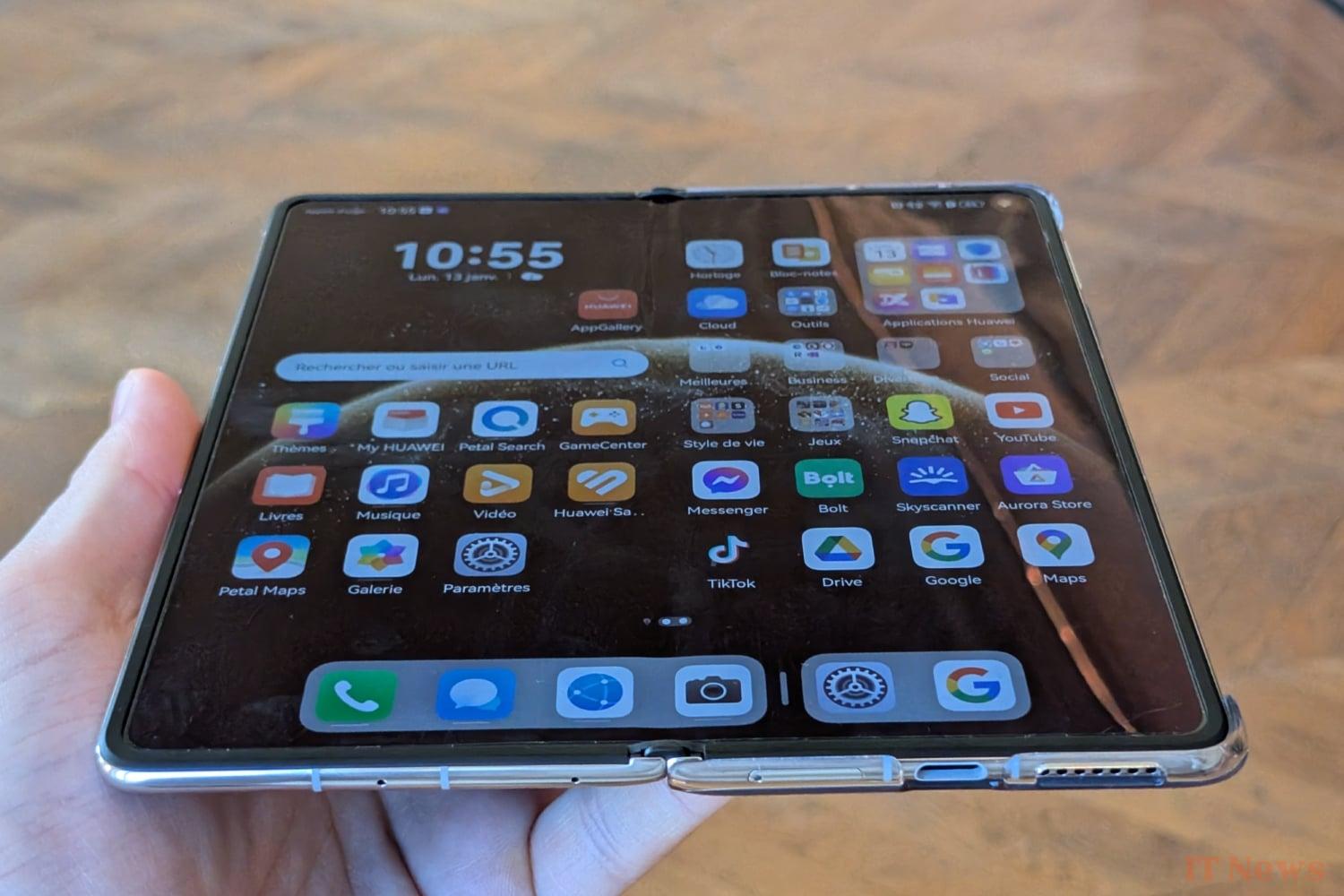
Huawei is trying its hand at the folding smartphone adventure in France, as we already knew, with the Mate X6. It will cost a whopping 2,000 euros and will be one of the thinnest (4.6 mm) and lightest (239 g) folding smartphones on the market.
We were able to get our hands on it in Paris during a press presentation organized by the Chinese giant. Here are our first impressions.
Design: our Pixel 9 Pro Fold pales in comparison
As luck would have it, we happened to go to Huawei's event with the Pixel 9 Pro Fold, Google's first folding smartphone sold on the French market. It has been with us for several months and let's be clear: the Huawei Mate X6 made us realize how bulky it is.
The thinness of the Huawei is just as impressive as on an Honor Magic V3. In addition, the grip is made much more pleasant by the presence of rounded edges.
A word also on the new hinge which seemed to us to be the perfect combination of robustness and flexibility. The fold is also easily forgotten. In short, it is a beautiful piece of work.
Impressive on the colorimetry
During our handling, we were able to take a few shots using the trio of photo modules on the back of the device (ultra wide angle, wide angle and telephoto lens equivalent to X4). And surprise, the one that interested us the most is a fourth module, which completes the photo block, called Ultra Chroma.
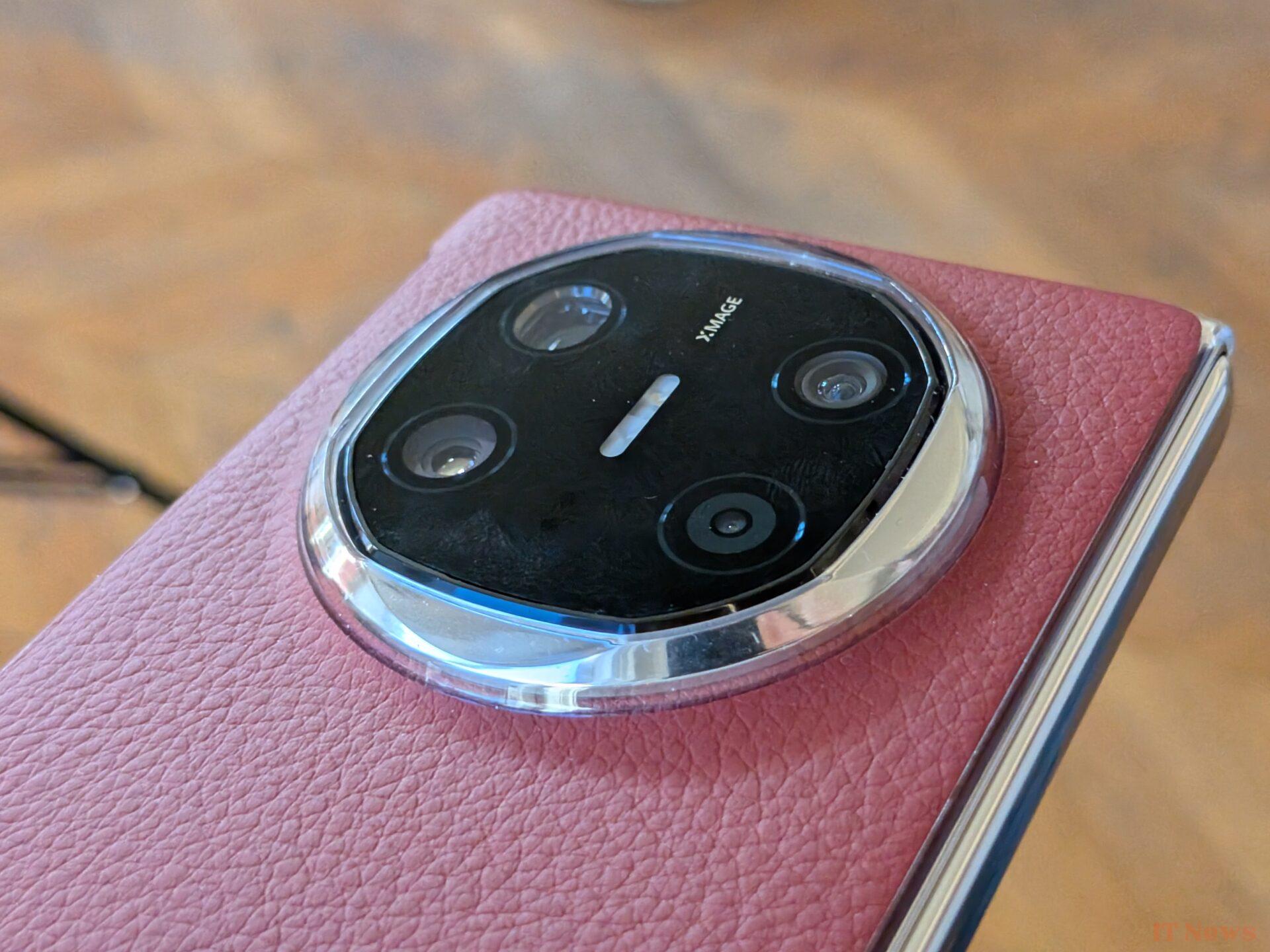
Its technical operation still seems a little cryptic to us, but the idea is this: it is a photo module specialized in capturing all the nuances of colors. It assists the photo modules, which are specialized in capturing light. Everything was put through the mill of Huawei's algorithms for a result very close to reality and therefore very natural. We were able to try it on half a dozen subjects and we were quite convinced by the result.
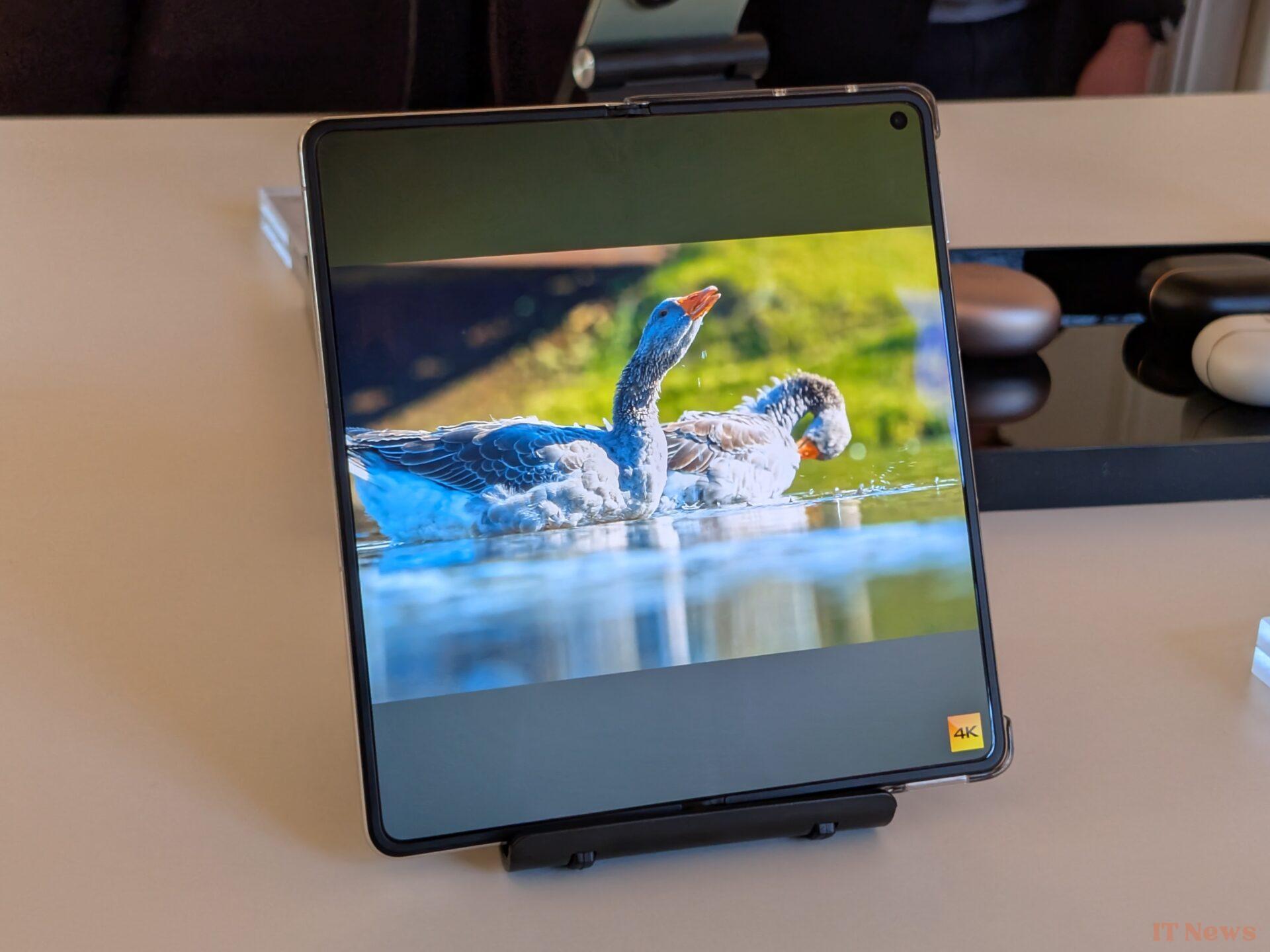
Beyond this insolent ability to reproduce colors, the rest of the photo experience seemed to us to be up to the standard of the Chinese giant. The sharpness seemed excellent, the fluidity to move from one module to another very impressive, without any jerks and with great colorimetric consistency between each module. In addition, the preview of the scene on the phone's screen corresponded strongly to the final result, despite a small passage in post-processing.
For the first time, Huawei openly talks about Aurora
Another important point to emphasize during the presentation organized in Paris, the Huawei teams dared to mention the elephant in the room. For the very first time, Huawei has highlighted an alternative to access Play Store apps, Aurora, an alternative app store developed in open source.
The fact that Huawei is talking about it shows several things. First: it allows this solution to be institutionalized. Second, it shows that Aurora looks less and less like a hack and more and more like a viable alternative. Third: the brand's ambitions on smartphones have returned to their highest level. For a few years, Huawei had lowered its sails, perhaps the time has come to try to convince again, despite the embargo.
Despite this good point, Huawei continues to market its folding smartphone with an outdated OS: EMUI 14, based on Android 12. As a reminder, the smartphone world is moving to Android 16. The Chinese brand seems determined not to import its new interface, HarmonyOS NEXT. At least she has the courage to try something with Aurora.
A Kirin chip engraved in 7 nm and no 5G
It would be good if they could do the same for their chip. In a balancing act to which Huawei teams have unfortunately accustomed us, the person responsible for the official presentation of the product refused to name the chip that equips the Mate X6. Imagine: selling a smartphone for 2000 euros and refusing to give the name of the central element that drives everything else…
This is of course a Kirin 9020, a chip engraved in 7 nm. This engraving finesse is undoubtedly the reason why Huawei does not want to communicate on the subject, since it finds itself far from the standards of the genre, which now reach 3 nm.
As usual, Huawei is once again paying the price of the embargo that weighs on it. And the penalty is double: in addition to lacking energy efficiency, the device must also pass its turn on 5G and be satisfied as best it can with 4G connectivity.


0 Comments