
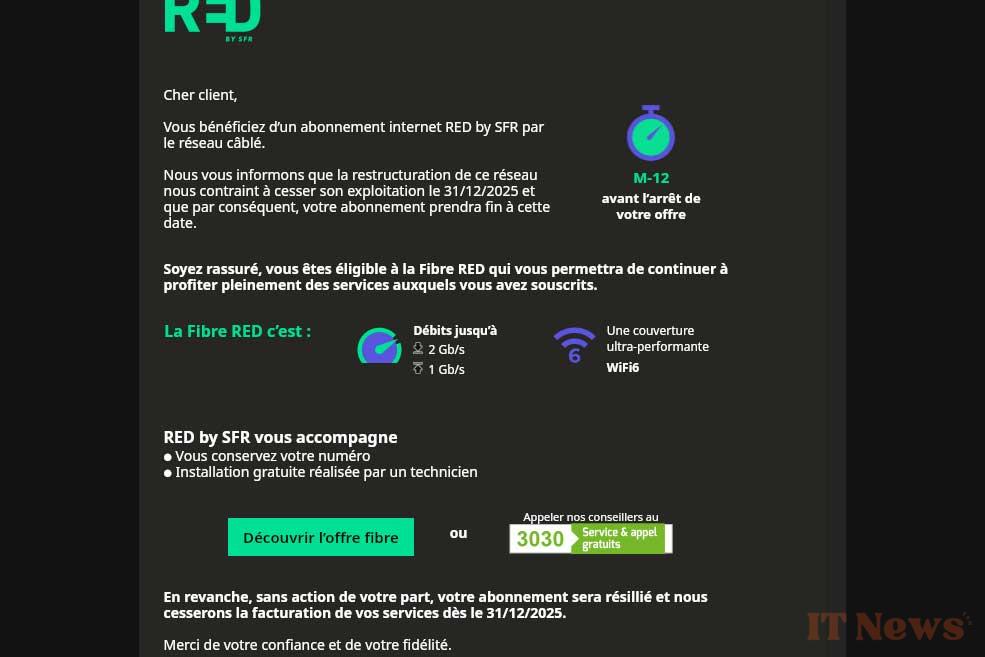
The end of the coaxial network is becoming clearer at SFR and is becoming concrete for the last FTTB subscribers. The Internet access provider no longer wants to keep track of the legacy of Numericable (purchased in 2014) and is warning customers of the end of the operation of its FTTB (Fiber to the Building or coaxial) network. “You benefit from a RED by SFR internet subscription via the cable network. We inform you that the restructuring of this network requires us to cease operations on 12/31/2025», we can read in an email sent to a customer.
After this date, the subscription will end and the customer is encouraged to switch to SFR or RED fiber to continue to benefit from the services. With the operator with the red square, fiber can climb up to 8 Gb/s symmetrical “subject to eligibility” with the Premium formula and up to 2 Gb/s shared for downloading and 1 Gb/s for sending via RED. Finally, customers who are not in an area covered by SFR fiber will have no choice but to subscribe to an offer from another ISP.
It's (finally) the end of the «fake» fiber at SFR
SFR's competing operators, Free, Orange and Bouygues, use fiber optic technology to the subscriber's home, or FTTH (Fiber to the Home). In concrete terms, the optical fiber is pulled into the subscriber's home to allow them to benefit from very high internet speeds.
SFR, on the other hand, has long used a different technology, called FTTB (Fiber To The Building) or FTTLa (Fiber to the Last Amplifier). In this case, the optical fiber was pulled to a distribution point located in the neighborhood, then the signal was routed to the subscriber's home. via a coaxial copper cable. This method, inherited from Numericable, allowed fiber to be deployed more quickly, but it offers lower speeds than FTTH.
A situation that prompted SFR's competitors to denounce this practice, considering it to be a "false fiber". Indeed, the maximum theoretical downstream speed of FTTB/FTTLA is lower than that of FTTH, and the upstream speed is also more limited. In addition, it is more sensitive to electromagnetic interference than FTTH. SFR was finally condemned by the courts for having demonstrated a lack of clarity on the way in which some of its customers are connected. Since then, SFR has modified its strategy by offering FTTH offers and using the term Very High Speed (THD) to designate its coaxial fiber technology. According to Arcep, fewer than 600,000 customers had a cable subscription in the second quarter of 2024.
Faced with this decision, customers have no choice but to migrate and some subscribers are now asking questions. X user Adrien Linuxtricks (@_adriend_) wonders whether he will be able to keep fullstack IPv4 or bridge mode.


0 Comments