

Shaken in recent years by the dazzling democratization of SSDs, with ever more affordable prices and ever-increasing capacities, hard drives have not yet had their last word. The few manufacturers still present on this market continue to innovate, their research allowing them to push back again and again the physical limits of this storage medium that has been announced many times at the end of its life.
While they have indeed given way to SSDs in fixed or portable consumer configurations, hard drives continue to be useful in certain specific cases, thanks to their unbeatable capacity/price ratio when it comes to large volumes. For example, we are thinking of “cold” data storage that does not require speeds of several GB per second or extremely low access times, as well as all cases where the demand for storage space is in the tens or hundreds of TB – or even more, such as data centers – and where the cost of SSD would be prohibitive.
New technologies for ever greater capacities
Western Digital has thus presented to its investors its roadmap for hard drives for the coming years. We learn that the manufacturer plans to massively adopt heat-assisted magnetic recording (HAMR) by the end of next year, with volume production starting in 2027.
This technology will make possible the arrival of models with a capacity of 36 TB using conventional magnetic recording (CMR), and up to 44 TB with multiple surface recording of the UltraSMR type (Shingled Magnetic Recording). Already used by some hard drive models on the market, this recording method sacrifices writing performance in favor of an increase in data density, by slightly superimposing the tracks on the hard drive platters. The manufacturer adds in passing that HAMR is already in large-scale testing phases at two of its customers, without providing further details.
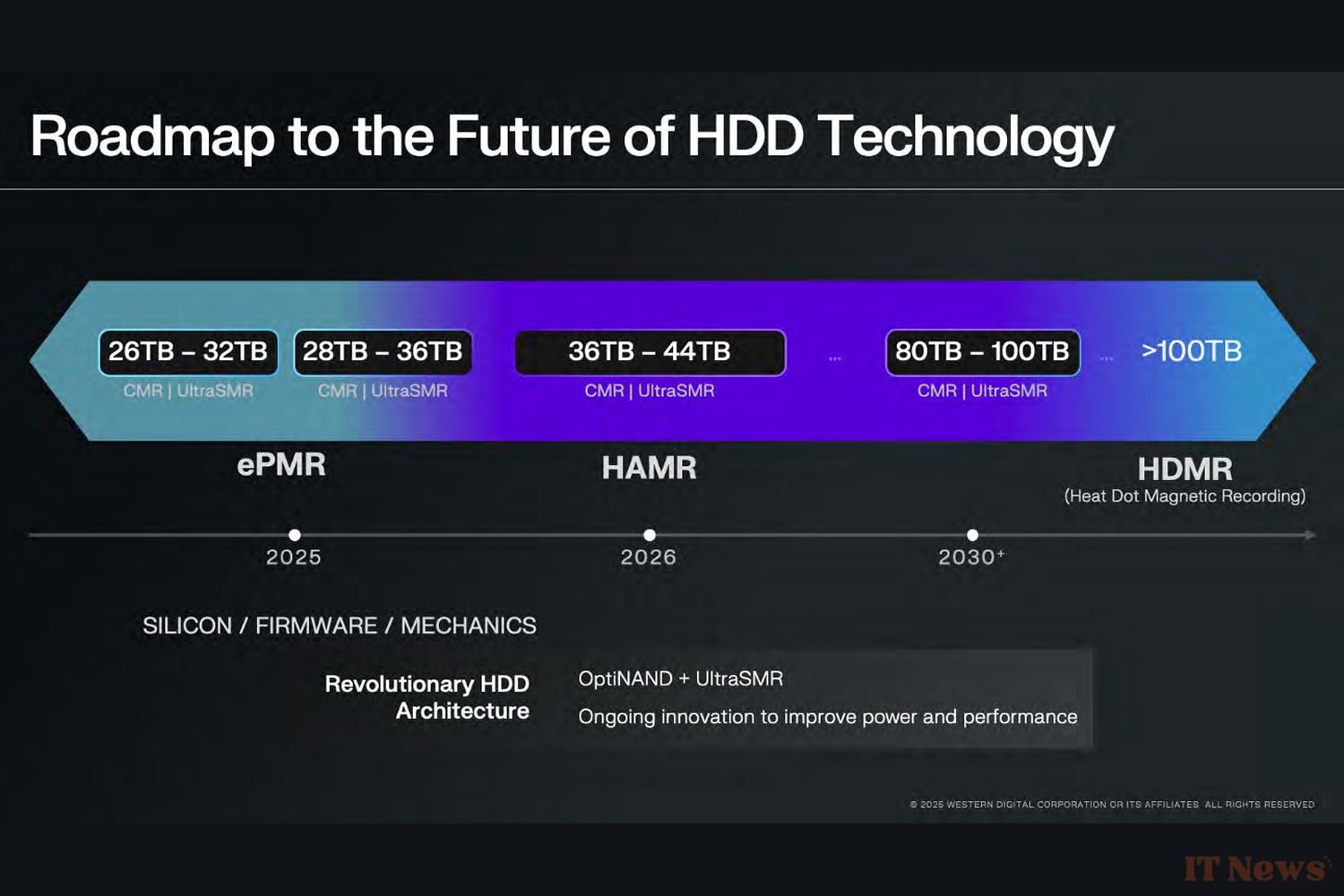
Western Digital should then switch to another technology, HDMR (Heat Dot Magnetic Recording), to reach 80 TB to 100 TB around 2030. However, such capacities will require adapting the architecture itself physical storage, with in particular the use of OptiNAND, a technology from the manufacturer based on flash memory intended to store various metadata. As always, this is a long-term vision that will inevitably evolve according to the progress of research and the evolution of the market.
Source: Western Digital


0 Comments