
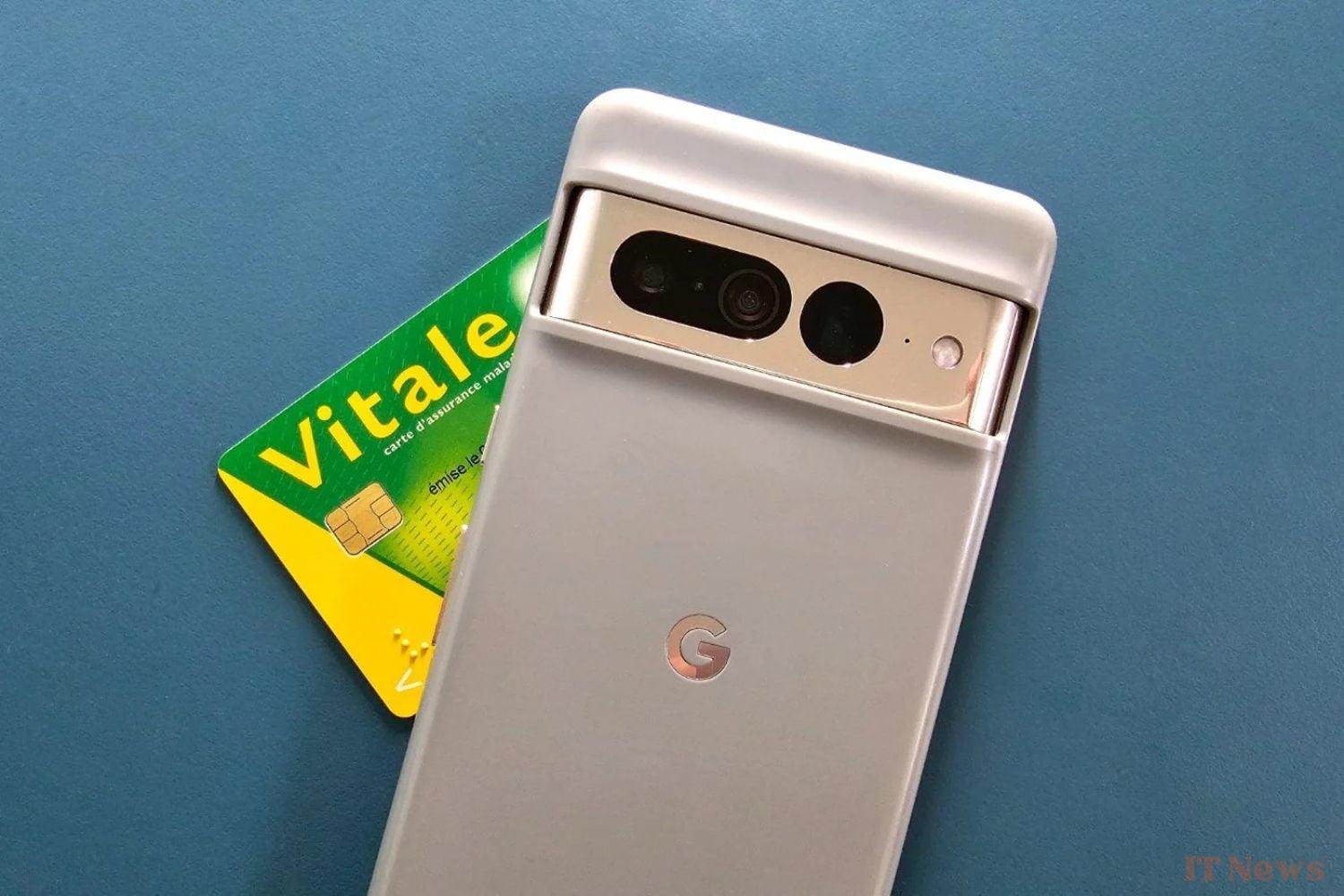
If you forgot your health card when you went to the doctor, don't panic: you can now do it via your smartphone, thanks to a dedicated application, subject to a few conditions. Since the beginning of March 2025, it has been possible throughout France to activate the Carte Vitale application, a way to request coverage of your health costs, to identify yourself to a doctor, and to track your reimbursements.
But this application is not yet open to everyone: once it has been downloaded on Android or iOS, you will need to go through several steps that could prove restrictive.
First option: go through France Identité
First option: you must first install and activate the France Identité application on your smartphone and have a biometric national identity card (CNI).
The Carte Vitale application, installed on your smartphone, will then go through the France Identity app to verify your identity. In concrete terms, you will first need to scan your identity card with your phone, enter your verification code, start the contactless reading of your CNI (via NFC communication), and add a new security code that will be used to unlock the application.
Second possibility: take a selfie
Second possibility, especially if you do not yet have this CNI in bank card format, you can verify your identity via “biometric identification processing” – a selfie, and an identity document (such as a passport or an identity card). Please note that this feature is still being rolled out: it is only available in 23 departments, but is set to be extended throughout France by the end of the year.
We just did the test on Tuesday, March 11: without a biometric identity card and without being located in these 23 departments, it was impossible for us to install the application, which states: "We are working to open this service to everyone. The Vitale card app will soon be available for you».
But if you are part of the following departments, it should work:
- Ain (01)
- Allier (03)
- Alpes-de-Haute-Provence (04)
- Alpes-Maritimes (06)
- Ardèche (07)
- Bas-Rhin (67)
- Bouches-du-Rhône (13)
- Cantal (15)
- Drome (26)
- Hautes-Alpes (05)
- Haute-Loire (43)
- Haute-Savoie (74)
- Isère (38)
- Loire (42)
- Loire-Atlantique (44)
- Puy-de-Dôme (63)
- Rhône (69)
- Saône-et-Loire (71)
- Sarthe (72)
- Savoie (73)
- Seine-Maritime (76)
- Var (83)
- Vaucluse (84)
You will then be asked for a selfie and proof of identity. You will also need to choose a six-digit secret code.
Another condition: the healthcare professional must be equipped
Once activated, you can present it at the pharmacy or at the doctor's office, in place of the physical green card... provided that the healthcare professional has acquired the equipment necessary to read the QR codes that will be displayed on the application.
What happens to your personal data that passes through the application? To answer this question, we have gone through the general conditions of use and the questions/answers available on the Health Insurance website. We learn that our personal data will be processed by the Cnam, the National Health Insurance Fund, and the central fund of the MSA: the latter called on the GIE SESAM-Vitale, to process the data, which itself called on the company Worldline and TESSI (in particular for the identity verification stage).
According to the app's website, "our identification data is encrypted and stored locally in the Vitale card app". The app is only accessible, once installed, by a personal secret code. This "encrypted data is transmitted securely according to the identification needs of each use with your healthcare professional". Data processing complies with the GDPR, the European general regulation that protects personal data, the app having been developed "in such a way as to guarantee the integrity, availability and confidentiality of your data".
Note that like the physical card, its digital version only contains administrative information necessary for the reimbursement of care or support: it does not contain any medical information, recalls the CNIL, the French authority responsible for protecting our privacy. The Vitale card application is not intended to replace, for the moment, your physical card. You will still be able to use one or the other: a point that the CNIL had insisted on two years earlier. In a press release of February 22, 2023, the guardian of our personal data recalled that alongside the digital Vitale card, "people can still use the "physical" Vitale card or the care sheet to obtain reimbursement of their health expenses". The objective: to prevent this app from "exacerbating the digital divide".


0 Comments