
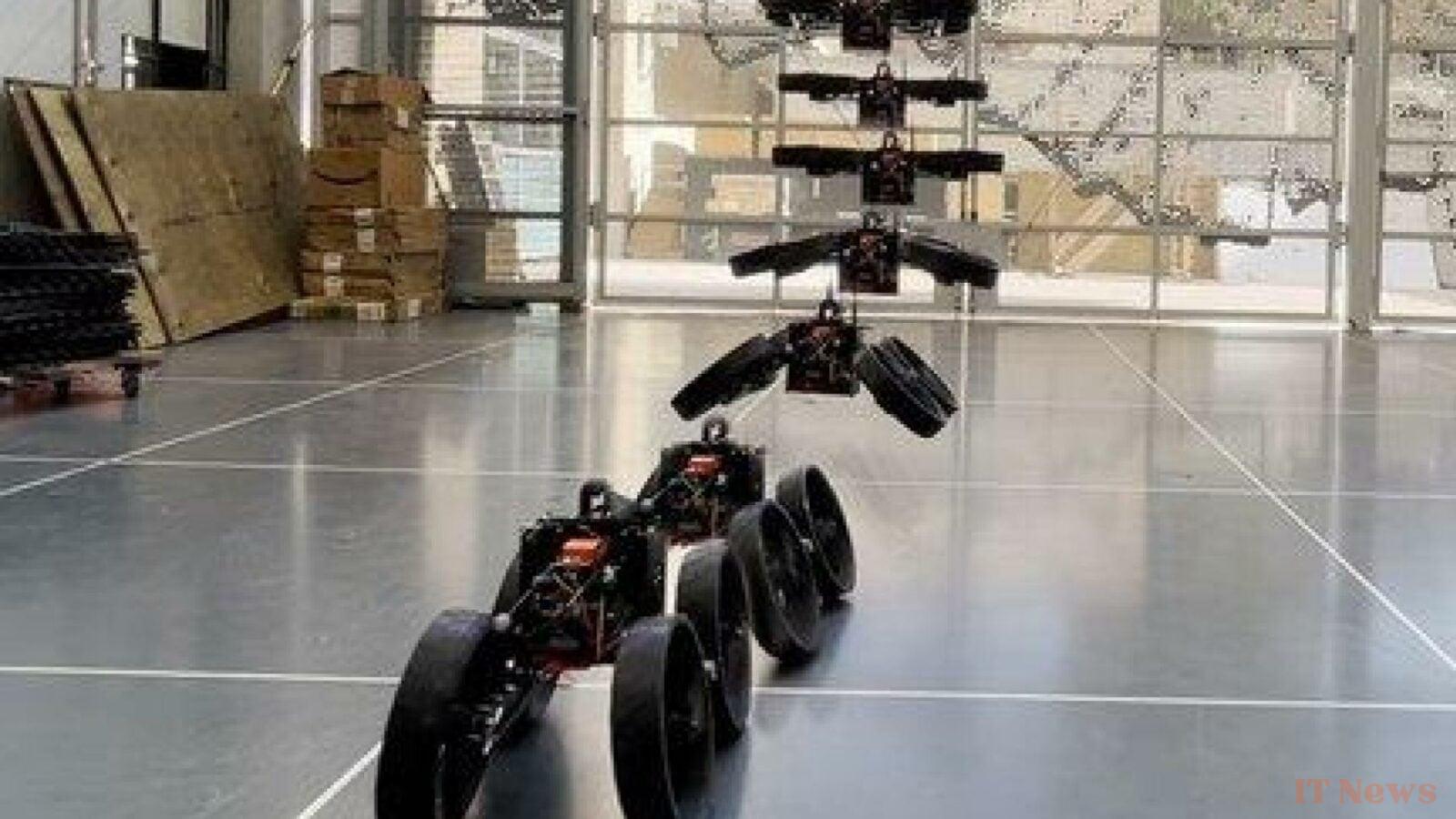
Engineers at the California Institute of Technology, better known as Caltech, have just presented a prototype that is as original as it is interesting: a hybrid drone, capable of transforming mid-flight into a rolling configuration.
This is far from the first time that a research laboratory has designed a drone capable of both flying and rolling. Until now, almost all devices of this type have opted for an approach consisting of performing the transformation on the ground, once landing is complete. But this approach has two drawbacks: the device is forced to stop for a while and risks being vulnerable during the transformation.
Caltech has therefore opted for a different approach. Its new machine, called Aerially Transforming Morphbot (or ATMO), features hybrid propellers that change configuration mid-flight, transforming into wheels as it approaches the surface.
A Big Engineering Challenge
It's a much harder concept to implement than it might seem, particularly because of the complex aerodynamic factors that come into play during metamorphosis.
"Even though it looks simple when you watch a bird land and then run, in reality, this is a problem that the aerospace industry has been struggling to address for probably over 50 years," explains Mory Gharib, director of the team behind this work.
Indeed, all flying vehicles experience complex forces near the ground. Helicopters are a good example. When they land, their propellers propel a large amount of air downward. However, this air does not disappear immediately; it interacts with the surface and “bounces” some of it upward. If the aircraft tries to land too quickly, it can be sucked into a vortex formed by this reflected air, resulting in a loss of lift with potentially catastrophic consequences.
It’s even more difficult with a vehicle like ATMO. Not only does it have to manage these complex interactions, but it also has four separate moving thrusters that constantly alter the dynamics of the airflow around each other, creating turbulence and instability that are particularly complex to manage.
"As soon as the robot starts to transform, we observe different dynamic couplings, that is, different forces interacting with each other. The control system must be able to react quickly to all of this," summarizes Ioannis Mandralis, co-author of the study.
To bring their concept to life, the Caltech engineers were therefore forced to carry out complex fluid physics simulations, both in the real world and in a virtual environment. These experiments allowed them to precisely model the interactions between all the elements of the system.
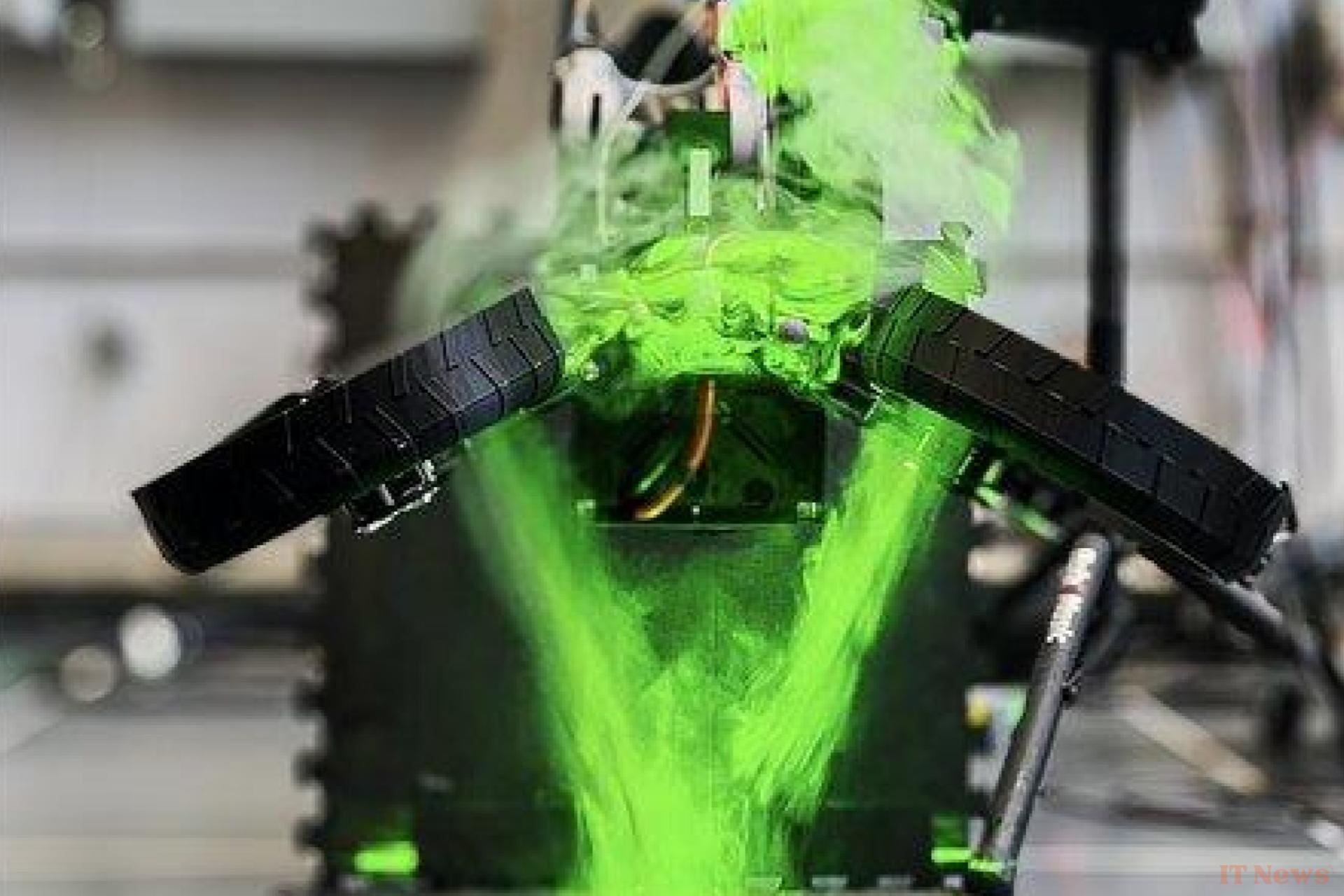
They were then able to integrate these parameters into what they call a predictive control model. This algorithm constantly anticipates how the device should behave based on the characteristics of its immediate environment and the configuration of its rotors at a given moment.
Real potential in several industries
Ultimately, this innovation could pave the way for a new generation of extremely versatile hybrid drones, capable of providing valuable services in many industries. For example, rescue operations come to mind; a machine of this type could easily move through very rugged and dangerous environments to search for victims of a natural disaster.
The space industry could also benefit from missions like Mars 2020. As a reminder, the latter was built around two vehicles: the Perseverance rover, which is searching for biosignatures in the Jezero Crater, and Ingenuity, NASA's formidable little Martian helicopter. The complementarity of the two partners greatly benefited the mission; the latter notably served as a guide and scout for the former, whose movements are considerably limited by the impassable Martian surface. A hybrid vehicle of this kind could do wonders in this context, as it could explore many points of scientific interest while minimizing risks.
We can also imagine applications in fields such as agriculture or ecosystem monitoring. A device of this kind could collect a large amount of valuable data from the air, then move on the ground to take soil samples, analyze local fauna, and so on. Finally, a device like the ATMO could also contribute to complex inspection and maintenance operations at sites such as refineries, bridges, or nuclear power plants.
It will therefore be interesting to see if the Caltech prototype will give ideas to other manufacturers, following which we could see the emergence of a new generation of fascinating hybrid drones.
The text of the study is available here.


0 Comments