
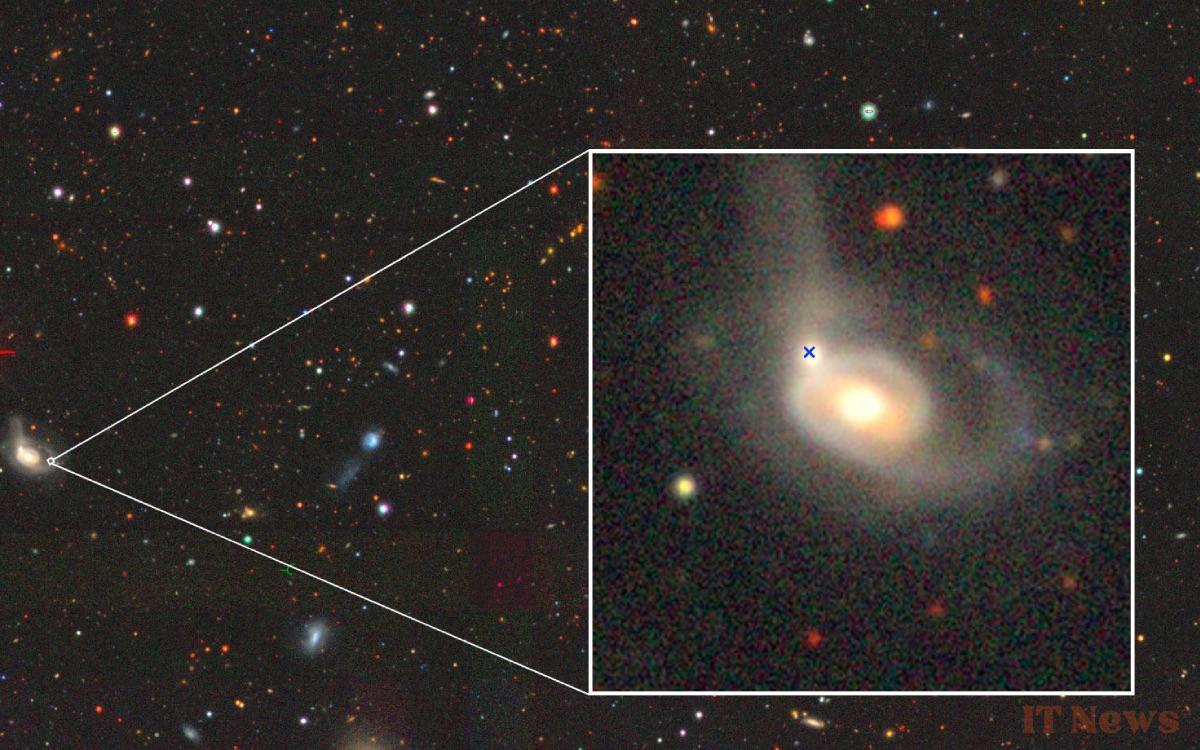
A rare violent event was captured hundreds of millions of light-years away. A star was pulverized by a giant black hole at the heart of a colliding galaxy. Scientists are calling it a unique case in its detail and power.
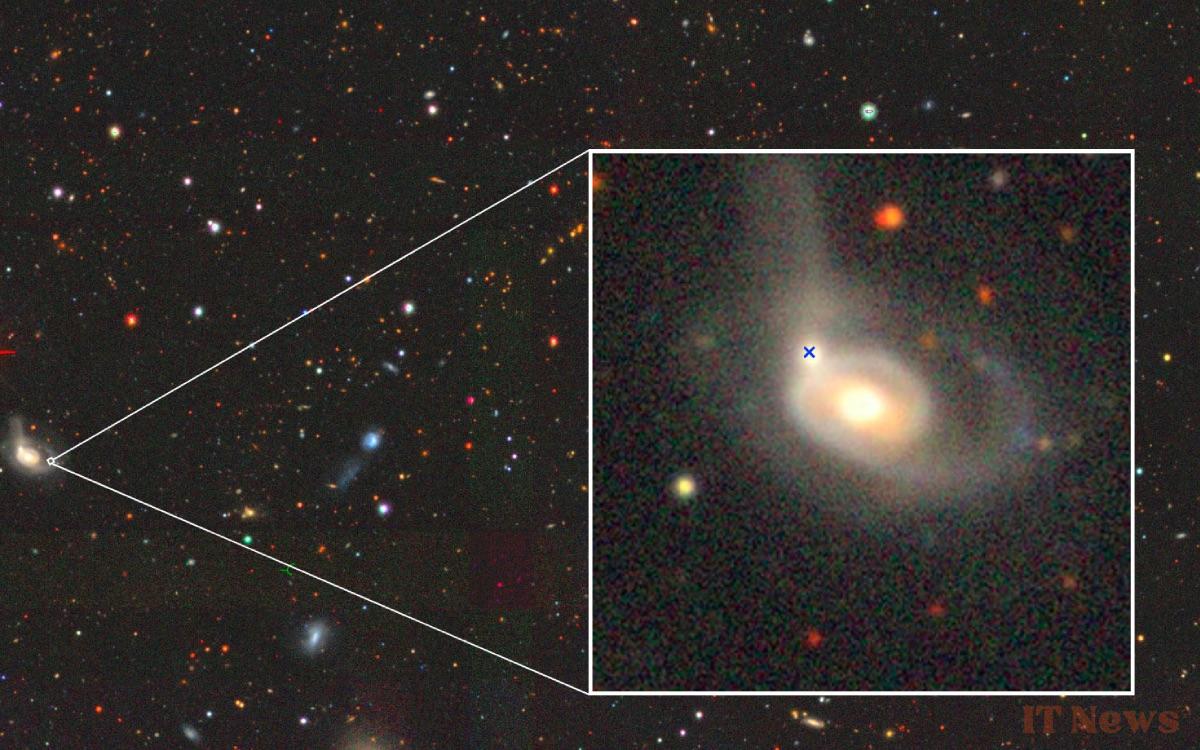
In the vastness of space, some scenes unfold on an unimaginable scale. Among them, the fatal encounters between a star and a black hole are among the most spectacular.
These extreme phenomena, called "tidal disruption events," occur when a star passes too close to a supermassive black hole. Its immense gravity stretches and tears the latter, causing a gigantic emission of light visible from Earth.
This is exactly what happened with the event named AT 2022wtn, observed in a small galaxy located about 700 million light-years away. What makes this observation exceptional is that it took place during the merger between two galaxies. The star was sucked into a black hole weighing nearly a million times the mass of the Sun. The phenomenon was detected by several telescopes and confirmed through the analysis of different wavelengths, from X-rays to the visible spectrum. This is only the second time that such an event has been detected in an interacting galactic system.
A star is shredded by a black hole during a galaxy collision
The violence of the event is difficult to imagine. The star was stretched, then disintegrated, a process nicknamed "spaghettification." Some of its matter was sucked in and formed a luminous disk around the black hole, called an accretion disk. The other part was ejected at high speed, forming an expanding bubble of gas. The whole thing generated an emission of light so intense that it briefly exceeded that of all the stars in the galaxy combined.
The astronomers also noticed unusual behavior: a phase of stable light for 30 days, followed by a sudden drop in temperature. Emissions of noble gases, such as helium and nitrogen, were detected. For the researchers, this indicates a rapid formation of the disk and a dynamic expulsion of matter. This observation helps to better understand how black holes influence the evolution of galaxies. The full study was published in the journal Monthly Notices of the Royal Astronomical Society.


0 Comments