
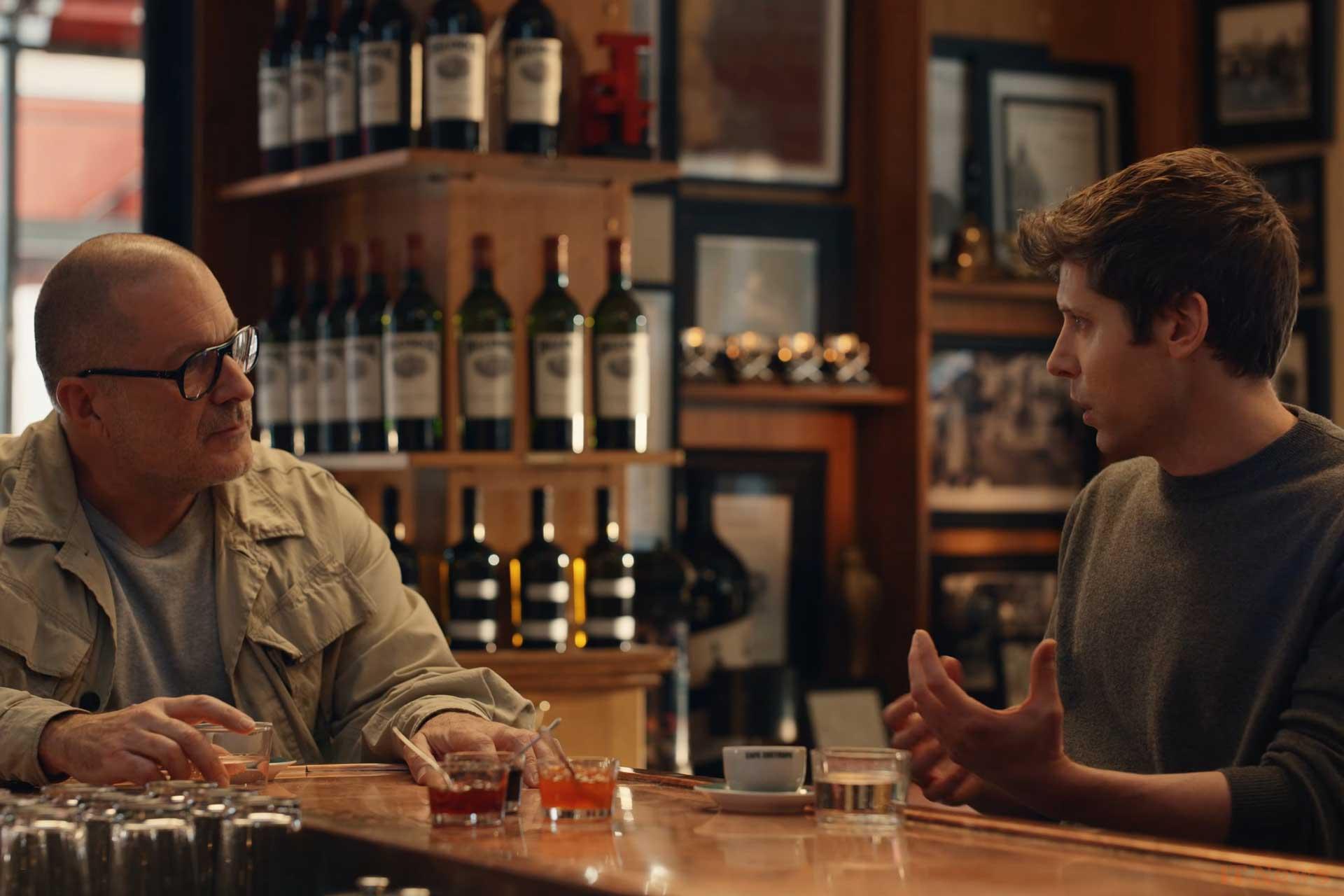
OpenAI CEO Sam Altman doesn't mince his words and estimates that this acquisition could add $1 trillion to his company's value. We understand the ChatGPT boss, as this acquisition, OpenAI's largest to date, is not just an investment. It marks an aggressive entry into hardware, aimed at establishing a direct relationship with the user and controlling their experience from start to finish.
Sam & Jony, like Steve & Jony?
This rapprochement between the head of one of the most prominent companies of the moment and Apple's number 2 under Steve Jobs has not gone unnoticed. The two men have also published a video on the theme of friendship, which confirms the closeness between the two men. They claim to have had a mutual crush and even began their collaboration, in secret, two years before this affiliation.
This bond inevitably recalls the one that united Jony Ive and Steve Jobs, a duo who strongly contributed to the Apple aesthetic style that we still know today. "If I had a spiritual partner at Apple, it would be Jony. Jony and I imagine most of the products together, then we bring the others in and say, 'So, what do you think?'", Steve Jobs even said of him, according to the reference biography written by Walter Isaacson.
While the agreement symbolizes OpenAI's desire to diversify, Sam Altman is not yet going into details. He nevertheless confides that a secret object is in progress and describes the prototype of their first device as "the coolest piece of technology the world has ever seen". The ambition would therefore be to take artificial intelligence out of the purely software domain and take shape in tangible objects. Some are already talking about a concept of "physical AI" to describe this new category of objects.
The envisaged device would be a third device for the user, discreet, screenless, and capable of being "fully aware of the user's environment, and even their life". It would act as an AI companion, offloading heavy processing to the cloud and relying on integrated cameras and microphones to perceive its surroundings.
Releasing an "AI object" is far from easy
However, the road to "physical AI" is fraught with pitfalls. The market has already seen failed attempts, such as the Humane AI Pin and the Rabbit R1. As the artificial intelligence revolution continues, the public remains skeptical about the need for "autonomous AI gadgets." Screenless design also raises the question of adoption by users accustomed to visual interfaces. This is where Jony Ive's expertise becomes crucial for the future of operations. His presence helps give OpenAI's project credibility, as his creative background has led to products like the iPod, iPhone, and iPad. The renowned designer also confirms that the first attempts at Humane and Rabbit were not good. "They were very mediocre products," he explains to Bloomberg.
Last year, we were already questioning the value of AI gadgets that didn't really add value.
OpenAI plans to share its work with io and Jony Ive as early as 2026, with the ambition of delivering 100 million AI "companions." "We're not going to ship 100 million devices on day one," Altman says. But he promises that OpenAI will be able to produce them "faster than any company has ever shipped 100 million units of a new product."


0 Comments