
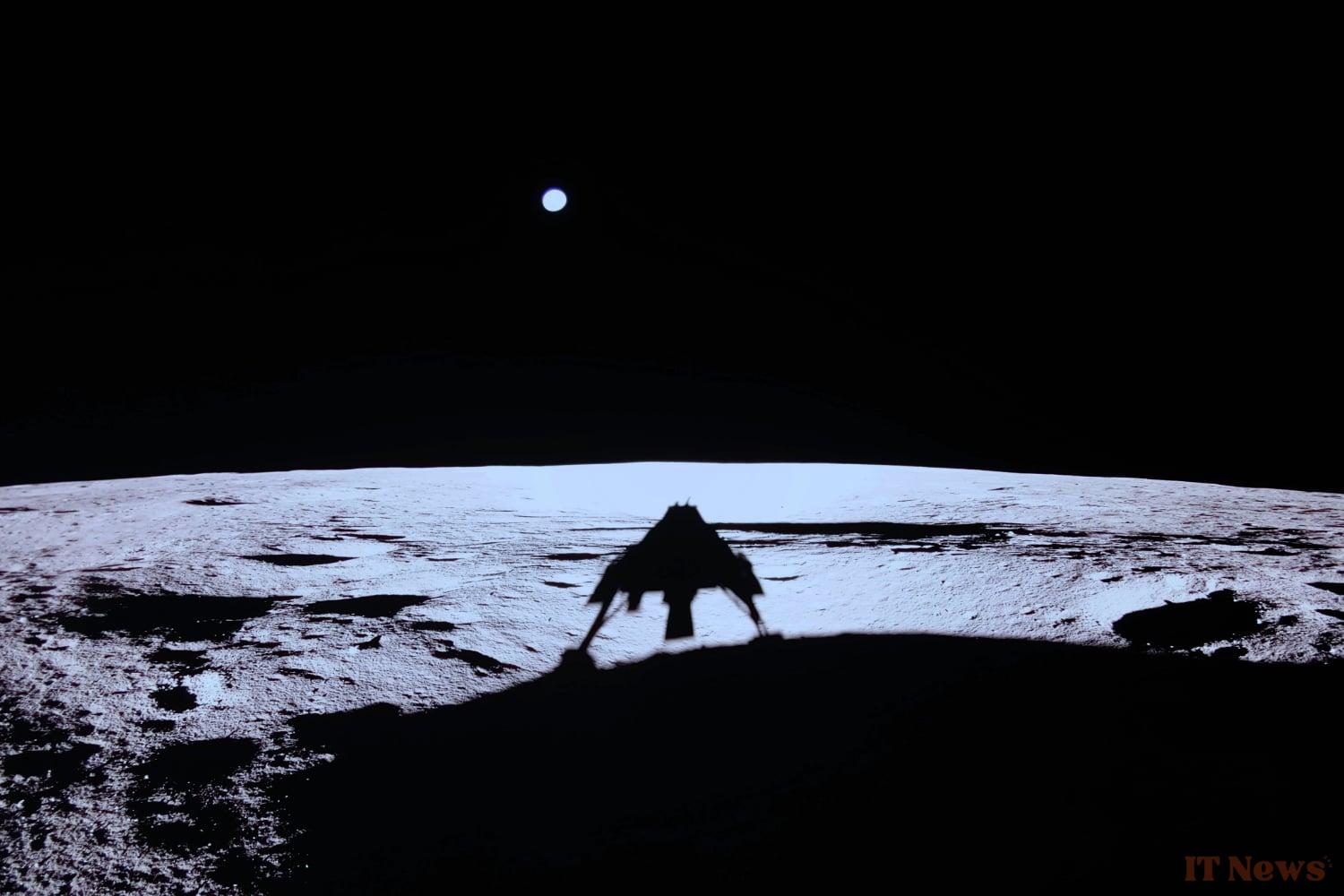
The sun behind it, casting the shadow of a spacecraft that had landed without any major anomalies a few minutes earlier. This is how NASA and the Texas company Firefly Aerospace demonstrated the success of their mission with Blue Ghost, the second American lunar lander to land safely on the lunar surface. On Sunday morning, March 2, 45 days after leaving Earth's soil via a Falcon 9 rocket, the module landed in the middle of the Sea of Crises, the name given to this immense plain formed by lava that filled and hardened over inside a 550-kilometer-wide crater carved by an ancient asteroid.
Located near the Moon's equator, northeast of the Moon's visible face, Blue Ghost's home will allow it, for an entire lunar day (14 days on Earth), to conduct several studies of lunar dust. "We're going to study how dust adheres to various materials," said Maria Banks, NASA's CLPS project scientist, before the launch last January. "We're taking images as we go down to the surface to see how the rocket plume affects the lunar regolith. And we're going to test using electromagnetism to mitigate or prevent dust buildup."
CLPS refers to NASA's program to invest in private companies to develop new lunar landers. On the night of January 14-15, Firefly Aerospace's Blue Ghost embarked on aboard SpaceX's launcher alongside another lander, developed by Ispace, a company based in Tokyo, Japan. Hakuto-R, the name of its own module, has not yet landed as it follows a very different approach from Blue Ghost. Rather than a 15-day journey, the device follows a more resource-efficient approach, which will take it 5 months to reach the surface of the Moon.
The equipment aboard Blue Ghost that will operate over the next 14 days is not directly developed by Firefly Aerospace. The Texas company that touched down $101 million from NASA was only responsible for the lunar lander. The rest of the equipment comes from other startups. This is the case of a lunar vacuum cleaner, the Lunar PlanetVac, developed by Honeybee Robotics. It will be used to sample lunar dust to study it later, once back on Earth, in preparation for the Artemis program.
Lunar landers: many failures in recent months
For such a mission to be a success, the lunar lander still had to land without a hitch. "What Firefly demonstrated today, I think they made it look easy, but it's incredibly difficult," Joel Kearns, associate deputy administrator for exploration in NASA's Science Mission Directorate, said at a news conference after the landing. In recent months, the Indians, Russians, Israelis and Japanese have all failed to fly similar missions. In the United States, too, the company Astrobotic lost its Peregrine lander in January 2024.
The return of the Americans to the Moon, since Apollo 17 (1972), was the following month, with the first lander of NASA's CLPS project, signed Intuitive Machines (IM-1). A mixed success, however, since the ship ended up lying on its side, greatly limiting its range of operations.


0 Comments